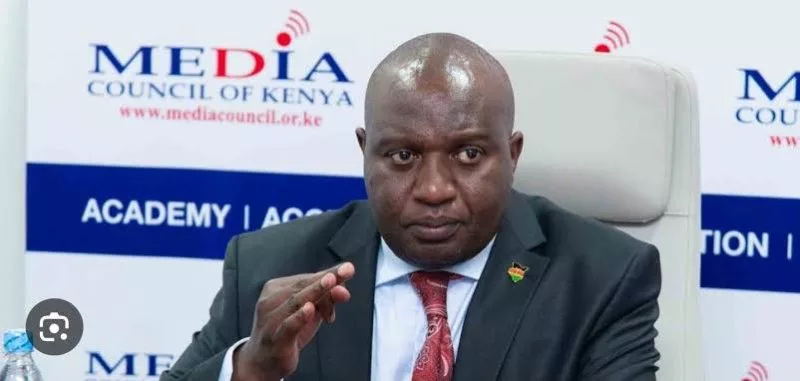
 Senate Justice, Legal Affairs and Human Rights Committee chairman Hillary Sigei/ HANDOUT
Aspirants banking on their popular names, nicknames and political brands to win votes in the 2027 elections have suffered a major blow after a Senate committee rejected a fresh bid to allow such names on ballot papers.
The Justice, Legal Affairs and Human Rights Committee has recommended that a petition seeking revival of a law allowing candidates to use popular names be rejected.
This leaves politicians with no option but to use the names appearing on their identification documents.
“Arising from its observations as set out in the preceding chapter, the Committee on Justice, Legal Affairs and Human Rights resolved not to accede to the prayers by the petitioner,” the report states.
The rejection follows a petition by Mohamed Alasow, who sought the introduction of the law after a similar bid collapsed before the 2022 general election.
Alasow wanted the Elections Act amended to enable candidates to use popular names.
He argued that voters, particularly in rural and marginalised areas, often know politicians by their popular names rather than their official names.
He said allowing such names on ballot papers would improve voter identification, reduce confusion and reject ballots, promote inclusivity and boost confidence in elections.
But the committee, chaired by Senator Hillary Sigei, dismissed the argument.
“There is no demonstrated evidence of the prevalence or scale of voter confusion or misidentification of candidates arising from the use of official names on ballot papers,” the report says.
The senators noted that ballot papers already carry a candidate's official name, photograph and party symbol, which they said were sufficient safeguards against misidentification.
“The committee recommends that the petition seeking the re-introduction and enactment of the Elections (Amendment) (No. 3) Bill, 2021, be declined,” the committee said.
The committee said there was no evidence that voters were being confused or casting ballots for the wrong candidates because of the use of official names.
It also warned that allowing politicians to create election-specific names could open the door to abuse of the electoral process.
Under the current law, an aspirant seeking to contest an election using a name different from that on their national identity card or passport must formally change the name.
The committee said the existing system provides “an established, verifiable and accountable mechanism” for candidates wishing to adopt a different name.
The rejection also closes the door on an easier system proposed under the 2021 Bill, which would have allowed candidates to apply directly to the Independent Electoral and Boundaries Commission for approval and certification of a popular name without changing their legal identity.
The committee raised serious questions about how such a system would work.
The senators feared aspirants could manufacture names specifically for the election and use them to gain an electoral advantage.
The committee cited other countries where popular names are subject to strict controls.
In Canada, candidates must provide documentary evidence that they are commonly known by the requested name. In Texas, a candidate must have been commonly known by a nickname for at least three years before an election.
The United Kingdom allows electoral officials to reject names that could mislead or confuse voters, while the Philippines permits one locally recognised nickname or stage name.
Kenya has twice attempted to legislate on the issue.
Bills sponsored by former Senator Ephraim Maina in 2019 and 2021 were passed by the Senate at Second Reading but lapsed before reaching the Committee of the Whole and Third Reading stages.
The 2021 Bill also proposed giving IEBC powers to approve popular names and prescribe rules governing their use.
But the electoral commission warned that popular names could create problems with the size, uniformity and cost of ballot papers. It also raised concerns over duplicate names, obscene or offensive names and the difficulty of maintaining alphabetical order.
In their submissions to the committee, stakeholders were divided on the petition.
The National Gender and Equality Commission, Council of Governors and Centre for Multiparty Democracy supported the proposal, arguing that popular names could make elections more inclusive.
ELOG and Mzalendo, however, opposed it, describing the proposal as “over-legislating” and arguing that candidates should simply follow existing laws on changing names.
The committee further ruled that the 2021 Bill could not simply be revived because provisions of the Elections Act it sought to amend had since been repealed or spent.
“The Bill cannot be re-introduced in its original form and would, in any event, require to be redrafted afresh,” the report states.
INSTANT ANALYSIS
The ruling means politicians preparing for the 2027 race must either stick to their official names or complete the formal legal process of changing them before seeking nomination. For aspirants who have spent years building political brands around nicknames, the Senate decision is likely to make the coming nomination battles more complicated — and potentially more expensive.