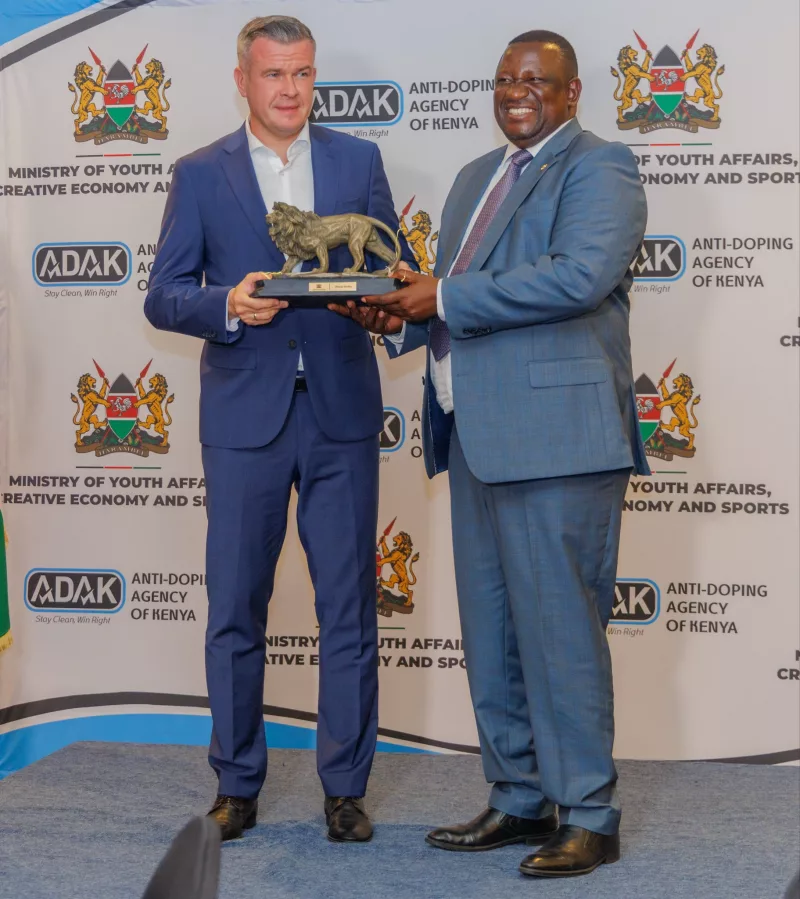
 Sports CS Salim Mvurya (R) with WADA President Witold Bańka/ HANDOUT
World Anti-Doping Agency (WADA) president Witold Bańka believes Kenya can emerge as a continental role model in the fight against doping after his two-day visit to the country.
Bańka, who arrived on Sunday morning, held a series of high-level meetings with key stakeholders involved in Kenya’s anti-doping efforts, including President William Ruto, Sports Cabinet Secretary Salim Mvurya, the National Olympic Committee of Kenya (NOCK), the Anti-Doping Agency of Kenya (ADAK) and athletes.
After the engagements, Bańka said he was convinced Kenya was on the right path and could set the pace for the rest of Africa in tackling doping and the distribution of performance-enhancing substances. “I truly believe that the fight against doping in Kenya will be stronger and that the country will be a role model for Africa on how to effectively fight against doping and the criminals who distribute steroids,” he said.
Bańka said Kenya’s reputation as the “Home of Champions” must be matched by a commitment to clean sport and protect the integrity of competition. “Kenya calls itself the home of champions, and I like this slogan. But you know every credible home has to have a good host and be clean. “It is very important to instil a culture of clean sports and a zero-tolerance policy.”
He said his meetings with Kenyan stakeholders revealed a shared commitment to strengthening the country’s response to doping. “We found common understanding, and we are on the same track. "The meeting with the President was very fruitful. He clearly established the goals for the country in putting sports at the centre of his agenda and Vision for Kenya. But this vision brings a lot of responsibility.”
While acknowledging Kenya’s rich pool of athletic talent and its status as one of the world’s leading distance-running nations, Bańka called for immediate and tougher action against those involved in doping. “Kenya is a great sporting nation full of great athletes. “There needs to be zero tolerance for doping, and it has to be established immediately with strong actions and a more aggressive approach to those destroying the nature of the country.”
Law enforcement chief Bańka said WADA also engaged law-enforcement agencies during his visit, stressing that their involvement will be crucial in identifying and prosecuting individuals involved in the distribution of banned substances.
“We gathered in one room all important people responsible for the fight against criminals—prosecutors, police, customs and immigration, intelligence, investigations, all the people responsible for sensitive matters—to create a coalition for clean sports. “WADA cannot achieve its mission without the strong support of law enforcement.”
The WADA president said the renewed campaign against doping should begin immediately. “I believe this work should start today. We need to go aggressively against doping.”
Mvurya, meanwhile, reiterated the government’s commitment to strengthening ADAK and supporting its anti-doping programmes. “Since 2025, we have been running a roadmap implementing key action plans to strengthen ADAK. “The government will continue to provide support to ADAK.”