For 70 Kenyan students, the journey to Russia will be about far more than earning a degree.
It will mean leaving behind familiar streets, family and friends for new classrooms, a different culture and, for many, their first encounter with a Russian winter.
However, as they prepare to begin their studies under the Russian government scholarship programme, both Kenya and Russia are looking beyond the certificates they will eventually bring home.
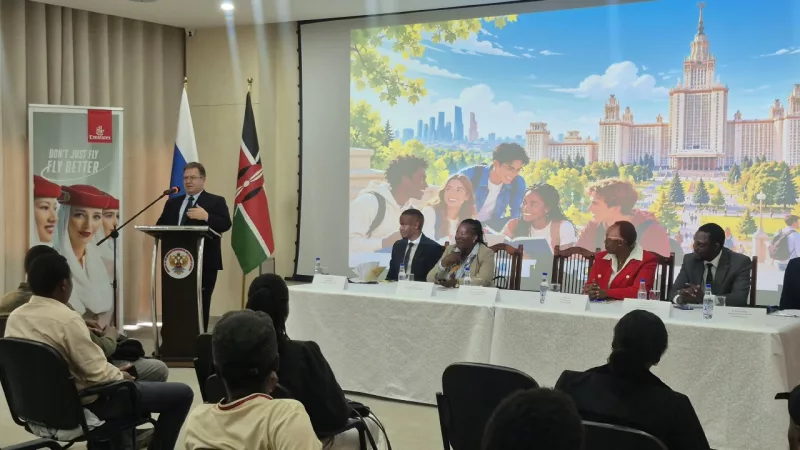
The students were recently hosted at the Embassy of the Russian Federation in Nairobi for a briefing ahead of their departure, where officials outlined what awaits them and what is expected of them when they return.
This year's scholarship allocation stands at 70 state-funded places, a gradual increase from previous years.
Yet the opportunity was fiercely contested.
The Russian ambassador to Kenya Vsevolod Tkachenko revealed that the embassy received about 10 times more requests than the number of scholarships available.
“The selection was very pointed,” he said, describing the successful applicants as “the cream of the young generation.”
For the students seated in the room, the words underscored the significance of their selection.
They were not simply being handed an opportunity to study abroad.
They had emerged from a highly competitive process at a time when thousands of young Kenyans are seeking pathways to quality education, professional experience and better career prospects, and Russia wants them to make the most of it.
“We are offering quality education first,” the ambassador said, pointing to Russia's reputation in fundamental and natural sciences, engineering and medicine.
He also made clear that the relationship Russia hopes to build through the programme goes beyond university campuses.
“We want more Kenyans to get a living experience in Russia, get a good education, be useful for the economic development of their countries and at the same time to become friends of Russia,” Ambassador Tkachenko added.
That statement captured the broader ambition behind the programme.
The scholarships are education opportunities, but they are also a form of people-to-people diplomacy.
The students will primarily pursue undergraduate and master's level studies, with opportunities for further academic advancement including PhD studies.
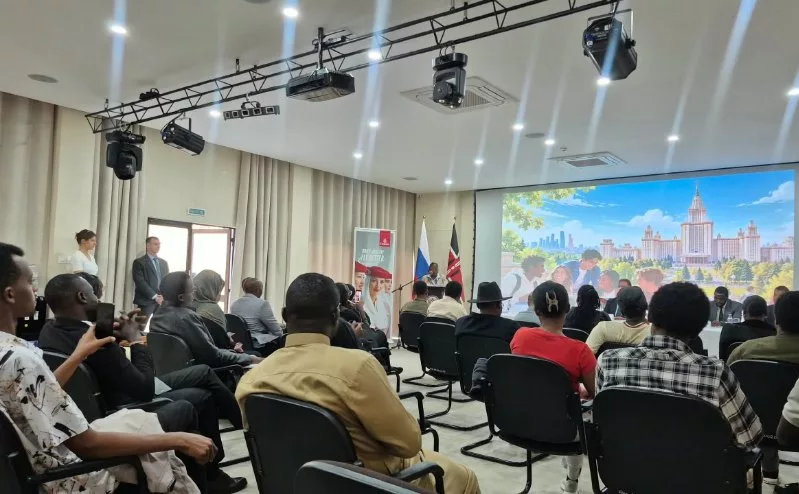
The Russian side said the package goes beyond tuition.
“Students will receive accommodation, monthly stipends, insurance and access to medical facilities. They are also well taken care of and not left alone,” the ambassador said.
The reassurance was particularly significant for parents, many of whom will be sending their children thousands of kilometres away.
For a parent, the excitement of a scholarship can easily be accompanied by questions, and the Russian Embassy encouraged parents to maintain contact with their children while also giving them assurance.
“We are always ready to be of help and do not hesitate to reach out to us in case of any difficulties,” the ambassador said.
Kenya's Ministry of Foreign and Diaspora Affairs offered a similar assurance.
Anne Mbeyu Mruche, Deputy Director, Foreign Service, said the government understands the fears that come with sending young people abroad.
“Yes, I know when you let your child go, you are always having those fears, and you want the best for the children,” she said.
She therefore urged parents to use the support structures available to them.
“Do not fear and always know that the government is here to work with you,” Mruche said.
She said the State Department for Diaspora Affairs has a welfare section where parents can seek assistance and guidance if their children encounter difficulties abroad.
The message from the officials was therefore clear: the students may be leaving Kenya, but they are not being abandoned by their country.
A competitive ticket to Russia
The scale of interest in the scholarships revealed something else: the appetite among Kenyan youth for opportunities outside the country's borders.
With the Russian Embassy receiving approximately ten times more applications than available places, the selection process was necessarily competitive.
For those who made it through, academic ability was only the beginning of the journey.
The students will have to adapt to a new environment and take responsibility for making the experience count.
The ambassador encouraged them to embrace Russian culture and social life rather than simply remaining within their academic routines.
“Also do not forget the inevitable subject for anyone travelling from Kenya to Russia, which is the cold. Do not be afraid of minus zero degrees,” he joked.
Behind the light-hearted comment was a serious expectation that students should be willing to adapt.
The ambassador said Russia has a long history of hosting African students and that many have integrated into Russian society.
He described seeing African students participating in everyday life, attending concerts, using public transport and even taking up part-time jobs.
“It shows us the real interest of those who decided to go to Russia to get the maximum of the knowledge, of the experience and of the practice in Russia,” the ambassador said.
That practical exposure could prove important once the students return home.
What Kenya expects back
For Kenya, the scholarships are ultimately an investment in human capital.
Christine Minyuki, the Assistant Director in the State Department for Higher Education, said international scholarships are communicated through government channels before being advertised to the public.
“Opportunities are posted through the Ministry of Education website and other platforms to ensure that students across the country can access them,” she said.
The government is also increasingly interested in ensuring that students pursue skills that correspond with national development priorities.
Minyuki therefore pointed to areas including ICT, agriculture, health and digital infrastructure.
“The reasoning is simple: sending a young Kenyan abroad to acquire a skill is most valuable when that skill can eventually contribute to the country's economy. We know jobs are hard to find for everyone,” she said.
“But by virtue of them going out to do something that the government of the day requires for its day-to-day running, then they stand a better chance of getting a job when they come back.”
For the 70 students, therefore, the journey to Russia carries an expectation to return with more than impressive academic credentials.
They are expected to return with skills Kenya can use.
Where education meets diplomacy
Another layer to the programme is that every student who studies in Russia becomes an informal link between the two countries.
The ambassador described the desired outcome in distinctly diplomatic terms by saying students should become friends of Russia and share their experiences of the country with their families, friends and wider communities back home.
That relationship does not necessarily end when the students graduate.
Kenya already has an active alumni network of graduates from Russian institutions, with former students participating in cultural events organised by the embassy and maintaining contact with Russian representatives.
The new graduates will eventually join that growing community.
The Ambassador therefore said, “Some of them may find careers in the private sector, others could work in government, parastatals, research institutions or international organisations and some could even find their way into diplomacy.”
He pointed to the Moscow State Institute of International Relations, where he studied and where several Kenyan students are currently enrolled.
For such students, the experience offers something particularly valuable, which is an understanding of Russia gained from living and studying there rather than simply reading about it.
“They will come back already with some experience, and it is a valuable feature for them,” the ambassador said.
While the students have won their places, officials also acknowledged the importance of ensuring that future opportunities do not become the preserve of a select few.
The Ministry of Education said scholarships received from foreign governments are communicated through official government channels and advertised publicly.
For applicants, however, there are still academic thresholds to meet.
Minyuki said students must first satisfy Kenya's basic requirements for higher education, after which individual countries can impose additional requirements.
For the Russian scholarships, competition remains intense.
Soon, the students will trade Nairobi's familiar rhythms for Russian cities and new routines.
They will encounter a different education system, different social customs and perhaps most dramatically, a climate far removed from Kenya's.
The officials who addressed them repeatedly returned to one idea: that the scholarship is an opportunity whose value will ultimately be determined by what they do with it.
For Russia, the hope is that the students receive a world-class education, experience Russian society and become lasting friends of the country.
Consequently, for Kenya, the expectation is that they acquire skills that can contribute to national development.
The Russian ambassador put the responsibility squarely in their hands.
“Get the maximum of the knowledge of the experience and of the practice in Russia and bring it back,” he urged.
When the 70 students eventually return to Kenya, the real test of the scholarship programme will begin.
Not with the degrees they hold, but with what they do with them.