Investment in Kenya is entering a dynamic new phase as global corporations increasingly pivot from greenfield setups to acquiring major stakes in established local businesses.
Powered by high regional production capacity and Nairobi’s status as a gateway to the wider continent, international capital is diversifying across telecommunications, banking, beverages, cement, manufacturing, technology, and energy.
Data from UN Trade and Development cited by local investment authorities highlights the shift:Kenya attracted a record $3.2 billion (Sh414 billion) in Foreign Direct Investment (FDI) in 2025, up from a revised $2.32 billion in 2024. Separately, government agency Invest Kenya facilitated roughly $1.8 billion (Sh233 billion) in investments, supporting more than 35,000 jobs.
The transactions now taking place suggest Kenya is increasingly becoming a destination for strategic acquisitions as well as new capital.
One of the biggest deals is the acquisition by Japan’s Asahi Group Holdings of a 65 per cent controlling stake in East African Breweries Plc (EABL) from Diageo for approximately $2.3 billion (Sh298 billion).
Kenya’s Competition Authority approved the transaction in September, subject to conditions, including requirements concerning outstanding liabilities and competition in retail cooler space.
The EABL transaction is significant because the company is not simply a Kenyan brewer. It is a regional business headquartered and listed in Nairobi, with operations extending into Uganda and Tanzania.
The deal therefore represents international capital buying into an established East African platform rather than building a new company from scratch.
Telecommunications has seen an equally significant transaction.
South Africa’s Vodacom completed the acquisition of an additional 20 per cent effective stake in Safaricom in June, taking its effective holding to approximately 55 per cent.
The transaction was valued at $2.1 billion (about Sh272 billion) and involved the acquisition of a 15 per cent stake from the Kenyan Government and an effective additional five per cent from Vodafone Group. Kenya retained a 20 per cent stake.
Safaricom is one of the country's most important corporate assets, combining telecommunications, mobile money, financial services and technology.
Central Bank of Kenya approved Nedbank's acquisition of a 66 per cent majority stake in NCBA Group on August 28, 2026.
CBK said the transaction would help maintain stability, strengthen resilience and promote competition in the banking sector.
Nedbank said the acquisition would strengthen its Southern and East African footprint, while the remaining NCBA shares would continue trading on the Nairobi Securities Exchange.
The transaction is particularly important because NCBA already has operations beyond Kenya, including Uganda, Tanzania, Rwanda and Ivory Coast. The acquisition consequently gives Nedbank a larger regional platform.
The cross-border investment wave is also visible in cement.
Tanzanian conglomerate Amsons Group acquired a 99.9 per cent controlling stake in Bamburi Cement Plc for approximately $183 million (Sh23.6 billion), moving to delist the iconic manufacturer from the Nairobi Securities Exchange (NSE).
It also acquired the East African Portland Cement ( EAPC) shares from Holcim-linked companies for about Sh719 million, giving the group, including Bamburi’s existing 12.5 per cent stake, approximately 41.75 per cent of EAPC.
The Bamburi takeover had already marked one of the most important cross-border acquisitions in Kenya’s manufacturing sector.
Amsons ultimately acquired more than 96 per cent of Bamburi's shares in the takeover process, before moving towards full ownership.
Amsons Group managing director Edha Nahdi described the Bamburi transaction as part of the company’s expansion strategy into Kenya and the wider East African market.
The acquisitions demonstrate another feature of Kenya's investment market where regional African companies are increasingly using Kenya as a platform for expansion.
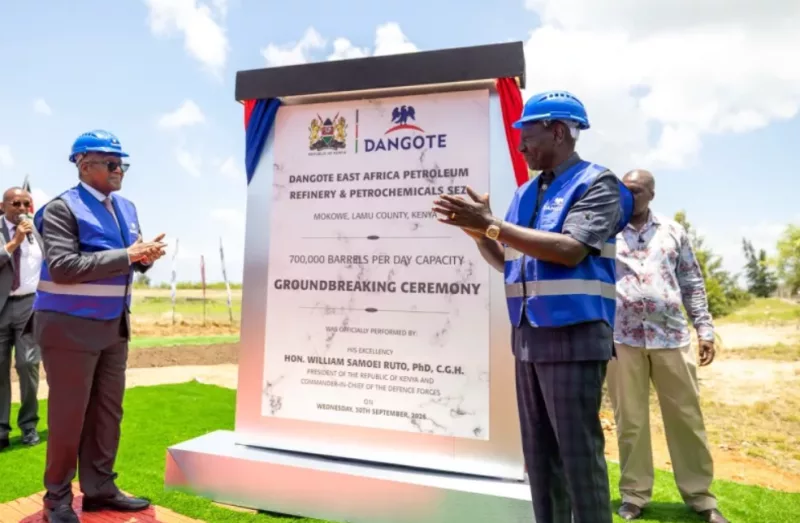
The most dramatic new investment is emerging in Lamu, where Nigerian industrialist Aliko Dangote has begun construction of a $16 billion (about Sh2.2 trillion) oil refinery and petrochemical complex.
The September 30 groundbreaking marked the start of what has been described as Kenya's largest-ever foreign direct investment.
The planned refinery is designed to process approximately 700,000 barrels of crude oil a day, with completion scheduled after 40 months.
The project is expected to include a 1,000-megawatt power plant and serve markets stretching from East Africa into the wider region.
Dangote's project has also attracted international technology partners, including Honeywell, which is providing engineering, licensing and equipment services.
But the investment has also exposed the tensions that can accompany mega-projects.
Local residents and conservation groups have raised concerns over land rights, compensation, environmental impacts and the proximity of the project to Lamu Old Town, a UNESCO World Heritage Site.
Dangote has nevertheless maintained his commitment to the project. The company says the legal challenges will not stop the investment from moving forward, although they could affect some site activities.
“Anybody who wants to cause trouble, we are ready for his trouble, and we'll give him a headache,” Dangote said.
For Kenya, the refinery is being positioned as more than an energy project. It could become the anchor for a broader industrial ecosystem around Lamu Port and the LAPSSET corridor.
The new investments are arriving as the government builds a much larger pipeline.
The Kenya Investment Projects Catalogue, published by Invest Kenya, identifies a pipeline of approximately $40 billion (about Sh5.18 trillion) in bankable investment opportunities across energy, transport, housing, ICT, water, healthcare and agro-processing.
The catalogue includes major infrastructure opportunities such as the Sh168 billion Nairobi-Mombasa Expressway, Sh194 billion in KPA Port Assets Phase Two, Sh155 billion Kibuka Falls hydropower and irrigation project, and the Sh126 billion Mau Summit-Eldoret-Malaba road project.
Invest Kenya chief executive John Mwendwa said the catalogue is designed to move the investment conversation from general interest to identifiable, financeable projects.
“The Kenya Investment Projects Catalogue is a strategic platform connecting investors to a USD 40 billion (Sh5.2 trillion) pipeline of bankable opportunities across energy, transport, housing, ICT, water, health and agroprocessing sectors.”
Mwendwa has also credited the government's international investment campaign with expanding the pool of potential investors.
He said President William Ruto's international roadshows and investment promotion efforts were helping to increase Kenya's reach.
“We have also seen macroeconomic stability with the country offering a wide range of opportunities in different sectors, which are offering investors good returns. Government has ensured economic stability,” Mwendwa told the Star.
But there is a critical distinction between a pipeline and actual investment.
The catalogue notes that project details are continuously updated, while some opportunities remain at different stages of preparation.
Kenya's PPP pipeline, for example, has 40 active projects, with 10 under implementation and 30 at stages including feasibility, structuring, approvals and tender preparation.
That distinction is important because the challenge for Kenya is increasingly to convert announcements and project concepts into financial close, construction, production and jobs.
At the Kenya International Investment Conference in March, the government announced more than $2.9 billion (about Sh375 billion) in 20 investment deals expected to create more than 63,000 direct jobs.
The projects span agriculture, manufacturing, mining, healthcare, ICT, energy and real estate.
Invest Kenya said agriculture and agro-processing attracted about Sh115 billion, manufacturing nearly Sh78 billion, real estate Sh82 billion and mining Sh43 billion.
“We are not just talking about numbers; we are talking about real investments, including Sh129 billion in agriculture alone,"President Ruto said.
He said Kenya was implementing reforms aimed at removing investment bottlenecks, including digitising the One-Stop Investment Centre, during the recent AmCham conference.
Among the investments highlighted were a $33 million (Sh4.3 billion) Mars Wrigley expansion at Athi River, a $45 million (Sh5.8 billion) Coca-Cola bottle manufacturing expansion in Kisumu and a $150 million (Sh19.4 billion) electric and hybrid vehicle manufacturing project in Nakuru.
American companies
At the September AmCham Business Summit in Nairobi, US companies announced more than $600 million (about Sh77.5 billion) in potential new investments across manufacturing, technology, data centres, healthcare and digital skills.
“We did see just in one day over $600 million (about Sh78 billion) of pledges and commitments from US-American firms," AmCham Kenya board president Angela Ng’ang’a said.
Among the announcements was a $175 million (Sh23 billion) Coca-Cola investment and an $80 million (Sh10 billion) data-centre project by iColo, now part of Digital Realty.
The broader technology ecosystem is also drawing global players, with Google, Amazon Web Services, IBM and Microsoft maintaining significant operations and development activities in Kenya.
Semiconductor Technologies Limited has also received a USTDA feasibility grant to explore chip fabrication capacity, adding advanced manufacturing to Kenya's investment pitch.
Treasury Cabinet Secretary John Mbadi argues that the investment figures and transactions provide evidence that global investors continue to see commercial opportunity in Kenya.
According to Mbadi, Kenya attracted approximately $3.2 billion (Sh414.46 billion) in Foreign Direct Investments in 2025, while Invest Kenya facilitated about $1.8 billion (Sh233.13 billion) in investments during the same year.
He said the government's investment record should be judged against actual transactions and projects rather than assertions that Kenya has failed to attract capital.
“Investors put capital where they see commercial opportunity, market potential and an environment in which that capital can be deployed productively and over the long term,” Mbadi said.
Investments, Trade and Industry Cabinet Secretary Lee Kinyanjui placed particular emphasis on stability.
“Stability attracts capital flows, and the reason Kenya has become the region’s trusted commercial hub is inseparable from our role as the region's anchor of peace and security,” Kinyanjui said.
For manufacturers, however, attracting capital is only part of the equation.
Kenya Association of Manufacturers chief executive Tobias Alando said the investment activity demonstrates confidence in the economy, but warned that gains could be undermined if investors face unpredictable policies and taxation.
“The concerns on predictable tax and policy space should be dealt with so that it does not erode the gains from the investments perspective,” Alando said.
The concern is significant. Invest Kenya's own engagement with investors has identified policy predictability as one of the issues repeatedly raised by prospective investors.
The investment push is increasingly centred on Nairobi as a financial, technology and corporate headquarters hub.
The Oxford Economics Global Cities Index 2026 named Nairobi among its African “Cities to Watch”, alongside Accra, Cairo, Dakar and Luanda. Nairobi scored particularly strongly in human capital, with a 75.1 score in that category.
The index forecasts average annual growth of 5.5 per cent in information technology and 4.1 per cent in finance over the next 25 years.
Nairobi's industrial output is projected to exceed $38 billion (about Sh4.9 trillion) by 2050, while industrial employment could increase by about 700,000 jobs.
Nairobi International Financial Centre chief executive Daniel Mainda said:
“Oxford Economics has identified the talent, technology and industrial momentum. Our task is to mobilise the investment that turns this potential into jobs and lasting prosperity,"Nairobi International Financial Centre chief executive Daniel Mainda said.
The same proposition is being used to attract regional financial institutions.
Lloyd's is progressing plans for a regional underwriting presence in Nairobi through the Nairobi International Financial Centre, strengthening the city's ambition to serve African insurance and reinsurance markets.
Kenya's investment pitch ultimately rests on geography, market access and infrastructure.
The country gives investors access not only to its domestic market but also to the East African Community, COMESA and the African Continental Free Trade Area.
Invest Kenya describes the country as a platform from which businesses can serve regional and continental markets, supported by the Port of Mombasa, airports, railways, road networks, renewable energy and a growing digital infrastructure.
The government's investment proposition is therefore changing.
It is no longer simply asking multinational companies to sell products in Kenya. It is increasingly asking them to manufacture in Kenya, acquire Kenyan companies, establish regional headquarters, finance infrastructure and use the country as a springboard into Africa.
The transactions involving Asahi, Vodacom, Nedbank and Amsons demonstrate the acquisition side of that proposition.
Dangote, Coca-Cola, Mars Wrigley, data-centre developers and electric-vehicle manufacturers illustrate the greenfield and expansion side.
The Sh5 trillion investment catalogue adds another layer, which is a pipeline intended to keep capital flowing into infrastructure, housing, energy, healthcare, water, ICT and agro-processing. But the next test will be implementation.
For investors, the questions will include policy certainty, taxation, regulation, infrastructure, access to affordable finance, land, skills and the speed of approvals.
For communities, mega-projects will also raise questions around jobs, environmental safeguards, land rights and how much of the value created remains in Kenya.
Kenya's investment story is therefore no longer about whether capital is arriving. The latest transactions show that it is.
The larger question is whether the country can turn this accelerating flow of acquisitions, project commitments and investment pipelines into productive capacity, exports, jobs, technology transfer and deeper local value chains.
That will determine whether the current wave becomes a sustained investment cycle or simply another period of large announcements.