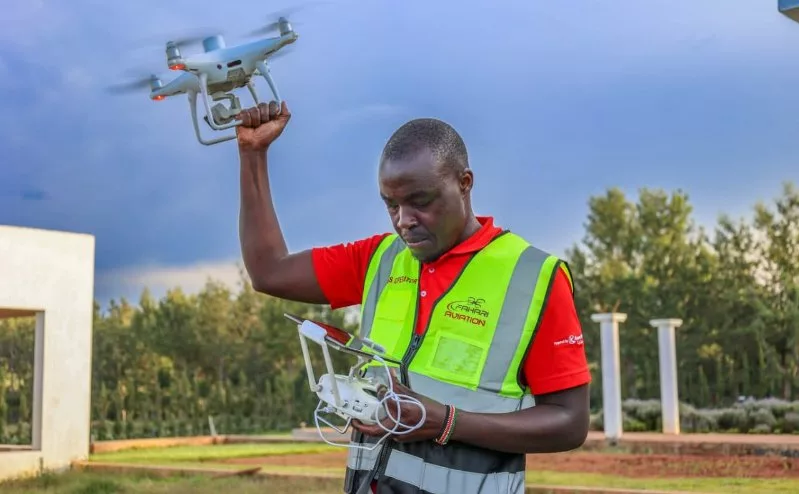
 Fahari Aviation staff flying a drone. [Photo by Fahari Aviation]
Five years ago, a visit to the Nairobi International Trade Fair would have offered a familiar agricultural scene, with fruits, seedlings, crops, livestock and other farm products dominating much of the exhibition space.
But the scene at Jamhuri Park Showground has changed. This year, visitors are encountering an increasingly technology-driven fair, with agricultural machinery, drones, artificial intelligence (AI), irrigation equipment and other innovations taking a more prominent place alongside the traditional displays of crops and livestock.
The shift reflects a broader transformation in Kenyan agriculture, as farmers, researchers, businesses and government increasingly turn to technology to improve productivity and respond to challenges such as changing weather, pests, diseases and water scarcity.
“This year about 400 exhibitors from Kenya and abroad are showcasing products and technologies, with climate-smart agriculture, innovation and digital farming among the key themes,” says Batram Muthoka, Agricultural Society of Kenya Chief Executive Officer.
According to him, the increasing presence of technology at the fair intends to expose farmers to options they may not ordinarily encounter, allowing them to see the equipment in operation and understand how they could be applied to their own farms.
The technologies on display are also changing the nature of farm work, with machines and digital tools being presented as alternatives for tasks that have traditionally required considerable time and manual effort.
“Agriculture is moving into the digital space. We are showcasing drones, for example, which can be used for spraying farms and demonstrate how technology can change farming practices,” Muthoka said.
Adding that “One of our key focuses this year is climate-smart agriculture. We are bringing together initiatives and technologies that can help farmers mitigate the challenges that come with climate change.”
Other new technologies being exhibited are seed varieties intended to withstand conditions associated with climate change, including high temperatures and drought.The varieties are being presented as an option for farmers looking for crops that can perform under increasingly unpredictable weather conditions.
The fair is also showcasing agricultural technologies from international exhibitors, including irrigation equipment and tractors from Thailand, giving farmers a chance to explore new options for improving farm operations.
“We want farmers to come to the show, see and learn from these technologies, understand how they work and explore how they can apply them to improve their farming practices and productivity,” he said.
Beyond the machinery and equipment on display, the fair is also giving farmers a glimpse of how digital technologies, including artificial intelligence (AI), are being applied to agriculture.
At the Ministry of Agriculture stand, guests are learning about an AI-powered agricultural platform that has been designed to provide farmers with more targeted information and advice based on their specific needs.
According to Brian John of the Ministry of Agriculture, the platform is designed to improve precision in delivering agricultural services by using AI to provide farmers with information tailored to their specific needs.
The technology can
support crop monitoring and livestock disease surveillance, helping authorities
identify problems and direct appropriate interventions to the farmers who need
them most. Agricultural Society of Kenya Chief Executive Officer Batram Muthoka when he addressed the press at Jamhuri Park Showground on September 28, 2026. [Photo Courtesy.]
The platform also acts as a “pocket agricultural agent” for farmers, allowing them to ask questions and receive information on issues such as crop production, fertiliser use, diseases and good agricultural practices based on their location and farming needs.
“Normally, interventions that most partners or government have to do to the farmers are not based on precision,” Nyangoka said. “With AI, we can target a specific farmer and solve a specific problem for that farmer.”
The approach, according to him, could change how agricultural services are delivered, moving from broad interventions aimed at groups of farmers towards advice that takes into account the circumstances and needs of individual farms.
The platform draws on agricultural data and information on good agricultural practices to respond to farmers' questions and provide advice. For example, a farmer seeking information on planting a particular crop in a specific location could use the platform to obtain guidance.
The system could also help farmers dealing with particular diseases or considering changes to their farming enterprises by providing information relevant to their questions.
“AI could also make disease surveillance more efficient, particularly when monitoring large geographical areas. If we want to do disease surveillance in some region in our country, it will be much easier to do it with the use of AI than deploying human surveillance,” he said.
The growing use of AI, however, comes as farmers grapple with concerns about adopting unfamiliar technologies. John says that some farmers fear that AI will replace human expertise, a misconception that could slow adoption.
He reveals that although AI will make some agricultural tasks faster and easier, the human aspect will remain important. Rather than replacing agricultural officers, AI will support their work by helping them deliver services more efficiently and reach farmers with information that would otherwise require considerable time and resources.
“AI should be viewed as a tool to complement, rather than to replace, agricultural officers. By handling tasks such as analysing information and identifying farmers who need specific interventions, the technology can free officers to focus on areas that require human interaction and expertise,” adds John.
But putting the technology on display is only the beginning. For farmers to use these technologies effectively, John says that they need to understand how they work and how they can be applied to their daily activities.
That is why there is need for capacity building to help farmers navigate the technologies and understand potential benefits. Regulation is also important in building confidence among farmers and other users.
“There should be legislation to regulate the use of AI, for example, to give everyone, including farmers, confidence that the technology is being used within a clear regulatory framework,” John says in conclusion.
ASK expects about 600,000 visitors during the seven-day exhibition, compared with about 400,000 last year.