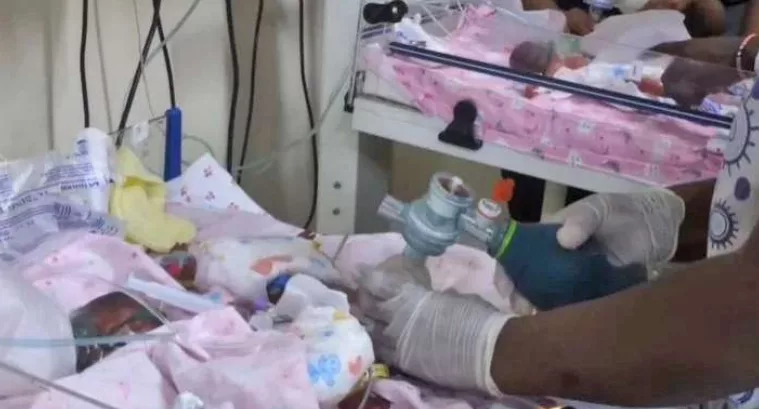
For a 28-year-old mother from Juja, the arrival of her five babies on September 13 should have been a moment of extraordinary joy.
Instead, the four girls and one boy were soon fighting for their lives.
Born at Thika Level 5 Hospital at about 25 weeks of pregnancy, the quintuplets weighed between 630 and 800 grammes each.
They were transferred to Kenyatta National Hospital for specialised neonatal care.
All five died.
Now, the Senate Health Committee is demanding answers — a minute-by-minute account of what happened between their birth at Thika and their deaths at KNH.
They want to know whether anything could have been done differently to improve their chances of survival.
The committee, chaired by Uasin Gishu Senator Jackson Mandago, began the inquiry on its own motion after taking note of reports about the delivery, referral and deaths of the newborns.
The inquiry is examining whether the facility was adequately prepared to handle an exceptionally high-risk pregnancy involving five extremely premature babies.
But senators have cautioned against assigning blame before the evidence is examined.
“The inquiry should not prejudge negligence or individual responsibility,” the committee said.
The panel added that such questions must be determined only after a review of “contemporaneous records and expert evidence”.
The committee noted that extreme prematurity and very low birth weight were major clinical factors in the deaths.
However, it said the public record did not yet provide a complete, independently verified account of the antenatal care, delivery, newborn stabilisation, referral and ambulance transfer.
That is what the senators now want to establish.
Kiambu Governor Kimani Wamatangi and the management of Thika Level 5 Hospital were summoned to appear before the committee on Thursday to explain how the mother and newborns were managed.
They did not appear.
The committee wants a complete clinical timeline, beginning with the mother’s admission and ending with the formal handover of the babies at KNH.
It wants to know when the quintuple pregnancy was identified, what antenatal preparations were made and whether specialists were involved in planning for the delivery.
A key question is why the mother was not transferred to a tertiary facility before delivery, if doctors considered such a transfer clinically necessary.
The committee is also examining whether Thika Level 5 had the capacity to deal with the emergency.
It wants details of the doctors, nurses and specialists on duty, including obstetric, anaesthetic, paediatric, neonatal, midwifery and theatre teams.
The senators want to know whether staffing levels were adequate to manage five extremely premature newborns simultaneously.
They are also demanding a baby-by-baby account of the resuscitation and stabilisation provided after delivery, including birth weights, Apgar scores, interventions and each baby’s condition before transfer.
The hospital has been asked to confirm whether incubators or warmers, oxygen, respiratory-support and resuscitation equipment, medicines and essential supplies were available and functional.
The committee wants records showing when KNH was contacted and accepted the referral, when the ambulance left Thika, when it arrived at KNH and what happened during the journey.
It is also examining whether the ambulance had the equipment, oxygen, temperature-control measures and trained personnel required to transport five extremely premature newborns safely.
The safety, appropriateness and timeliness of the referral and ambulance transfer are among the issues the committee has specifically identified for investigation.
The senators are also seeking answers from Kiambu county on what happened after the deaths.
The county has been asked whether it initiated a formal maternal and perinatal death surveillance and response review or an independent clinical audit.
The committee wants details of any findings, the records preserved and measures being taken to prevent a similar tragedy.
It is seeking a “credible, costed and time-bound corrective-action plan” to address any weaknesses identified in high-risk pregnancy management, neonatal care, staffing, equipment and referral systems.