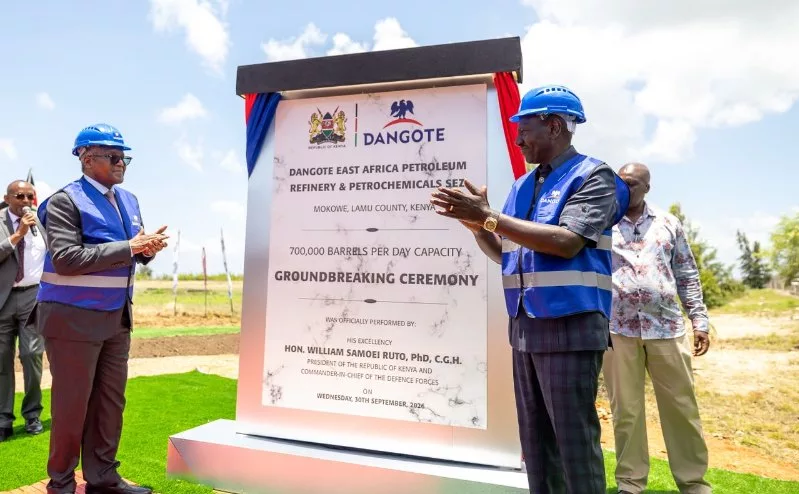
 President William Ruto and President of Dangote Group Aliko Dangote during the groundbreaking ceremony for the Dangote East Africa Refinery in Lamu County yesterday / ELLY OKWARE /PCS
For decades, East Africa has consumed billions of dollars’ worth of imported petroleum products while exporting the crude oil and other raw materials needed to power its economies.
That equation could begin to change with the construction of the Sh2.2 trillion Dangote East Africa Refinery in Lamu, a 700,000-barrel-per-day facility that is expected to become the largest refinery in East Africa and one of the biggest on the continent.
Groundbreaking of the project on Wednesday brought together President William Ruto, Nigerian industrialist Aliko Dangote and several African leaders, signalling the wider regional ambitions attached to the investment.
For Dangote, the refinery is much more than a plant for turning crude into petrol, diesel and aviation fuel.
“What this investment (Lamu refinery) will do for the Kenyans is not only the refinery; the refinery is like the gate. Once you open and have the refinery, you'll be shocked at how many people will now come and invest in Kenya,” he said.
He described fuel as the “primary engine” of an economy and argued that lower energy costs would unlock productivity across Africa.
“By cutting the cost of fuel and energy by half, Africa will have solved half of its economic challenges. This can only be realised if Africa reinvests its resources to improve productivity,” he said.
The $16 billion project, equivalent to about Sh2.2 trillion, is expected to take about 40 months to complete.
The refinery is designed to supply diesel, petrol and jet fuel to Kenya and neighbouring markets, with the project also expected to include a 1,000MW power plant.
The fuel price promise
For Kenyan households and businesses, perhaps the most immediate economic question is what the refinery will do to the price of fuel.
Super petrol currently sells for a maximum of Sh214.03 a litre in Nairobi, diesel Sh217.86 and kerosene Sh191.38, according to the latest EPRA price schedule.
Those prices feed directly into transport, manufacturing, agriculture, construction and food distribution costs.
President Ruto said the refinery would help reduce the landed cost of petroleum products by reducing exposure to international supply disruptions, foreign exchange movements and shipping costs.
The argument is particularly important for a country whose petroleum imports have traditionally created substantial demand for dollars.
Kenya introduced its Government-to-Government petroleum importation framework in March 2023, when it signed master framework agreements with Saudi Aramco Trading, Abu Dhabi National Oil Company (ADNOC), Global Trading and Emirates National Oil Company.
The arrangement replaced the Open Tender System and was designed principally to address dollar shortages and exchange-rate volatility.
Before the arrangement, petroleum companies were estimated to require about $500 million every month to finance imports.
The six-month credit arrangement allowed nominated oil marketers to pay locally in shillings while payment to suppliers was deferred, reducing immediate demand for dollars.
The government said this would ease pressure on foreign-exchange reserves and reduce speculative pressure on the shilling.
The G-to-G system, however, has not insulated Kenya from global oil-price movements.
Pump prices still reflect international crude and refined-product prices, freight, taxes, levies, margins and exchange-rate movements.
Even so, the model has since influenced the wider region.
Uganda gave its state-owned Uganda National Oil Company a greater role in directly importing petroleum products, with UNOC beginning to use Kenya's port and pipeline infrastructure in 2024.
Uganda consumes close to seven million litres of fuel a day and historically sourced more than 90 per cent of its imports through Kenya.
Rwanda has also moved towards direct government-backed procurement.
In June this year, Kigali and Nairobi signed agreements allowing Rwanda National Energy Company to source bulk fuel and use Kenya's port, pipeline and storage infrastructure.
A 40,000-tonne consignment arrived at Mombasa in September.
A refinery in Lamu offers the region another layer of protection: instead of importing finished products, East African countries could increasingly import crude and process it closer to their markets.
The strongest argument for the Lamu project comes from Dangote's existing refinery in Lagos.
Commissioned in May 2023 at a reported cost of about $20 billion, the Nigerian facility has a refining capacity of 650,000 barrels a day and began commercial production in January 2024.
Its experience demonstrates both the potential and limitations of large-scale refining.
Nigeria's Central Bank reported that the availability of locally refined products contributed to a substantial decline in fuel imports.
Refined petroleum product imports fell from $14.06 billion in 2024 to $10 billion in 2025, a 28.88 per cent reduction.
In May this year, it cut petrol to N1,250 a litre from N1,275 and diesel to N1,700 from N1,800.
The Nigerian experience does not mean Kenyan motorists will automatically see a 50 per cent reduction in pump prices.
The West African country continued importing substantial volumes of petrol even after Dangote began supplying the market, highlighting the importance of crude availability, refinery utilisation, logistics and market structure.
However, the local refinery has already reduced Nigeria's dependence on imported refined products and increased the country's ability to export petroleum products.
The US Energy Information Administration data shows Nigeria's petroleum-product exports almost quadrupled to 146,000 barrels per day in 2024 after Dangote started operations.
The Lamu project also carries an electricity proposition.
Dangote says the refinery's power plant will generate about 1,000MW, with up to 500MW potentially available for sale to the Kenyan government.
That would be significant in an electricity market where Kenya generated 5,718GWh from geothermal sources, 3,503GWh from hydro and 1,908GWh from wind in the year ended June 2025.
The economic value of 500MW depends on how continuously it is generated and the tariff under which it is sold.
EPRA's power-market study estimates generation costs for 2025/26 at about Sh4.43 per kWh off-peak and Sh7.59 per kWh at peak.
At full utilisation, 500MW would represent about 4.38 billion kWh a year, giving an indicative annual energy value of roughly Sh19.4 billion to Sh33.2 billion at those generation-cost benchmarks.
Employment could be another major transmission channel.
Ruto has said the project will require about 60,000 young people, describing the refinery as a major employment opportunity during construction and operation.
The Lagos project provides a useful benchmark.
According to Dangote, the Nigerian refinery has trained 900 young engineers at international refineries, 50 process engineers through Honeywell UOP and other technical personnel, while the construction phase supported more than 150,000 jobs.
The Lamu project has already announced 1,000 training and employment opportunities targeting engineering degree, diploma and technical graduates from the region.
That points to opportunities for chemical, mechanical, electrical, civil, petroleum, instrumentation and control engineers.
Others are technicians, welders, fabricators, plant operators, laboratory specialists, logistics professionals and safety experts.
The larger prize, however, lies outside the refinery payroll.
Lamu refinery is being built next to the deep-water Lamu Port, giving it a strategic connection to the Lamu Port-South Sudan-Ethiopia Transport corridor.
The corridor was conceived around a network of ports, roads, railways, pipelines, airports, power transmission infrastructure and industrial facilities.
Its original master plan included an oil refinery, crude and refined-product pipelines and an oil terminal at Lamu.
The refinery could finally provide the industrial anchor that turns pieces of that infrastructure into an interconnected economic corridor.
Lamu Port can receive crude, refinery equipment and other bulk cargo before exporting refined products.
Increased vessel traffic would create demand for marine services, freight forwarding, storage, bunkering, ship agency, cargo handling, port security and engineering.
Kenya's State Department for Shipping and Maritime Affairs says the project is already stimulating vessel traffic and specialised maritime skills, with a ship carrying about 2,930 tonnes of refinery construction equipment docking at Lamu Port last week.
Beyond petroleum storage, pipelines, petrochemicals, plastics, fertiliser production, manufacturing and transport services could cluster around the refinery.
The economic logic is straightforward: a refinery attracts storage; storage attracts logistics; reliable fuel and power attract manufacturers; manufacturers create demand for transport, housing, financial services and other businesses.
The refinery's feedstock could come from Uganda, South Sudan and other African producers, turning Lamu into both an import and export gateway.
An African Union infrastructure prospectus says the proposed LAPSSET crude pipeline is intended to transport oil from South Sudan and Kenya's Lokichar Basin to Lamu, reducing transport costs and creating government revenue, jobs and wider economic activity along the corridor.
But Lamu will not operate in an empty regional market.
Uganda is developing a $4 billion, 60,000-barrel-per-day refinery at Kabaale, Hoima, alongside a 211km products pipeline and storage infrastructure.
Its government says the facility will support domestic supply, regional exports, petrochemicals, fertiliser and LPG industries.
Uganda's crude, meanwhile, is being developed around the 1,443km East African Crude Oil Pipeline to Tanzania's Tanga port.
TotalEnergies holds a 62 per cent stake in EACOP, with Uganda National Oil Company and Tanzania Petroleum Development Corporation each holding 15 per cent and CNOOC eight per cent.