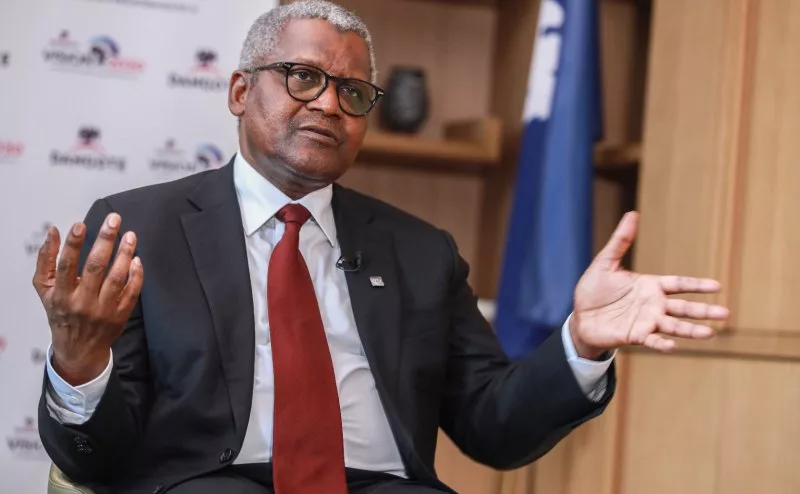
 Businessman Aliko Dangote during an interview with journalists in Nairobi on September 29, 2026. /ENOS TECHE
When Bob Marley and The Wailers released Redemption Song in 1980, Aliko Dangote was only about three years into the business journey that would eventually make him Africa’s richest man.
Forty-six years later, on the eve of breaking ground on his Sh2.2 trillion East Africa refinery in Lamu, Dangote looked back to Marley’s enduring call for African liberation to explain why he wants the continent to own more of its economic destiny.
“We must emancipate ourselves from mental slavery. This must be done by us and in this generation,” Dangote told a packed press room at the JW Marriott Hotel in Nairobi on Tuesday.
It was an arresting moment from a businessman whose personal fortune was recently estimated by Forbes at about $51.3 billion, following a sharp revaluation of his refinery business.
His empire, however, began in 1977 with commodity trading before expanding into cement, fertiliser, food and, eventually, oil refining.
Now, Dangote wants to take the industrial model that made his Lagos refinery Africa’s biggest and transplant it to East Africa.
His message was blunt: African countries should stop leaving strategic businesses, infrastructure and capital in the hands of outsiders.
“This thing that people are holding, there are a lot of mafia organisations that have actually overtaken most of our businesses in Africa: airline, shipping, ports, you name it,” Dangote said.
“So which means the intention is to continue
to make us Africans slaves. And this has to stop.”
The Lamu refinery is therefore being presented
as more than a fuel plant. At 700,000 barrels per day, it is designed to become
the largest refinery in East Africa, a petrochemical complex and an industrial
anchor around Lamu Port.
And Dangote has now added another radical element: ordinary Africans should be able to own part of it.
He told The Star that the refinery will ultimately be listed on the Nairobi Securities Exchange, giving investors an opportunity to own shares in a project that would otherwise remain largely under the control of Dangote Industries.
The approach represents a departure from the
group’s traditional practice of retaining and reinvesting earnings rather than
paying dividends.
The Nigerian industrialist is already testing
the concept at home.
His Lagos refinery has launched what is
expected to become Africa’s largest IPO, with a $1.6 billion (Sh207 billion) share sale
designed to widen public ownership.
Dangote said the response had exceeded expectations.
“Demand is there, enormous demand. In fact, I
didn't know the depth of our capital markets until now, really, because we have
never tested it,” he said in Nairobi.
The choice of Lamu followed months of
uncertainty over where Dangote would establish his East African refinery.
Tanga in Tanzania was initially central to the
regional plan announced in April. Mombasa later emerged as a preferred Kenyan
location before the Dangote team settled on Lamu.
According to Dangote, the decisive consideration
appears to have been commercial and logistical.
Lamu offers a deep-water port beside large
tracts of undeveloped land within the Lamu Port-South Sudan-Ethiopia Transport,
or LAPSSET, corridor. That is important for a refinery that will have to import
huge quantities of crude.
Tanga has one major advantage: its connection
to Uganda’s oil through the East African Crude Oil Pipeline. But those barrels
are already committed to the EACOP system and international markets, while
Uganda is simultaneously pursuing its own 60,000-barrel-per-day refinery at
Hoima.
For Dangote, Lamu provides something different: direct access to the Indian Ocean and the ability to source crude from
several parts of the world. He said that the site decision followed commercial
and technical considerations, while its engineering partner, Engineers India
Limited, is designing the refinery to process a wider basket of crude.
The location also puts the refinery close to
Kenya’s biggest economy and the Northern Corridor, potentially giving it access
to markets in Uganda, Rwanda, South Sudan, Tanzania and the Democratic Republic
of Congo.
The refinery is expected to blend emerging
crude from East Africa, including Kenya and potentially South Sudan and Uganda
where commercially and contractually available — with seaborne crude sourced
from the Middle East and other international markets.
That is broadly the same lesson learned in
Lagos, where Dangote has increasingly imported crude from countries including
the United States, Brazil, Angola and the United Arab Emirates when domestic
supplies have been insufficient.
The advantage of Lamu is that crude does not necessarily have to travel across Africa by pipeline. It can arrive by sea. But this also exposes the refinery to global shipping costs, geopolitical disruptions and crude-price volatility.
Various experts have noted that Lamu Port does
not yet have operational oil-storage terminals, although LAPSSET plans provide
for storage capacity of up to 1.5 million barrels.
Dangote has not publicly disclosed a specific
minimum capacity-utilisation rate at which the Lamu refinery would break even
or generate his targeted return.
But the Lagos refinery provides the clearest
available benchmark.
In the first half of 2026, the Nigerian plant averaged
about 83.6 per cent utilisation and generated $13.91 billion (Sh1.8 trillion) in revenue and
$1.82 billion (Sh235 billion) in net profit.
Its gross refining margin rose to about $24.50
per barrel, compared with $13.70 in 2025.
The lesson is that scale alone does not
guarantee profitability. Throughput, crude cost, product prices, refining
margins and financing costs determine the economics.
Industry data also shows that global refinery
utilisation has generally hovered around 80 per cent, while Africa has
historically operated well below that level.
For Lamu, Dangote says a sustained
utilisation rate in the 80 per cent range would be a commercially important
threshold, but it would be wrong to describe 80 per cent as Dangote’s disclosed
break-even point. No such figure has been made public.
At full capacity, 700,000 barrels per day
means processing roughly 255.5 million barrels of crude annually.
Dangote has revised the project cost from an
earlier estimate of about $17 billion (Sh2.2 trillion) to roughly $16 billion (Sh2.06 trillion), saying experience
gained from building the Lagos plant should reduce construction time and
financing costs.
His proposed capital structure is straightforward: 70 per cent debt and 30 per cent equity.