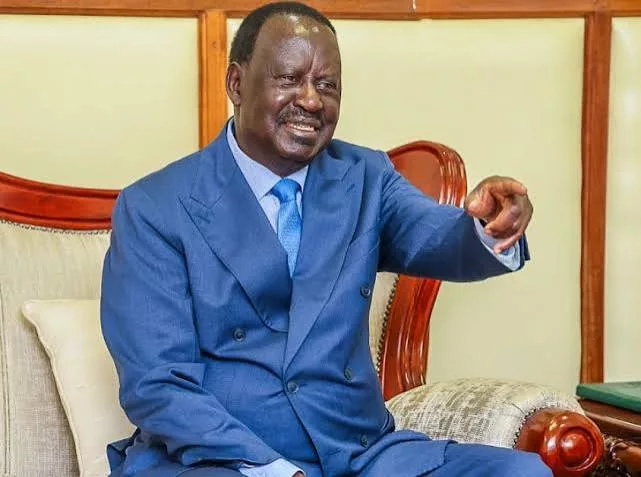
 Former ODM leader Raila Odinga /FILE
The former Prime Minister Raila Odinga’s name refuses to disappear from the country’s politics, with his legacy emerging as a key factor in the 2027 election.Raila died onOctober 15 last year.
But in death, just as in life, political formations are increasingly invoking his name and legacy as they court his supporters and seek to endear themselves to the electorate.
Political analyst Suba Churchill says Raila will continue to influence the country’s election even from his grave.
“Raila’s legacy will continue to be a factor in the 2027 elections and even beyond because even those who are positioning themselves want to be seen to be continuing his legacy,” he told the Star.
“Moving forward and as we prepare to celebrate his first anniversary, I think Raila’s name will remain bigger, even more than when he was alive and will continue to be invoked by people. We are yet to see the peak of it when we approach the elections.”
The latest politician to reopen the Raila question is retired President Uhuru Kenyatta, who on Wednesday claimed that the former Prime Minister actually won the 2022 presidential election.
President William Ruto was declared the winner with 7,176,141 votes against the former ODM leader’s 6,942,930 by the Independent Electoral and Boundaries Commission.
The Supreme Court subsequently upheld Ruto’s victory.
Speaking during a Jubilee Party meeting in Nairobi, Uhuru said he
remained convinced that Raila had won the votes, reviving one of the most
contested narratives from the 2022 election.
“We did everything to help Baba (Raila)become the president. He got the votes and I still believe he won but we know how things went. We don’t want a repeat of the same,” Uhuru said.
The remarks immediately triggered a political storm, underscoring how Raila’s 2022 candidature remains politically potent four years after the election and following his death.
“If he was convinced that Raila Odinga had won, why did his government facilitate the transfer of the instruments of power to a person he believed had not won?” ODM leader Oburu Oginga said.
The former premier’s long-serving pressman Dennis Onyango also weighed in on the matter, terming Uhuru’s remarks “unfortunate”, adding they were meant to whip emotions.
“Uhuru might have wanted to help Raila but some of the senior government officials he seconded to our campaigns did not believe in Raila’s presidency,” Onyango told the Star.
According to Churchill, the former president’s remarks were aimed at making a case for his Jubilee candidate among Raila’s supporters.
“It was a statement to appeal to Raila’s constituencies across the country that he meant well and therefore they should not look for his Jubilee Party and Fred Matiangi with a bad eye,” he told the Star.
But Uhuru is not alone in keeping Raila at the centre of the 2027 political conversation.
Within emerging opposition formations, Raila’s name has become a powerful political reference point, particularly for leaders seeking to inherit his support base.
Nairobi Senator Edwin Sifuna has repeatedly appeared in Raila-branded attire, with the former ODM leader’s final message to the ODM parliamentary group inscribed on his clothes, effectively presenting himself as part of a continuing struggle.
Homa Bay Town MP Opondo Kaluma has threatened to sue Sifuna over use of Raila’s image in his campaigns, even after disengaging from ODM.
“Before the end of this week, we are going to write to Sifuna. We’re going to tell him to stop branding his clothes using Baba (Raila’s) image,” Kaluma said.
Sifuna’s recent Nairobi rally also deliberately passed through locations strongly associated with Raila’s political campaigns, including Jacaranda grounds.
The choice was significant, given that the former Prime Minister repeatedly used the venue for major political gatherings.
Sifuna’s allies have openly drawn the parallel, with Funyula MP Wilberforce Oundo claiming that the Nairobi senator was inheriting what he described as Raila’s political spirit and numbers.
The lawmaker added that Linda Mwananchi was moving to occupy political space previously loyal to the former ODM supremo.
“We brought the spirit of Baba Raila Amolo Odinga to his home turf of Nairobi. We wanted to tell the people of Kenya that we have inherited the spirit and the numbers of Baba Raila Amolo Odinga,” Oundo said.
Embakasi East MP Babu Owino has also leaned heavily on the Raila legacy during Linda Mwananchi campaigns, telling supporters that he is the natural successor to Raila.
“Baada ya Baba ni Babu (After Raila, it is Babu),” the youthful lawmaker has repeatedly said during opposition rallies.
Wiper leader Kalonzo Musyoka has also brought Raila back into the 2027 debate, claiming that the former Prime Minister won the 2013, 2017 and 2022 presidential elections.
Kalonzo's remarks came shortly before his visit to Siaya, Raila’s political home.
Speaking in Kitui County, the former vice president defended Uhuru’s claim on the 2022 election, adding that Raila was denied victory in both the 2013 and 2022 elections as well.
“Uhuru was in the position to know, but because he was not the chair of IEBC, he could not declare Raila the winner,” Kalonzo claimed.
He was Raila’s running mate in both the 2013 and 2017 elections.
Kalonzo was in Siaya on Sunday, where he attended a church service before addressing a number of roadside rallies.
Senate Majority Leader Aaron Cheruiyot said that Raila's ODM party will play a significant role in determining the course of the August 10 elections.
“Raila will be a factor in the elections; his party ODM is still existing and very strong. Many of his supporters want to support ODM to stay in government in honour of his legacy,” the Kericho senator argued.
INSTANT ANALYSIS
Raila’s name is therefore likely to remain woven into the political calculations of competing formations, whether through direct appeals to his supporters, claims to his legacy or attempts to position themselves as custodians of the political causes he championed.