STAKEHOLDERS in retail, hospitality, entertainment and harm reduction have continued to urge Parliament to review sections of the proposed Tobacco Control (Amendment) Bill, as public hearing forums take place in different parts of the country.
They warn that some measures could increase business costs, complicate enforcement and affect legitimate trade.
The concerns emerged during public participation on the Bill held in Nairobi, Uasin Gishu, Meru and Kisumu counties, with the National Assembly Committee on Health also engaging stakeholders in other counties as it gathers views before preparing its report for consideration by MPs.
Stakeholders said they support measures aimed at protecting public health and regulating tobacco and emerging nicotine products, but called for legislation that takes into account the realities facing businesses, consumers and regulators.
One of the major areas of concern is a proposal requiring businesses dealing in tobacco products to obtain a separate licence from county governments.
The Bill proposes that a person intending to manufacture, distribute, store, sell or otherwise deal in tobacco products should obtain a licence from the respective county executive committee member.
Retailers and other traders said the proposal could duplicate existing licensing requirements, particularly the Single Business Permit, and increase compliance costs for small businesses.
Retail Trade Association of Kenya (Retrak) chief executive Wambui Mbarire said retailers already operate under numerous licences and warned that another requirement would undermine efforts to simplify the business environment.
“With an already existing licence burden, for instance, on average a supermarket requires 39 licences to operate, this bill puts in a new licence that a retailer must get to sell tobacco,” she said.
Mbarire said the additional licence would complicate the operating environment and increase the cost of doing business.
Similar concerns were raised in Uasin Gishu, where traders told the committee that tobacco-specific licensing amounted to duplication since businesses already pay county fees to operate.
BAT Kenya senior regulatory affairs manager, Billy Tsuma, said the industry supports regulation that is evidence-based, consultative and practically enforceable.
“We support regulation that is evidence-based, consultative, fit-for-purpose, and practically enforceable,” Tsuma said, urging the committee to consider views raised by traders and other players across the value chain.
Another contentious proposal is a restriction on the sale of tobacco products within 100 metres of places primarily serving people below 18 years.
Traders in Uasin Gishu and Kisumu questioned how the provision would work in densely populated urban areas where schools, residential areas, shops, restaurants and other businesses are located close to one another.
Sharlynne Chelang’at, a trader in Uasin Gishu, said enforcement of the existing prohibition on selling tobacco products to minors would be more practical.
“The proposed law seeking to restrict sale of tobacco products to more than 100 metres from places with children does not work and is impractical. Instead, the current law prohibiting sale of these products to underage users should be strictly enforced,” she said.
Hospitality traders in Kisumu also challenged the proposal, arguing that existing regulations governing smoking areas already address some of the concerns around exposure to tobacco products.
The proposal to raise the minimum age for purchasing nicotine and tobacco products from 18 to 21 also generated debate in Kisumu.
Dan Ouma, chairperson of the Pubs, Entertainment and Restaurants Association of Kenya (PERAK) in Kisumu, questioned how the proposed age limit would be enforced.
“They are trying to raise the smoking age limit from 18 years to 21 years. We are here to tell them that it is not possible because the implementation of the proposal is unclear,” Ouma said.
The committee chairman, Dr James Nyikal, had earlier said there was significant stakeholder support for increasing the age at which people can purchase nicotine products.
In Meru, harm reduction experts focused on provisions dealing with emerging products, including nicotine pouches and vapes.
Dr Michael Kariuki, secretary general of the Harm Reduction Society of Kenya, called for clearer definitions and differentiation between combustible and non-combustible products.
“We are also saying that we need product differentiation between combustible and non-combustible products,” Kariuki said, arguing that the two categories should not automatically be subjected to identical regulatory treatment.
The experts also opposed a proposed ban on flavours, arguing that some adult consumers seeking alternatives to combustible tobacco products use flavoured nicotine products.
Kariuki said the bill should also define tobacco control, noting that the World Health Organisation's Framework Convention on Tobacco Control provides a basis for such terminology.
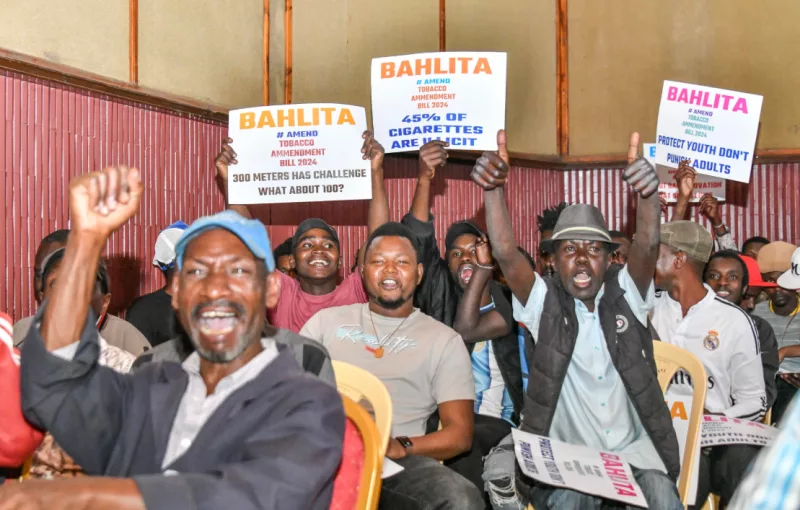
Meanwhile, the Bars, Hotels and Liquor Traders Association of Kenya (BAHLITA) warned that restrictions on flavours could have implications for illicit trade.
BAHLITA secretary-general Boniface Gachoka said a blanket ban could push some consumers towards unregulated products, potentially affecting legitimate businesses and government revenues.
“There is no need to ban flavours in tobacco products,” Gachoka said, while calling for measures that distinguish between child-appealing flavours and products intended for adult consumers.
Perak also warned against adding licensing requirements without strengthening enforcement against illicit operators.
Michael Kiragu, the association's national chairman, said multiple licences would overburden businesses and duplicate the existing licensing framework.
The Tobacco Control (Amendment) Bill, sponsored by nominated Senator Catherine Mumma, seeks to amend the 2007 Tobacco Control Act to provide a regulatory framework for new and emerging tobacco and nicotine products.
The bill has already passed the Senate and was committed to the National Assembly Committee on Health for stakeholder engagement and public participation.
The committee was to conduct hearings across several counties, including Nairobi, Uasin Gishu, Bungoma, Kisumu, Meru, Tharaka-Nithi and Laikipia, before concluding the exercise in Kisumu and Nanyuki.
It is expected to consolidate the submissions before preparing a report for tabling in the National Assembly, where MPs will consider the proposed amendments.