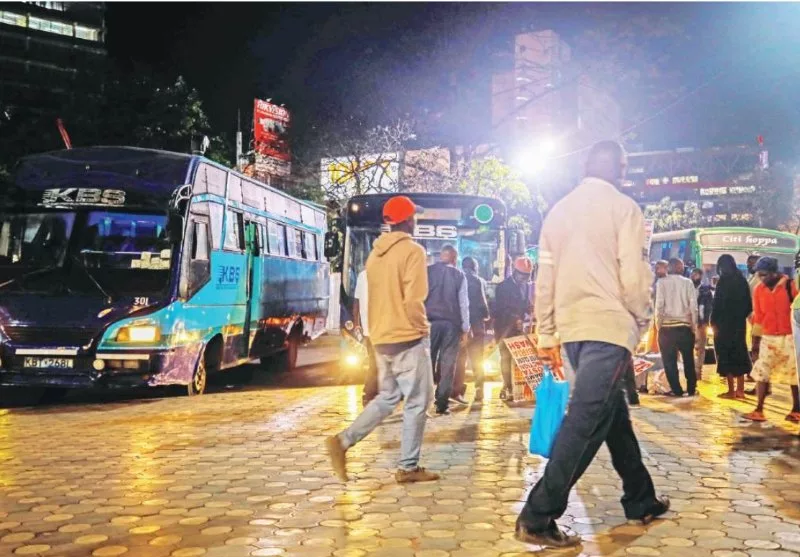
For a Nairobi employee earning about Sh45,000 a month, payday is less about building wealth than settling the bills that have accumulated over the previous four weeks.
Rent comes first. Then food, transport, electricity, school expenses and debt repayments. By the time everything is paid, there is often little left or nothing to set aside.
“Once my salary comes in, I repay the small loans, only to start borrowing again to get through the new month,” Bonface Mbithi (not his real name) tells the Star. He asked not to be identified because he does not want his employer or family discussing his finances.
"I can survive one month, maybe two, if I cut everything.”
His experience is shared, in different forms, by Kenyans across income groups.
Victoria, a professional banker in a tier-one lender, earns Sh150,000 to Sh250,000 a month and has savings. She says if she lost? her salary for six months, she would quickly be forced to change her lifestyle.
“I earn what people would consider a good salary, but that does not mean I have that amount available to save.”
Mortgage or rent, school fees, insurance, transport, household expenses, family obligations and loan repayments absorb much of her income.
Then there is the senior employee earning more than Sh300,000 a month.
On paper, such an income should provide a substantial cushion. Yet even he says the gap between earning and accumulating wealth can remain surprisingly wide.
“When your income increases, your responsibilities also increase,” he says. “You have children in better schools, a bigger house, insurance, investments and family responsibilities. You can earn Sh300,000 and still feel that you are living from one month to the next.”
Their experiences expose a paradox at the heart of Kenya’s financial transformation.
The country has built one of Africa’s most extensive financial access ecosystems, bringing millions of people into banking, mobile money, digital credit, Saccos, insurance and investment products.
Yet access to financial services has not necessarily translated into financial security.
The latest FinAccess Household Survey puts formal financial inclusion at 84.8 per cent of adults, up from 83.7 per cent in 2021 and 75.3 per cent in 2016.
FinAccess is a regular household survey tracking financial inclusion, usage, quality, and impact from consumer perspective. It is a public-private partnership involving CBK, KNBS and Financial Sector Deepening Kenya (FSD Kenya).
But only 18.3 per cent of adults were classified as financially healthy in 2024.
More strikingly, the proportion of adults reporting savings fell from 74 per cent in 2021 to 68.1 per cent in 2024, the first decline in the savings rate since 2009.
At the same time, the share using credit rose from 60.8 per cent to 64 per cent.
In other words, more Kenyans are inside the financial system, but a smaller proportion is accumulating financial buffers.
That raises a more important question than whether someone owns a bank account or mobile wallet: how long could their household survive if their income stopped today?
The distinction is important because financial inclusion is traditionally measured by access, whether people can open an account, send money, borrow or make payments.
Experts now say financial well being is different. People should be able to meet their daily needs, absorb a financial shock and invest for the future.
“Meaningful financial inclusion begins with visibility,” TransUnion Kenya CEO Morris Maina says.
“But visibility is not about collecting more data for its own sake. It is about capturing the right signals, interpreting them accurately, and ensuring those signals reflect real-world behaviour.”
However, by those measures, Kenya’s picture is considerably weaker than it should be.
The Central Bank of Kenya says only 25 per cent of adults could access emergency funds within three days in 2024.
The proportion was 17 per cent in 2021. But the improvement was driven partly by greater access to credit rather than accumulated savings.
At the same time, the source of emergency money has shifted dramatically.
The proportion relying on bank savings when faced with an emergency fell from 24 per cent in 2019 to only nine per cent in 2024.
Reliance on alternative sources, including family, informal lenders, Saccos and other financial solutions rose from 65 per cent to 86 per cent over the same period.
This suggests that for many households, financial inclusion has made money easier to access without necessarily making it easier to accumulate and save.
A medical bill can become a digital loan, a rent shortfall can become a salary advance, school fees can mean borrowing from a Sacco and a broken vehicle can push a household further into debt.
The financial system is therefore increasingly effective at helping households obtain liquidity.
Octagon Africa Financial Services founder Fred Waswa says the harder question is whether it is helping them build enough wealth to need that liquidity less often.
Waswa emphasises that Kenya has made real progress in financial access, but access alone does mean a household could cope with two missed salaries.
“FinAccess’s finding that only 18.3 per cent of adults are financially healthy points to the gap,” Waswa says. “The better test of financial wellness is whether a household has enough accessible savings to cover essential expenses for at least two months without borrowing or missing payments.”
The founder says Kenyans save in bank accounts, mobile wallets, Saccos, chamas, money market funds (MMFs) and pension schemes, so a bank balance alone does not measure total savings.
Equally, having savings does not mean those funds are readily available for rent, food or school fees in an emergency.
“When households have little financial breathing room, voluntary pension contributions, for example, can fall down the priority list as immediate needs take precedence,” Waswa says.
Building an emergency fund in an accessible account or money market fund, alongside regular pension contributions, can help protect both short-term stability and retirement savings, he recommends.
Financial experts say the apparent weakness in bank balances should not be interpreted as proof that Kenyans have stopped saving.
Mobile money, Saccos, money market funds, pension schemes, investment clubs, Treasury securities and other products now compete with conventional bank accounts as stores of value.
CBK analysis of FinAccess shows that only 14 per cent of the population saved through banks or microfinance banks, compared with 36 per cent through mobile money.
Mobile banking accounted for another 17 per cent. That means a worker could have only Sh20,000 in a bank account while holding considerably more in a Sacco, money market fund, pension, investment or business.
But Sacco figures suggest the problem is not where Kenyans keep their savings.
The Sacco Societies Regulatory Authority data shows that regulated Saccos had 18.95 million deposit accounts holding Sh832.8 billion by December 2025.
Of these, 16.88 million accounts, almost nine in every 10 or 90 per cent, held less than Sh50,000, collectively accounting for only Sh45 billion, or 5.36 per cent of total deposits.
Overall, 91.78 per cent of deposit accounts held Sh100,000 or less. The figures point to a financial system with millions of savers, but relatively shallow balances among the majority.
One reason is straightforward: there is often simply not enough disposable income.
The Parliamentary Budget Office found that real wages in Kenya’s formal sector recorded annual declines from 2020 to 2023.
Combined real wages for public and private sector employees fell by 10.7 per cent over the period, with a 4.1 per cent decline in 2023 alone.
Nominal salaries, therefore, can rise while the purchasing power of those salaries falls.
A Sh100,000 salary today does not buy what it did several years ago because rent, food, transport, healthcare and education all have become more expensive.
For the lower-income worker, the problem is often insufficient income.
For the middle class, it is the collision between income and increasingly expensive obligations.
For higher earners, it can be lifestyle inflation: bigger homes, better schools, insurance, investments and family responsibilities.
The result is the same: income continues to flow, but little survives long enough to become wealth.
This is where Kenya's financial inclusion success presents another paradox. The same infrastructure that enables saving also makes borrowing remarkably easy.
FinAccess found that credit use rose to 64 per cent in 2024, while savings declined to 68.1 per cent. The survey also found significant debt distress. The proportion of borrowers who had completely defaulted rose from 10.7 per cent in 2021 to 16.6 per cent in 2024.
CBK's Financial Sector Stability Report similarly warns that while financial inclusion has expanded, indebtedness has increased and financial health remains weak.
It notes that credit is increasingly being used by households and micro and small enterprises for consumption and emergencies rather than investment.
If access to credit helps a household survive a temporary shock, it can provide valuable resilience.
Financial expert Clement Mugura says that when borrowing becomes the routine solution to recurring income shortfalls, inclusion can become a revolving door.
"Income arrives, debt is repaid, expenses accumulate and another loan fills the next gap. This is highly unsustainable," he says.
The implications extend beyond individual households.
The FinAccess survey shows only 18.3 per cent of adults meet the definition of financial health, while the ability to invest in the future has deteriorated.
Only 15.1 per cent reported having arrangements for old-age financial support in the survey's financial-health framework.