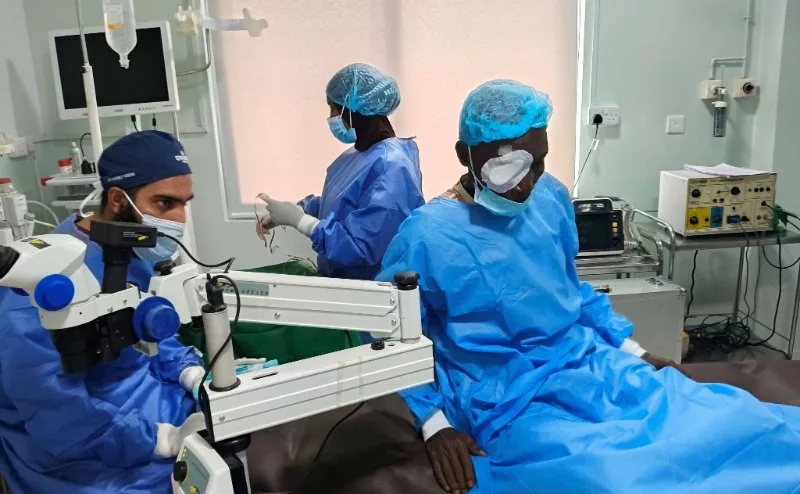
 Consultant ophthalmologist Shabbir Abdulrasul [L]and Said Mwinyi [R]at the Saifee Foundation Medical Centre in Bondeni, Mombasa on Saturday / BRIAN OTIENO
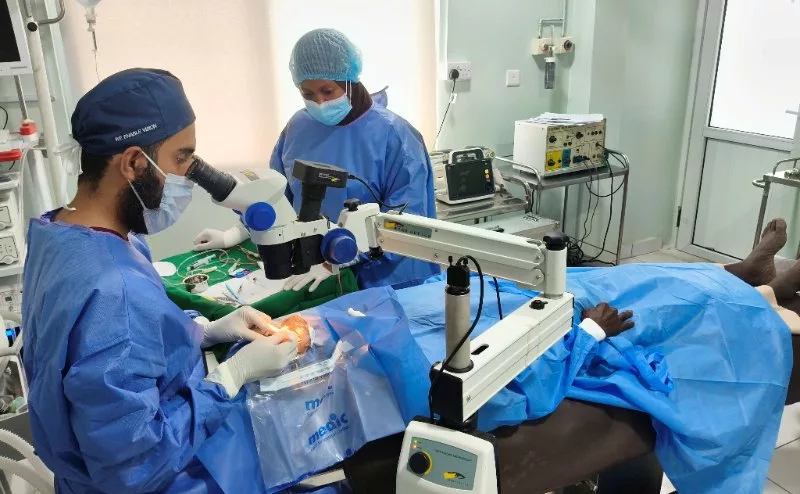 Consultant ophthalmologist Shabbir Abdulrasul operates on Said Mwinyi at the Saifee Foundation Medical Centre in Bondeni, Mombasa on Saturday / BRIAN OTIENO
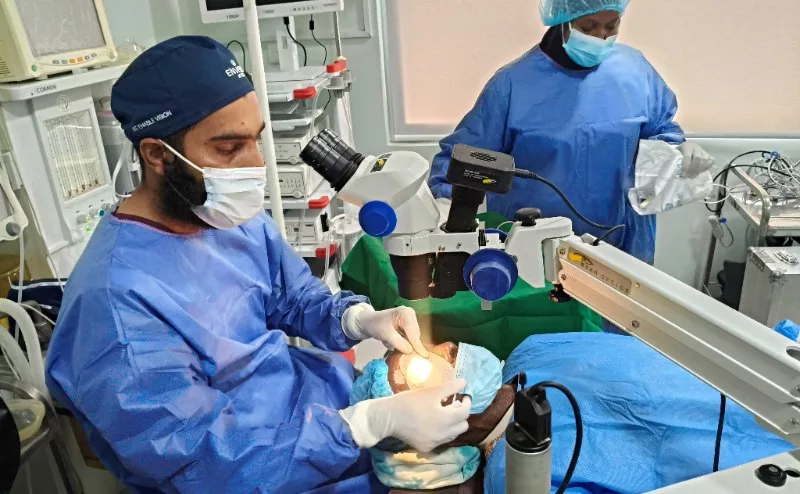 Consultant ophthalmologist Shabbir Abdulrasul operates on Said Mwinyi at the Saifee Foundation Medical Centre in Bondeni, Mombasa on Saturday / BRIAN OTIENO
Eye doctors at the Saifee Foundation Medical Center have lamented the myths that prevent the elderly people suffering from eye cataracts from getting medical attention.
The ophthalmologists say despite a free surgical medical camp, initiated by the Dawoodi Bohra Community through their global Project Rise, some of those suffering from cataracts fear the medical intervention because of the many myths that are spread in the villages.
“This needs to stop,” ophthalmologist consultant Shabbir Abdulrasul said on Saturday.
He spoke after conducting free cataract surgeries on 10 patients at the Saifee Foundation Medical Centre, in Mombasa’s Bondeni area.
The 10 were part of 24 referrals for surgeries after a free medical camp in Miritini, two weeks ago.
“We had scheduled 24 surgeries but less than half turned up, despite this being a free initiative. It is common for patients to fail to turn up for these surgeries and we all know it is because of the falsehoods being peddled in the villages,” Abdulrasul said.
According to reports, some of those that did not turn cited need for more time to think about the surgeries, others cited lack of fare, while some did not give a reason only saying they will show up later.
Meanwhile, they continue suffering blurry or impaired vision.
Abdulrasul said they have witnessed many such scenarios, with many of the patient fearing the procedure altogether.
“Some believe the rumours that the procedure involves replacing their human eyes with animal ones, either a goat’s eye, a cow’s eye or a sheep’s eye. This is completely false,” the consultant ophthalmologist told the Star.
A cataract is a cloudy area in the natural lens of the eye that blurs or impairs vision.
Most cataracts develop slowly and do not disturb eyesight early on. They are mainly caused by old age.
“Cataracts are primarily caused by the natural breakdown and clumping of proteins and fibers within the eye’s lens as you age. But diseases like diabetes can also cause cataracts because diabetes raise blood sugar levels and accelerate protein breakdown,” Abdulrasul said.
He said cataracts are bound to appear in humans at some point in life, just like grey hair.
“There is no running away from cataracts. It will come but when it will come is genetically different. For some, it will come earlier at even 60 years, while for others it will come late at even 80 years. But it will come,” he explained.
The ophthalmologist however said nowadays it comes earlier to people because of lifestyle changes that cause diabetes, and a lot of exposure to UV radiation (sunlight) and prolonged screen time.
“But it does not mean that if you are going to stay indoors (lack of sunlight), you will never get cataracts,” Abdulrasul warned.
Unfortunately, he said, up to date, the only available treatment for cataracts is surgery.
“There are no eye drops or tablets you will take to clear the lens. We just have to remove dirty lens - the cloudy lens – and replace it with an artificial one, and by the will of God, they start seeing clearly,” Abdulrasul said.
The procedure itself is usually about 10-15 minutes long.
A small injection of anesthesia is done at the side of the eye to make the patient comfortable during the procedure.
“During the procedure, the patient just feels a bit of touch but no pain,” Abdulrasul said.
He said the myths that the eyes will be replaced should be demystified, because that is what keeps patients away from treatment.
“As you can see, we don’t remove the eye. Those are just myths outside there. It is a minor procedure but life-changing,” Abdulrasul said during a procedure.
As he operated on a patient from Jomvu subcounty, who had not had vision on his right eye for two years, Abdulrasul kept on conversing with him, to keep him engaged.
The patient, a farmer, said he did not have the required money, between Sh15,000 to Sh20,000, for the procedure, and that is why he jumped at the opportunity to have free surgery.
“I have not been going to the farm because of this eye that cannot see,” he said.
After the procedure, the patient’s clear vision is restored after one or two hours, once the anesthesia wears off.
Hamisi Swaleh, from Dongo Kundu, said he had been suffering from eye cataracts for about 10 years.
It started gradually until he lost sight in his left eye completely.
“By good luck, I was one of the people selected to undergo surgery here at Saifee by our good brothers from the Dawoodi Bohra Community. I was operated on Saturday and today I had the bandage removed after check-up.
“I have received my spectacles and my eye now sees well,” he said.
He said without the free medical camp, he would not have undergone the procedure because of the cost involved.
“It is unfortunate that we were many that were scheduled for the procedure here but only about 10 of us came. The others feared. I feel for them because they were misinformed and missed out on a life-changing opportunity,” Swaleh said.
He said in the villages, the rumours against cataracts keep sufferers away from treatment.
Said Mwinyi, a Miritini KCC resident, said he had been suffering from blurry vision for four years.
He got help on one eye two years ago, and on Saturday got help on the other.
“When the Dawoodi Bohra Community brought the medical camp to Miritini, I had to jump at the opportunity. Now my vision has been restored and I can see like a small child again,” Mwinyi said.
He rubbished speculation that such procedures involve the removal of the human eye and replacing it with those of animals.
“You feel nothing during the surgery. The only time you feel a pinch is when you are injected with the anesthesia. But during that time the doctors encourages you and before you know it, you suddenly only feel the touch, no pain,” he said.
Kalonzo Kioko, a Mamlai resident in Jomvu subcounty, had been suffering from poor eyesight due to cataracts for eight years.
He was operated on on Saturday by Abdurasul, and now he sees clearly for the first time in eight years.
“Let us not fear the procedure. It is not like what people are saying out there,” he said.