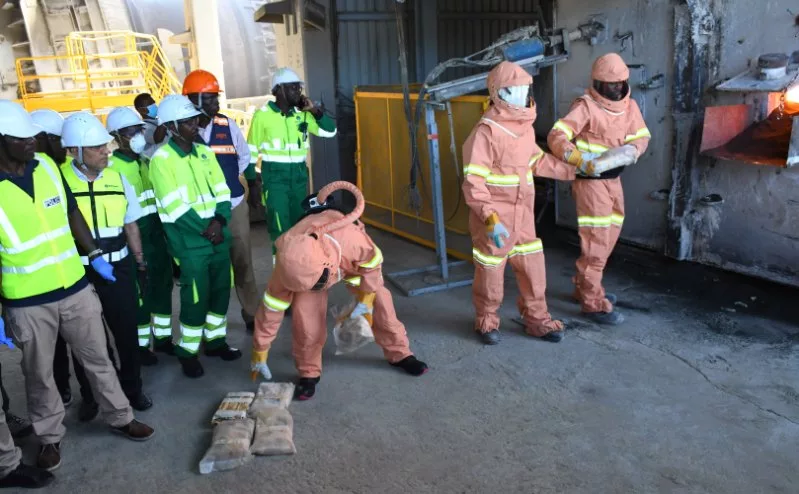
 The incineration of the Sh8.2 billion methamphetamine at Bamburi Cement factory in Mombasa on Thursday / BRIAN OTIENO
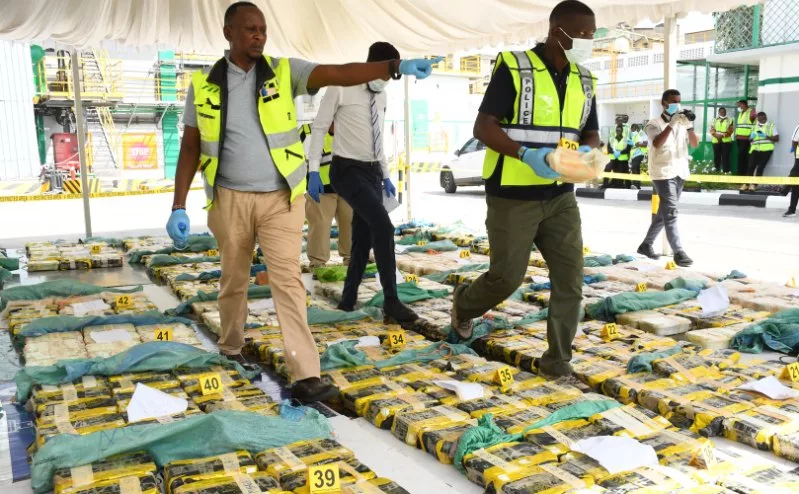 The Sh8.2 billion drugs haul that was destroyed at Bamburi Cement in Mombasa on Thursday / BRIAN OTIENO
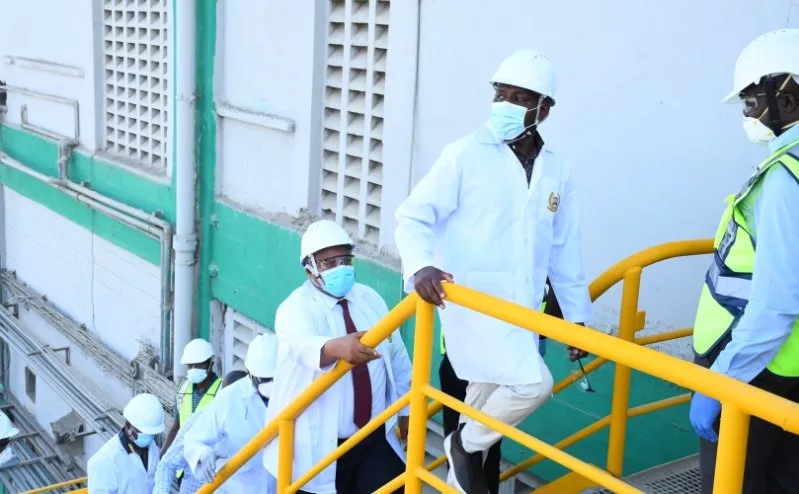 Interior CS Kipchumba Murkomen at Bamburi Cement company factory on Thursday / BRIAN OTIENO
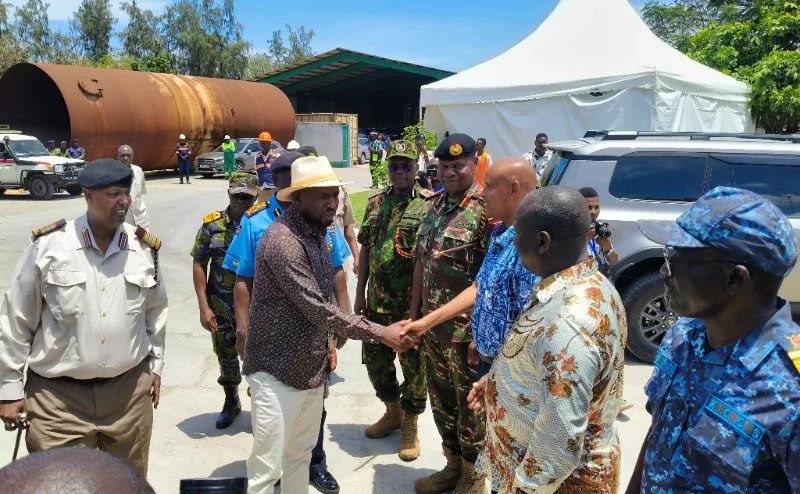 Interior CS Kipchumba Murkomen at Bamburi Cement company factory on Thursday / BRIAN OTIENO
Around 2014, when Kenya was struggling to contain heightened acts of terrorism, there was a bitter clash among security chiefs over responsibility.
It happened during a security meeting attended by then President Uhuru Kenyatta, and his then deputy William Ruto, security chiefs and, as Murkomen recalled, then Senator Kipchumba Murkomen.
“Security chiefs were quarrelling among themselves over who should go first, who should provide which equipment and who should do what,” Interior CS Kipchumba Murkomen revealed on Thursday.
“The president was very decisive then and I think since then our country's security chiefs have fashioned and perfected the multi-agency approach to security operations.”
He spoke at the Bamburi Cement factory shortly before witnessing the destruction of 1,036kg of methamphetamine worth about Sh8.2 billion.
The drugs had been seized in the Indian Ocean high seas in October last year.
Bamburi Cement was used to destroy the methamphetamine haul because its industrial kilns provide extremely high temperatures capable of completely incinerating and neutralising hazardous narcotics safely.
The factory's kilns operate at extreme heat, ensuring the complete destruction of the chemical compounds in the illegal drugs without leaving harmful residue.
The haul formed part of the evidence in a case at the Shanzu Law Courts in Mombasa involving six Iranian suspects charged with drug trafficking.
Murkomen said the successful seizure, which represents a major victory in the war on drugs, was not the result of one agency outperforming another.
“It is because of teamwork,” Murkomen said.
He said the operation succeeded because the Kenya Navy intercepted the vessel deep in the Indian Ocean, while international partners monitored its movement. The Directorate of Criminal Investigations, the National Police Service and the Judiciary also played key roles.
He singled out the Judiciary, particularly Shanzu Law Courts Chief Magistrate Antony Mwicigi, for being steadfast and cooperative in the fight against drugs.
“In the past, we have had judges and magistrates who frustrated these efforts when we were dealing with such crimes. We are successful as a country when we work together as a team. We will do more if we do not care who takes the credit,” the Interior CS said.
However, Mwicigi stressed that destroying narcotic drugs is an evidentiary and judicial process.
“It is not and must never be understood to be a determination of the guilt of the accused persons. The accused persons remain entitled to the full protection of the law and the presumption of innocence until the evidence is analysed and determined accordingly,” Mwicigi said.
He said the case involving the destroyed drugs was unique because many protocols had been broken.
“Today, I was out of my house at 4am to go to the Kenya Navy and have the process begin. My colleagues who are here woke up at 3am,” Mwicigi said on Thursday.
He said the exercise should serve as a model for future cases because the law allows the destruction of drug exhibits once they have been properly documented and processed.
“In future, do not be afraid. As long as the process has gone through, first things first. If you have a large consignment like that one, destroy it, then deal with the other consequences later,” Mwicigi advised judicial officers.
Murkomen said the country is safer today because security agencies have accepted that, under one Commander-in-Chief, they must work together as a team.
He said no single institution can dismantle crime that moves across borders, financial systems, factories, villages and online platforms.
“Working together is therefore not a courtesy, but our chosen tactic,” he said.
Murkomen said the government had adopted a no-nonsense and ruthless approach to tackling drugs because of the harm narcotics have caused Kenyans.
One in six Kenyans aged between 15 and 65, representing more than 4.7 million people, use at least one drug or substance of abuse, according to data from the National Authority for the Campaign Against Alcohol and Drug Abuse (Nacada). The Coast region is among the hardest hit.
Mombasa county recorded the highest prevalence rate in the country at 34.4 per cent.
Under the government's tougher approach, Murkomen said traffickers and drug barons will increasingly face the consequences of their crimes.
All assets used in or acquired through drug trafficking and the illicit alcohol trade will be treated as proceeds of crime, promptly frozen and forfeited to the state.
Murkomen said there would be no safe space for the manufacture, trafficking, distribution or sale of illicit drugs and illicit alcohol in the country.
He said President William Ruto had directed that forfeited assets be redirected towards rehabilitation, prevention and treatment programmes.
“We are not just taking drugs off the streets. We are taking the profits out of the pockets of criminals and putting them to work for the benefit of the very communities they have harmed,” Murkomen said.
He warned that any government official found colluding with drug traffickers or illicit alcohol networks would be dismissed from service and prosecuted to the full extent of the law.
“There will be no sacred cows,” he said.
“Our objective is to see fewer drugs entering our communities, fewer young people exposed to them and fewer criminal networks able to profit from them.
“That requires sustained political will, disciplined enforcement, credible rehabilitation and the cooperation of the public,” Murkomen said.
To complement enforcement with prevention, treatment and rehabilitation, Murkomen said the government had launched the first National Policy for the Prevention, Management and Control of Alcohol, Drugs and Substance Abuse.
A nationwide assessment of 266 rehabilitation facilities has been completed, with 164 facilities accredited.
Eleven counties have confirmed their willingness to establish rehabilitation centres.
A workplace policy on substance abuse is also being finalised.
To strengthen the fight against drug trafficking, the government has transformed the Anti-Narcotics Unit into the National Anti-Narcotics Investigations Bureau.
The number of specialised officers has increased from 200 to 405, while the government is procuring 20 vehicles to strengthen operations.
The bureau has been elevated into a standalone formation and is being equipped for intelligence, surveillance, forensic and financial investigations.
US Drug Enforcement Administration Country Attaché Karl Ash said Kenya's efforts to combat drug trafficking have the full support of the United States.
Ash said the destruction of the Sh8.2 billion methamphetamine haul signified the professionalism, cooperation and determination of officers, investigators, analysts and partner agencies who worked together to complete the operation.
“Criminal organisations operate across borders and our response must be equally coordinated,” Ash said.
He said the seizure of more than a tonne of methamphetamine in October 2025 demonstrated what can be achieved when partner agencies share information, expertise and commitment to public service across Kenya, East Africa and the wider world.
The United Nations Office on Drugs and Crime (UNODC) said the challenge of transnational organised crime at sea is becoming increasingly complex and requires greater collaboration.
The agency said addressing the global drug problem does not end with seizing drugs or making arrests.
“The true test of our international frameworks lies in ensuring accountability through transparent and watertight legal processes,” UNODC said.
The agency added that a stronger and well-supported criminal justice system is essential in the fight against drugs.