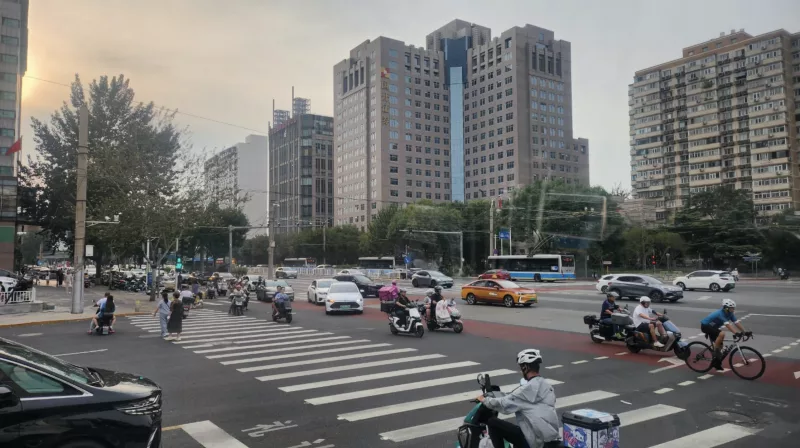
 Moving traffic in Beijing./Nancy Agutu
When I first arrived in China, the traffic was flowing. The street lights were working, and the passengers, drivers, and cyclists were all following a natural order.
That was my first surprise. I had expected chaos, horns, a solid wall of cars, just like Nairobi, where matatus and motorists are all over and do not always follow traffic lights.
Instead, from the window of our coach in Beijing, I saw something that looked choreographed. Private cars moved in wide, orderly lanes. We admired the different types of vehicles, and at one point we were looking to see a 'Probox', because almost all the vehicles were high-end types.
But that was not the end because we looked for matatus and PSVs, but what we saw were clean, well-ordered buses, at least from outside.
And on the right, separated by a low white fence, was another river entirely: bicycles and cyclists. Hundreds of them. Blue ones, yellow ones, green ones, all gliding silently. The bicycles were being ridden by everyone; old men in suits, young girls in uniforms, delivery riders with boxes stacked high.
“This is so smooth. ‘Yaani’ all these people are waiting for the traffic lights. If this was CBD, things would be totally different,” I whispered to my colleague.
My colleague Millicent Rose was sitting next to me, her phone camera already open. She loves to take pictures of things, even though her phone has no clear images.
“Wacha nipige picha. I will one day show my children,” she said as she clack-clacked and smiled as she did so.
THE FACE OF TRAFFIC CONTROL
It was then, in a mild jam near the Third Ring Road, that we saw her. In the lane to our left, a woman in a small mint sedan was busy wiping her dashboard next to the driver's seat.
Traffic was crawling, and she was cleaning her car with a small yellow cloth; she was wiping the dust off her dashboard, then her steering.
“Why is she cleaning her car while driving? It's like she has not driven it for a while,” Millicent Rose remarked, leaning forward to look keenly.
The car was truly dusty. Not dirty from the road, but dusty like a bookshelf that has not been touched. A fine, even grey film over the whole body. In a city where people wash their cars almost every day, it stood out.
“Maybe she was away and left her car unattended,” I told her. “Maybe she just came back from a trip.”
The woman did not seem rushed. She wiped carefully, as if she had time. After about three minutes, the traffic light ahead turned and the jam opened up before she tossed the cloth onto the passenger seat and left with surprising speed, the dust puffing off her trunk as she accelerated.
We were left behind, still not understanding why her vehicle was so dusty, but we just brushed it off.
Days later, on our way to the Great Wall of China, we met our guide Tom for a city orientation. Tom is a Beijinger, in his early forties, with perfect English and a habit of answering a question with a whole system.
I told him about the woman and Tom just smiled instantly.
“Ah, you saw a 'resting car'. Congratulations. You saw our traffic control in real time,” he said as he asked us to sit down and then began to explain how it really works.
“Look, Beijing has over six million private cars,” he said. “Six million. If we all drive every day, Beijing will die. No one will move. So we had to be clever.”
He explained what we had been seeing without knowing.
“We use the number plate rule. It is called tail number restriction. Those with odd numbers in their number plate drive on a certain day, and those with even numbers also do the same.”
Tom explained that the system meant that not every private car could use the restricted roads every day, with particular licence-plate numbers restricted on particular weekdays.
“For example, on Monday, plates ending with 1 and 6 cannot drive within the city. Tuesday, 2 and 7 cannot drive, and so on. Every day we stop 20 per cent of cars. Almost 20 per cent of vehicles are parked at home.”
I remembered the dusty car.
“Exactly,” Tom said, pointing at me. “That woman's car was not abandoned. It was resting.” My colleague and I laughed.
“Sometimes the car stays at home and you cannot use it in the restricted area. So you have to use the subway, the bus or the bicycle.”
Then Tom added something I had not expected. “But this is not the only way we control cars.”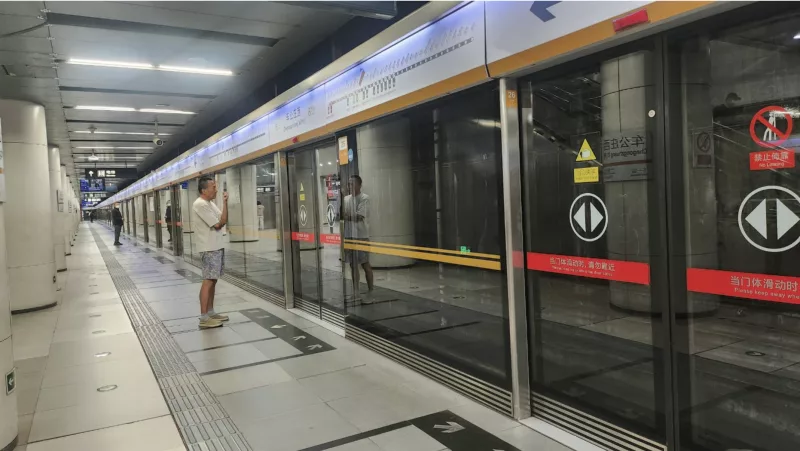 The subway./Nancy Agutu
LOTTERY SYSTEM
He knelt on the Coach seat and leaned forward before he explained how Beijing has another way to control traffic.
“Before you can even drive your car, you need the plate. For normal private cars, you cannot just buy the car and say, ‘I want a Beijing plate.’ You apply for the plate, and there is a lottery.”
I looked at him, still in disbelief
“A lottery?” A keen colleague, Wuod Rusinga, remarked.
“Yes. A lottery. Some too many people want cars, so we cannot give everybody a plate.” That was perhaps the strangest thing we had heard so far.
In Nairobi, if you can afford to buy a car and meet the registration requirements, there is no city lottery that determines whether you are allowed to register an ordinary private passenger vehicle.
But in Beijing, the number of ordinary passenger cars that can be added to the city's system is limited, and eligible applicants compete through a quota-allocation process.
The ordinary-car lottery is conducted twice a year, meaning that for some people, buying a car and getting permission to register it under the city's quota system are two different things.
“So you control the number of cars before they come onto the road?” Another Colleague asked.
“Yes,” Tom said. “Because if we don't control, everybody will buy a car. Then everybody will drive. Then we have traffic.”
It was such a simple explanation, but it changed the way I was looking at everything.
The restriction was not only about stopping cars from driving on a particular day. Beijing was also controlling how many ordinary private cars could be added to the system in the first place.
Tom went back to the number-plate restriction.
“So, if you have a car and your number is restricted today, you don't drive in the restricted area. You leave it at home. If you need to go somewhere, you take the subway or bus.”
That was when the dusty car finally began to make sense. We could not know whether the woman had actually left the car sitting for several days, but the explanation gave us a new way of understanding why a car could be so dusty, and its owner could still be casually wiping it down while waiting for the lights.
Another colleague, Ken Kibs, seated in front of me, asked what happens if you break the vehicle rule. Tom became more serious.
“If you are found contravening these laws, you are warned first by the cameras. Our cameras see your plate automatically. Then you are given a ticket to pay 300 yuan (Sh5500), and you must pay within a few hours through your phone,” he said.
“The system is very fast. But we are also human. If you had an emergency, you show evidence, a hospital paper, a police note, and you are let go. The point is not to punish; the point is to keep flow.”
Tom then looked out of the window at the street below. A subway entrance dubbed Erligou station was swallowing crowds of people.
“And that is why we have almost 30 subways in Beijing,” he continued. “Twenty-nine lines now, more than 800 kilometres. So that the people can use it for transport. We cannot build more roads, so we build down.”
He was making another point that we had not immediately connected to the dusty car or the number plates. If you tell people to leave their cars at home, you have to give them another way of getting around.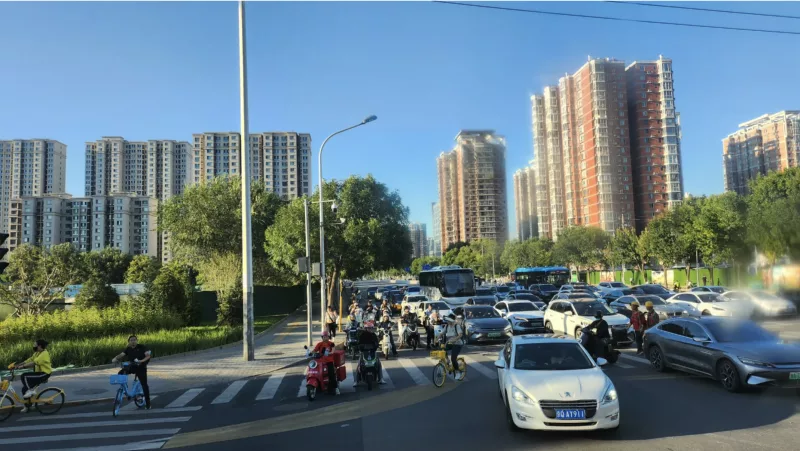 Traffic in Beijing/ Nancy Agutu
"Otherwise, you have not solved the traffic problem. But we also we have shared transport,” Tom said.
This was his favourite part.
He took out his phone, trying to explain how the bikes were working.
“Use your WeChat and apps and scan the QR codes of bicycles and use it. One hour is 1 yuan to 2 yuan. (Sh20-50) It is beneficial for the people. We call it the sharing economy: bicycles and electric cars.”
“They are around metro stations and very convenient for local people. You get off the metro, scan, ride to your office or home. You don't need to own.”
The bicycles we had watched from the coach suddenly made more sense.
You could take a train for the longer journey and then pick up a shared bicycle for the final stretch. You did not need to own a bicycle, carry it around or find somewhere to keep it.
“A lot of the teenagers use their parents' cellphone to scan the code,” Tom said. “The parents pay.”
He was smiling as he explained it, clearly pleased by the convenience of the system.
“So the bicycle is there when you need it, and you leave it when you finish?” Another question from the Kenyan delegation echoed the Coach.
“Yes,” he said. “Very convenient.”
He then moved on to electric bikes and the way the city was trying to manage them.
“We cannot issue too many private electric bikes,” he explained. “The shared ones are safer and managed.”
Whether every aspect of the system works exactly as neatly as Tom described it is another question, but his explanation helped us understand what we had been seeing from the road: transport in Beijing is not built around one solution.
It is a combination of restrictions and alternatives.
What Tom described finally made sense when I understood the numbers behind it.
China today has about 1.4 billion people, about 17 per cent of the world's population with Beijing alone having more than 20 million people.
That one city has almost as many people as the whole Nairobi metropolitan area multiplied several times.
Compare that with Kenya. Kenya has about 58 million people, while Nairobi is a much smaller city by population.
The numbers are not the only difference, but they help explain why transport planning becomes such a serious issue in Beijing.
In Kenya, with a much smaller population, our transport system has grown around a different set of realities.
We have matatus, boda bodas, buses, private cars, walking and an increasing number of app-based transport services. The system is flexible, loud and human.