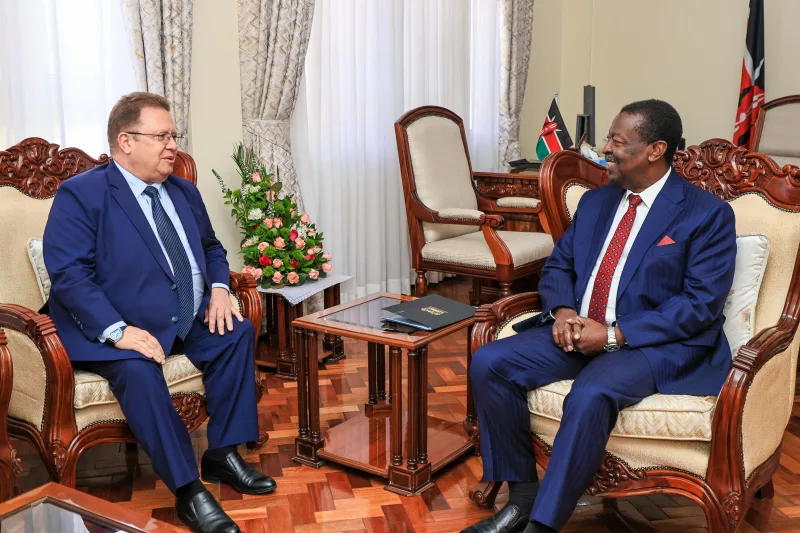
 The Partnering in Business with Germany Programme, run by GIZ on behalf of the German government, helps export-ready companies build long-term business partnerships with German firms. /HANDOUT
Twenty-one Kenyan exporters will travel to Germany next week to seek buyers and business partnerships as the country steps up efforts to expand its exports to Europe’s largest economy.
The exporters, drawn from the tea, coffee, avocado, herbs and spices, horticulture, agro-processing and crafts sectors, will spend three weeks in Mannheim from September 28 to October 16 under a market-linkage programme run by the Kenya Export Promotion and Branding Agency (KEPROBA) and German development agency GIZ.
The programme will involve business-to-business meetings, sector-based training and negotiations on potential cooperation agreements with German companies.
The initiative comes against a widening trade imbalance between Kenya and Germany, with Kenya’s exports to the European country standing at $164.8 million (Sh21.3 billion) in 2025 compared with imports of $405.4 million (Sh52.4 billion).
Kenyan exports to Germany have fluctuated over the past decade, ranging from $110.2 million (Sh14.3 billion) in 2018 to the 2025 high.
Coffee was the largest Kenyan export to Germany last year, earning $51.6 million (Sh6.7 billion), or 31.3 per cent of total exports to the market.
The new programme seeks to help Kenyan firms secure direct commercial relationships with German businesses rather than relying mainly on traditional commodity exports.
Principal Secretary for Industry Juma Mukhwana said exporters would need to adapt their products and branding to the requirements of foreign consumers.
“You can have a good product, but does the market know its value? You need to take that product to the market,” said Mukhwana.
He urged companies to understand the culture and expectations of their target markets, including how products are branded and positioned.
The companies were selected from 102 applicants, with 40 initially shortlisted before GIZ made the final selection.
The programme is being implemented under the Partnering in Business with Germany initiative, which is backed by Germany's Federal Ministry for Economic Affairs and Energy and delivered through AHP International and the German Business Development Centre.
KEPROBA chief executive Floice Mukabana said the programme would give exporters direct exposure to German buyers and market requirements.
“Germany presents significant opportunities for Kenyan products, and our role as KEPROBA is to ensure that exporters are equipped with the market intelligence, standards, skills and business linkages they need to compete effectively in international markets,” she said.
The exporters will enter the German market at a time when Kenya already enjoys duty-free and quota-free access to the European Union under the Kenya-EU Economic Partnership Agreement.
However, access to the market does not automatically translate into sales, making buyer connections, compliance with standards and product positioning critical for exporters.
Germany has remained an important trading partner for Kenya, although the trade balance has consistently favoured German exports.
In 2025, Kenyan firms bought goods worth $405.4 million (Sh52 billion) from Germany, more than twice the value of exports to the market.
The government is seeking to increase foreign exchange earnings by expanding exports and encouraging companies to move into value addition and higher-value products.
The German programme is expected to track outcomes from the business meetings, including cooperation agreements, repeat orders and export revenues generated by participating firms.
The initiative also reflects a broader push by Kenyan trade agencies to convert existing market access arrangements into actual commercial opportunities for local manufacturers, farmers and exporters.