
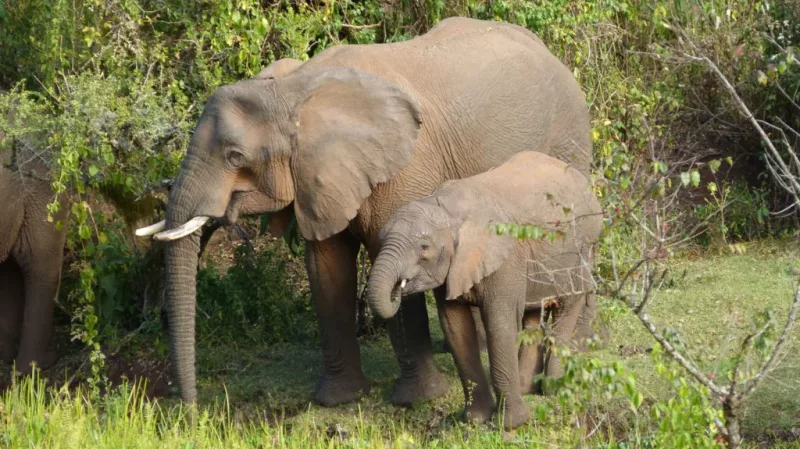
 Accounts from local experts revealed that wild elephants used more than 35 plants, many of which have known medicinal uses
New research suggests elephants living on Mount Elgon may use plants as medicine when they are sick.
The elephants, known for entering caves to mine mineral-rich rock, have been reported to select certain plants when they appear unwell.
Researchers also found reports of mother elephants giving plant material to their young, raising the possibility that the animals may pass knowledge about medicinal plants from one generation to another.
However, scientists caution that the findings do not prove that the plants actually treat illnesses in elephants.
The study was based on detailed accounts from eight local Sabaot experts who have spent decades living and working around the elephants on Mount Elgon.
The researchers documented 35 plant species and four types of soil, minerals or clay that the experts reported elephants consuming.
Of the 35 plants, 34 were also known to have traditional medicinal uses among local people. The experts said elephants used 25 of the resources as medicine.
Eight plants provided the strongest evidence of possible medicinal use. In these cases, the local experts linked a particular plant to a specific health problem or described plant material being given to another elephant.
The researchers said some elephants were reported travelling long distances to particular trees without feeding along the way, apparently to eat their bark or leaves.
Dr Fabien Schultz, the study's lead author, said the findings showed a close link between the plants of Mount Elgon and the health of both people and elephants.
“Our results show how closely the plant life of Mount Elgon is linked to the health of both elephants and people. Reports that elephants use some of the same plants that local communities use in traditional medicine make protecting these habitats a One Health issue,” he said.
“In the coming years, together with our partners, we want to investigate whether and how these behaviours are learned or socially transmitted, and which plants and locations may be particularly important to protect.”
The researchers used local knowledge instead of directly disturbing elephants in the forest.
The eight experts included wildlife scouts, guides and local elders. They included a former Kenya Wildlife Service ranger and a retired agricultural officer. All had more than 20 years of experience living in the Mount Elgon area or observing its elephants.
Kennedy Ngityo Chemoywo, one of the Sabaot experts, said local people had observed the elephants for generations.
“Before there were roads, schools, or researchers on this mountain, our people were already learning from the forest. I am one of them. We have watched elephants since childhood. We know where they travel, how they behave and even the plants they choose when they are unwell,” he said.
“The forest speaks, and if you spend enough time in it, you learn how to listen. Scientists study nature, and we respect their work. We study nature by being part of it. When these two kinds of knowledge come together, both become stronger.”
Researchers then collected plant specimens and had them identified at the East African Herbarium in Nairobi. They also compared the plants with scientific studies on their possible medicinal properties.
Of the 10 plants most frequently mentioned by the eight experts, nine had previously been reported in scientific literature as having some pharmacological activity.
The researchers also recorded five cases in which local experts said elephants used plant resources for their young.
These reports included mothers providing plant material to calves. The researchers describe this as possible “allo-medication”, where one animal may provide a medicinal resource to another.
But the scientists stressed that these observations came from interviews and were not directly observed and experimentally tested by the research team.
The study therefore describes the behaviour as “putative self-medication”, meaning it is possible but has not been proven.
The research also considered the famous cave-mining behaviour of Mount Elgon elephants. The elephants enter caves, sometimes as far as 160 metres underground, and use their tusks to remove mineral-rich material from cave walls.
However, the researchers did not classify this behaviour as medicinal use. The study says the clay and mineral consumption was considered mainly in relation to mineral intake and was not established as self-medication.
Christopher Powles, chair of the Mount Elgon Foundation and a co-author of the study, said the findings showed how much remains to be learned about the elephants.
“The longer we spend with Mount Elgon's remarkable elephants, the more we realise how much we still have to learn about them. This research gives us a fascinating glimpse into the complexity of their lives — and another reason to do all we can to protect both them and the extraordinary landscape on which they depend,” he said.
The research is published in the journal Scientific Reports under the title “African elephants putatively self-medicate with medicinal plants in the Mount Elgon region, Kenya.”
The researchers say the next step is to observe the behaviour directly and test the plants to establish whether they have medicinal effects.
Such work may also help scientists understand whether elephants deliberately select certain plants when they are unwell and whether knowledge about the plants is passed between elephants.
Mount Elgon’s elephants live in high-altitude forest along the Kenya-Uganda border. The population faces threats including habitat loss, poaching and conflict between people and elephants.
The researchers say protecting the forest is therefore important not only for elephants but also for the plants and knowledge shared by wildlife and local communities.