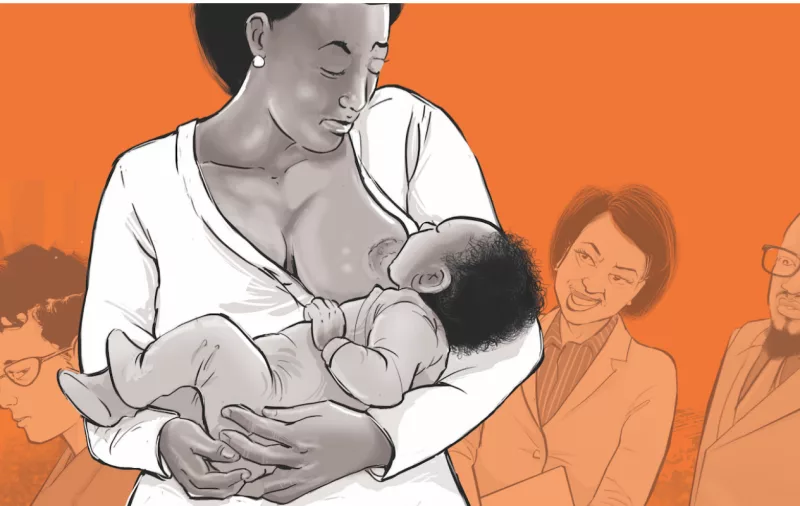
Kenyan mothers are happy to donate their extra breast milk to save another woman's baby. But ask them to let their own baby drink milk from a stranger and they will reject it straightaway.
Their main fear is the possibility of their babies contracting diseases such as HIV.
That is the main finding of a study done at Pumwani
Maternity Hospital in Nairobi, the only facility in Kenya with a human milk
bank.
It found that the mothers also have cultural discomfort with their baby taking a body fluid from a stranger.
Researchers from the University of Nairobi spoke to 21 pregnant women at the hospital's antenatal clinic in three group discussions. More than half (56 per cent) said they would gladly donate their own milk if they had more than their baby needed. They called it a good and noble thing to do.
But when the question was turned around, the mood changed. About a third refused outright to let their baby be fed donated milk. Most of the others said yes only under strict conditions such as if they were extremely sick, if they had no milk of their own, or if it was the advise of a doctor.
Human milk donated through the Pumwani milk bank is screened
and processed under safety and quality procedures before it is given to
vulnerable newborns.
“I think I would be very hesitant to allow my child to be fed with donated human milk. Maybe if I am very sick and cannot help it,” a mother said.
Another mother was more direct about her feelings.
“Personally, it is a no. Why would I allow my child to be offered breast milk from another woman? Honestly, I do not see that working with me,” she said.
A third mother said trust was the problem.
"For me, it would take a lot of persuasion to allow my child to be fed with breast milk from a human milk bank. It is hard to trust people, you know. So, I have my own reservations about it."
Part of the problem was that the idea is new. Over half the mothers had never heard of a woman donating milk for another baby. About two-thirds had never heard of the milk bank at all.
The word of a health worker was the one thing that tipped the balance again and again. Mothers said they would accept donated milk if a doctor or nurse advised them to.
Lead author Jane Wangui from the Department of Nursing Sciences at the University of Nairobi, said this shows nurses and doctors hold the key, and that teaching mothers about the milk bank during antenatal clinic visits could change attitudes.
“Understanding and addressing the barriers to using human milk banking (HMB) is crucial for the successful implementation of the programme, as its use is demand-driven,” the researchers said.
They said involving all key stakeholders, including healthcare workers, relatives, community health workers, and peers, is essential to promote acceptance and ensure community support.
“Health education initiatives, preferably embedded as part of Antenatal and Postnatal care, would be a starting point in achieving buy-in,” they said.
The co-authors are Mary Njue-Kamau, Fidel Omollo, and Lucy Kivuti-Bitok, all of UoN.
Donated milk mostly goes to premature, sick, abandoned and orphaned newborns. The milk is screened and treated before use, and the World Health Organization recommends it only when a mother's own milk is not available.
The study, titled 'Your baby can take my milk… but my baby won't take yours', was published in the International Breastfeeding Journal.
The researchers said the findings cannot represent all Kenyan mothers because the study involved women at only one hospital.
The Human Milk Bank at Pumwani was established in 2019 and has provided donated breast milk to 1,887 newborns as of August 31, 2025.
It supports premature and sick infants unable to breastfeed and has also extended its services to facilities such as Mbagathi County Referral Hospital and Mama Lucy Kibaki Hospital. Since inception, 2,598 mothers have donated to the bank.
Understanding and addressing the barriers to using human milk banking (HMB) is crucial for the successful implementation of the programme, as its use is demand-driven.
Involving all key stakeholders, including healthcare workers, relatives, community health workers, and peers, is essential to promoting acceptance and ensuring community support.