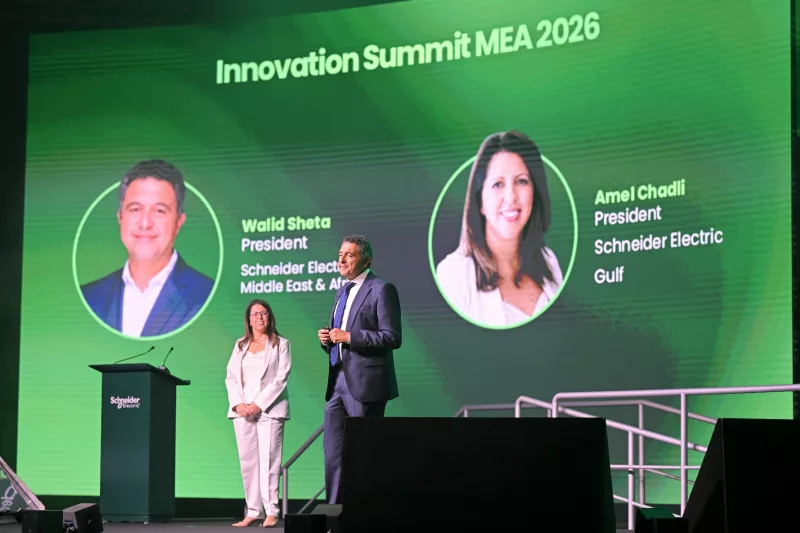
 Amel Chadli, President of Schneider Electric Gulf and Walid Sheta, President Schneider Electric Middle East and Africa, speak during the Abu Dhabi Summit./HANDOUT
UAE manufacturers are adopting industrial artificial intelligence (AI) faster than their global peers, according to a new study released during Schneider Electric’s Innovation Summit Middle East and Africa in Abu Dhabi.
The two-day summit brought together more than 2,500 energy professionals, government leaders, industry analysts, customers, partners, students and media to examine how energy, AI and industrial software are reshaping the region’s future.
Schneider Electric launched its 2026 Industrial AI in CPG Study: UAE during the summit. The study focused on food and beverage manufacturers and highlighted growing confidence in the use of AI across the UAE’s industrial sector.
According to the study, 23 per cent of UAE manufacturers already consider AI a core part of their operations, compared with 16.3 per cent globally.
The report also found that 59 per cent of UAE manufacturers expect AI to have a transformational impact on their organisations by 2030. Globally, 42.2 per cent of manufacturers share the same expectation.
However, cybersecurity is emerging as a major concern as AI adoption expands, with 38 per cent of respondents identifying it as a top priority.
“Industrial AI is moving from experimentation to deployment,” said Walid Sheta, President for MEA Zone at Schneider Electric.
“What distinguishes the UAE is not only the pace of adoption, but the confidence manufacturers have in AI's ability to improve productivity, efficiency and resilience,” Sheta said.
He said the next challenge would be ensuring that AI deployments are secure, scalable and capable of delivering measurable business outcomes.
The summit was held under the theme “Advancing Energy Tech to Power Intelligence and Resilience”. Discussions focused on the shift from simply decarbonising energy supply to developing intelligent, connected and resilient systems capable of supporting AI-driven economic growth.
Schneider Electric CEO Olivier Blum said AI was increasingly becoming part of the physical economy and would require reliable energy and physical infrastructure.
“We are entering an Era of Intelligence in which AI is becoming embedded in the physical economy. AI may be digital, but it runs on electricity and depends on the physical systems beneath it,” Blum said.
The summit examined four major areas: AI-powered energy and industrial operations, grid modernisation and electrification, data centres as critical infrastructure, and cybersecurity as a foundation for digital resilience.
Speakers also explored how AI can improve operational efficiency, strengthen industrial performance, optimise energy use and support the expansion of digital infrastructure across the Middle East and Africa.
Alongside the summit, the UAE Ministry of Economy and Tourism and Schneider Electric signed an agreement to launch the NEST Accelerator Programme.
The 12-week programme will target high-potential early-stage startups in the Middle East and Africa working in Energy Tech, Industrial Tech and Enterprise AI.
The event also featured a newly unveiled 3,000-square-metre Innovation Hub showcasing technologies covering infrastructure design, construction, operation and maintenance.
Schneider Electric said the summit reaffirmed its commitment to working with governments, customers and partners to accelerate intelligent, resilient and sustainable infrastructure across the Middle East and Africa.