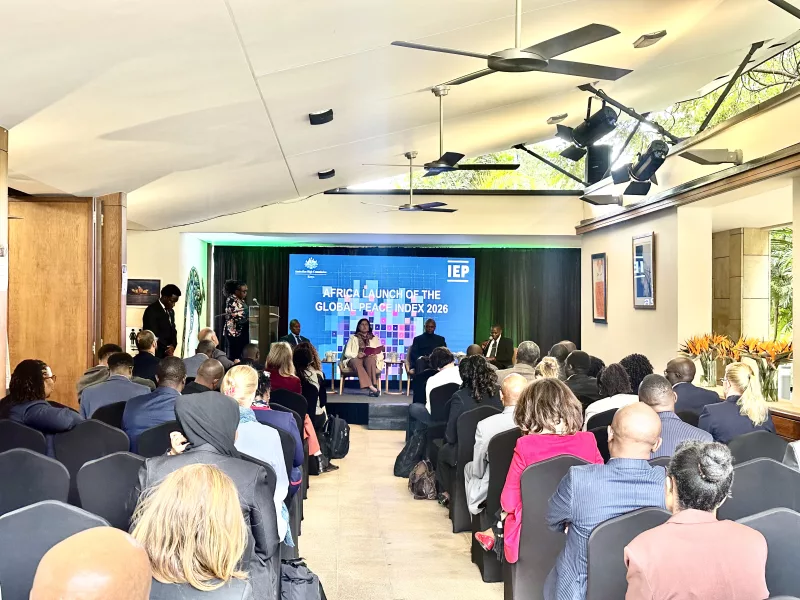
 A panel discussing at the Africa launch of the Global Peace Index 2026 at the Australia High Commission in Nairobi. on September 17, 2026
National Security adviser Joseph Boinnet has reassured Kenyans the country has sufficient institutional safeguards to withstand political shocks as it heads towards the 2027 general election.
Boinnet said Kenya's security and governance institutions had been built over decades and had acquired experience from previous political transitions, including the 2007-08 post-election crisis.
He was speaking at the Africa launch of the Global Peace Index 2026 at the Australia High Commission in Nairobi.
Responding to a question on whether Kenya has sufficient “shock absorbers” to withstand what could be a turbulent electoral period, Boinnet said, “I want to assure that we not only have shock absorbers, but we have a complete car”.
The adviser said Kenya's institutions had been developed over time and had also benefited from lessons learnt from previous crises.
“Succeeding administrations have built on these institutions over time, and along the way we have also learned our lessons,” he said during a panel discussion on peace and security in the region.
Boinnet said Kenya's political system had demonstrated an ability to manage transitions despite the challenges that accompany competitive politics.
“I know a lot of people are cynical about what will happen next year. I don't blame them, the situation is quite interesting right now politically, especially with the conduct of politicians. Today they are on this side, the next day they are on other camp” he said. “And our politics can be a bit noisy”.
His remarks come against growing warnings over political violence, the emergence of organised groups at political rallies and concerns about whether the country is adequately prepared to prevent the escalation of election-related tensions.
Top diplomats in Kenya have previously warned that recurrent violence during by-elections, disruption of opposition rallies and involvement of hired goons could become an early indicator of wider instability as the country approaches the election.
Envoys have particularly expressed concerns deteriorating political environment was creating uncertainty for their missions, businesses and expatriates.
“We would want to have some predictability for our businesses and our citizens working here. Unfortunately, that's not the case,” one diplomat said.
Diplomats have also questioned the “clear facilitation” of goons by politicians allied to the government and the apparent reluctance of security agencies to decisively address the problem.
The government has denied opposition allegations that it uses hired gangs to disrupt political rallies.
The concerns have since been reinforced by the Kofi Annan Foundation's Electoral Vulnerability Index.
The Foundation's 2026-27 analysis identifies Kenya among countries requiring particular attention ahead of the next electoral cycle.
Its Kenya assessment gives the country an EVI risk score of 45.4, while separate modelling cited in the foundation's assessment estimates an 84.1 per cent probability of some form of election-related violence.
The foundation identifies the Independent Electoral and Boundaries Commission, National Police Service and Judiciary as among the institutions that will be critical in preventing a repeat of previous electoral crises.
It says confidence in the IEBC will depend partly on transparency around election technology, while the handling of demonstrations and respect for human rights by security agencies will influence the peaceful conduct of the elections. The Judiciary remains an important avenue for resolving electoral disputes.
The warnings have been particularly sharp around the re-emergence of “goonism” in rallies.
Human Rights Watch said in September that unidentified armed groups had attacked civil society and opposition gatherings in several parts of Kenya ahead of the 2027 election, with the organisation reporting at least six deaths and dozens of injuries. It called for prompt and transparent investigations and accountability.
The opposition has also raised the alarm, accusing the government of failing to prevent political intimidation and calling for international scrutiny of the situation.
In August, opposition leaders urged the international community and the International Criminal Court to closely monitor developments in Kenya and undertake a preliminary assessment of whether information existed that could warrant action under the Rome Statute.
The opposition has pointed to attacks and disruptions involving opposition politicians and rallies, arguing the incidents should not be treated as isolated confrontations.
The government has rejected allegations that it is responsible for organised political violence.