Principals of some of the country’s prestigious schools have been put on the spot over extra levies charged on students and payments made without clear government approval.
The school heads are being grilled for the first time by Parliament, bringing every financial decision made by schools under close scrutiny.
For the third day running, MPs demanded to know why the principals were collecting additional money from parents without approvals by the ministry.
Principals are required to seek authorisation from the Ministry of Education on any extra levies.
The Ministry then issues a circular on how the same should be handled.
The Public Investments Committee on Governance and Education warned the principals they risk being surcharged if auditors establish that public money was spent without the required authority.
The move could leave the principals personally liable for unauthorised levies.
On Thursday, principals from top national schools were grilled.
They included Kenya High School principal Edith Koech, Mang’u's Benard King’ah, Limuru Girls principal Susan Kariuki and Alliance High School principal David Kamau.
MPs examined remedial levies, Kenya Secondary School Heads Association (Kessha) subscriptions, variances in student numbers, excess textbooks and unregistered school land.
Koech told MPs that some charges were introduced after parents requested special services for their children.
“There are times when parents themselves ask that we include the charges in our budget. Some are for special meals which if we remove the students can burn the school,” she said.
King’ah said the government allocation was insufficient to feed students and support the Competency-Based Education curriculum.
“As a school, we may not be able to survive the entire year with the Sh53,000,” the Mang'u principal said. He cited enhanced meals for the students.
Limuru Girls principal Susan Kariuki said parents agreed to pay an additional amount on grounds that the government allocation was inadequate. However, no ministry authorisation was given.
“The Sh53,000 we receive from the ministry is not enough to
service the workforce, diet for the students, pay BOM teachers, water and electricity bills,” Kariuki said.
She said parents met and agreed on the additional amount and the same is endorsed by the school’s Board of Management.
Alliance High School principal David Kamau said parents themselves proposed additional contributions to “sustain the standards expected of the institution”.
But the explanations did little to settle MPs, who questioned what happens to pupils whose parents cannot afford the additional payments.
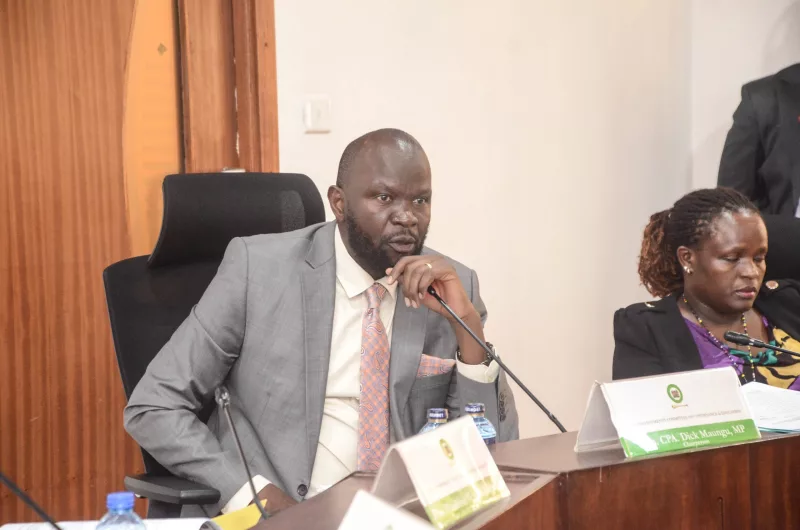
“Why are parents forcing principals to charge extra levies ending up breaking the law?” committee chairman Dick Maungu asked.
The hearings have also raised questions about how schools have been allowed to charge the extra levies for years without clear approval from the ministry.
Auditor-General Nancy Gathungu has flagged the payments in audit reports covering the 2020-21 to 2024-25 financial years.
Limuru Girls High School was flagged for charging Sh73,580 per student annually against the approved Sh53,580.
Mang’u High School charged Sh46,082 per student under its Parent Association Support Programme without approval.
At Alliance High School, parents agreed to contribute Sh26,000 towards the school budget, but the school had not obtained the required approval to implement the additional charge.
MPs maintained that schools must follow the law regardless of the justifications fronted by some of the principals.
Education Cabinet Secretary Julius Ogamba and ministry officials are expected to appear before the committee to respond to the concerns raised by the school heads.
School heads have also previously been brought under the microscope for compelling parents to buy uniforms from schools.
The issue of Kessha subscriptions also featured, with principals defending the payments as necessary to fund co-curricular activities.
Nairobi School principal Casper Maina told MPs that schools contribute money to Kessha to support sports, drama, music and other activities.
“We are supposed to pay for co-curricular activities. We pay Sh500 at sub-county level and Sh200 for regional level. We can have a problem if we don’t contribute,” Maina said.
But MPs wanted to know where the authority to make the payments came from.
“Without a circular the transfers are illegal,” Maungu said.
Maina acknowledged that there was no circular authorising the payments.
“We have no circular. All principals contribute to the kitty,” he said.
The admission immediately raised questions over the legality of the payments, with MPs warning that principals could face personal financial liability if the transfers were found to have been unauthorised.
Igembe Central MP Moses Kirema cautioned the principals that they could not rely on established practice to shield themselves from accountability.
“At the end of the day, you may find that despite the way you put it, and justify Kessha issues, it will not be surprising that principals will be surcharged,” Kirema said.
Lungalunga MP Chiforomodo Munga questioned why public schools were transferring money to organisations whose legal status and authority to receive public funds remained unclear.
“What is the interest in transferring this money to entities which are not recognised by law?” Munga asked.
The MPs questioned why schools could not budget directly for co-curricular activities instead of sending money to Kessha.
The principals have argued that failure to make the contributions could lock students out of regional and national competitions.
But MPs insisted that the benefits of an expenditure did not remove the need for legal authority.
The committee is also probing discrepancies between student enrolment figures kept by schools and those recorded in the National Education Management Information System (NEMIS).
The MPs want principals to explain the differences, particularly because student numbers determine the level of government support received by schools.
Textbook management has also come under scrutiny, with the committee questioning why some institutions have excess books in certain subjects while others have shortages.
It emerged that some schools have thousands of outdated textbooks lying unused, raising questions about procurement and distribution of learning materials.
The committee has also turned its attention to school land, particularly institutions operating without title deeds.
Maungu said schools were vulnerable to encroachment where ownership documents were missing and questioned why managers had not dealt with squatters occupying school land.
Cases involving schools linked to faith-based organisations were also raised, with MPs seeking clarity on ownership and the status of properties on which some institutions operate.
The committee wants school managers and relevant government agencies to clarify ownership and secure the properties.
Yesterday, principals of Kenya High School, Pangani Girls Senior School, Lenana School, Starehe Boys’ Centre and School, Starehe Girls’ Centre and Nairobi School appeared before the committee.
They followed heads of Loreto High School Limuru, Alliance High School, Alliance Girls’ High School, Mang’u High School, Limuru Girls’ School and Kiambu High School, who appeared before the committee the previous day.
On Monday, the committee had summoned principals of Murang’a High School, Kagumo High School, Bishop Gatimu Ngandu Girls High School, Our Lady Consolata Mugoiri Girls High School, Kabare Girls High School and Baricho Boys High School.
The committee has been scrutinising Auditor General Nancy Gathungu’s reports on national schools, bringing principals directly before Parliament to respond to audit queries contained in the reports.
Maungu said the committee would continue following up the queries and summon Ministry of Education officials where principals’ explanations require further clarification.