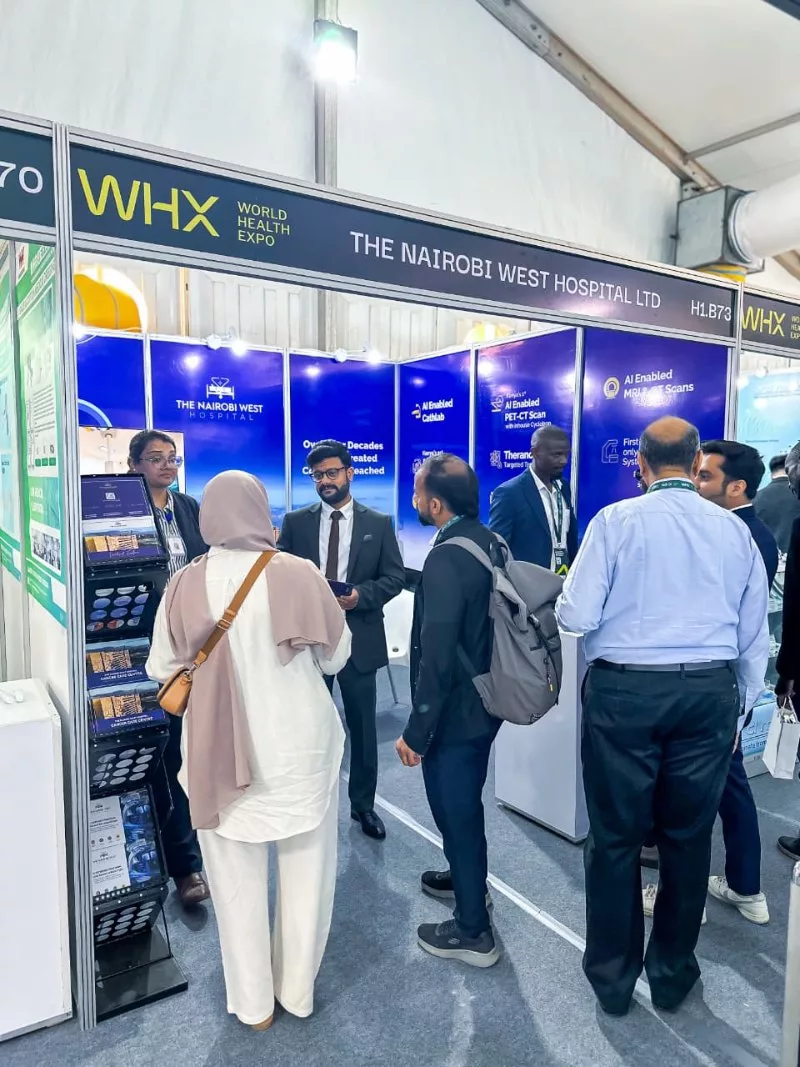
 The Nairobi West Hospital Medical Superintendent Prakash Saini
For three days this week, Nairobi has become a meeting point for the people shaping the future of healthcare in Africa.
The World Health Expo (WHX) Nairobi, formerly known as Medic East Africa, opened at the Kenyatta International Convention Centre on Wednesday, bringing together healthcare professionals, technology companies, manufacturers, suppliers, policymakers and investors from Kenya and beyond.
The 2026 edition is expected to attract more than 5,500 visitors and 250 exhibitors from more than 30 countries.
The exhibition covers areas ranging from medical devices and laboratory technology to imaging, diagnostics, digital health, orthopaedics and hospital infrastructure. But beyond the equipment on display, the expo comes at an important moment for African healthcare.
Kenya is trying to expand access to specialised services while reducing the cost and inconvenience associated with seeking treatment abroad. At the same time, hospitals face persistent challenges around equipment maintenance, skills, financing, supply chains and access to modern diagnostic technology.
These were among the issues raised at the opening of the expo, with the Ministry of Health calling for partnerships that go beyond selling equipment to include maintenance, technical training and technology transfer.
The participation of Kenyan hospitals therefore offers an opportunity to examine how medical innovation is translating into actual patient care.
Among the institutions exhibiting at the event is The Nairobi West Hospital, a Level 6B facility that has increasingly invested in highly specialised services.
Some of its developments illustrate the gradual expansion of complex care within Kenya. In 2022, the hospital established a dedicated bone marrow transplant unit, becoming the first Kenyan facility to offer the procedure locally.
The significance of such capacity is perhaps best understood from the patient's perspective. In July, a 57-year-old Kenyan with multiple myeloma shared his experience after undergoing a bone marrow transplant at the hospital in December 2025, having initially belieed treatment required travelling abroad.
Specialised care is also increasingly being supported by advances in diagnosis. The hospital has invested in PET/CT imaging and nuclear medicine, including a cyclotron capable of producing radioisotopes used in cancer diagnosis and treatment.
The equipment forms part of a broader push to strengthen molecular imaging and reduce dependence on overseas medical referrals. Cardiology provides another example.
Kenyan specialists have increasingly adopted minimally invasive interventions, including transcatheter aortic valve implantation and renal denervation for selected patients with resistant hypertension.
Meanwhile, collaboration between facilities is becoming increasingly important. In western Kenya, The Nairobi West Hospital has worked with Jaramogi Oginga Odinga Teaching and Referral Hospital on red blood cell exchange therapy for patients with sickle cell disease, with specialists supporting the development of local capacity.
Such partnerships point to a healthcare model that is less dependent on individual institutions working in isolation. The wider regional picture makes this particularly relevant.
WHX organisers say the 2025 Nairobi edition recorded 5,601 unique attendees and 188 exhibitors, generating an estimated $84.19 million in business opportunities.
This year's larger gathering reflects growing interest in East Africa as a healthcare market and distribution hub. For patients, however, the real test of this growth will not be the number of exhibitors or sophisticated machines unveiled at an expo.
It will be whether innovation translates into earlier diagnosis, safer procedures, better treatment outcomes and fewer journeys abroad for services that can be delivered locally.
That is where the conversation around WHX Nairobi ultimately belongs, not only in the exhibition halls, but in the ability of Kenya's health system to turn technology, expertise and partnerships into accessible care.