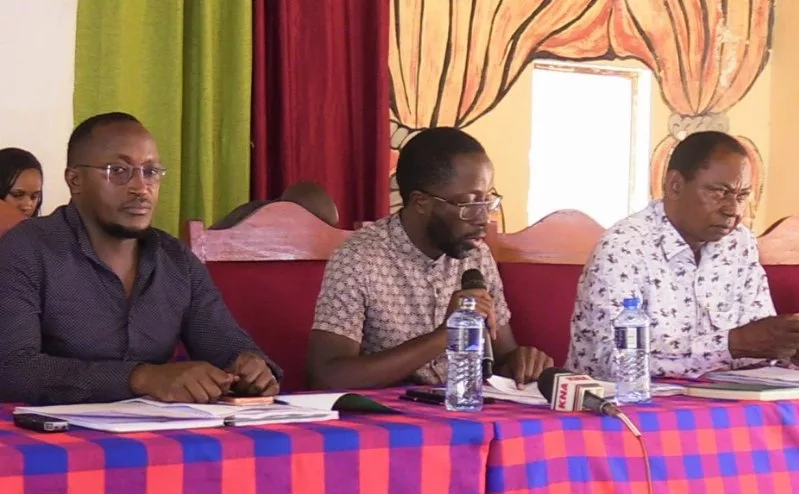
 National Assembly Departmental Committee on Education and Research Chairman Clive Gisairo (centre), chairs the education stakeholders during a public participation on six education-related bills at Ngala Memorial Girls High School in Kilifi North Sub-County, Kilifi County, on Monday.
Education players have demanded major amendments to the proposed Basic Education Bill, warning some provisions are punitive and could harm the sector if passed in its current form.
The concerns were raised in Kilifi during public participation sessions conducted by the National Assembly Departmental Committee on Education and Research, which is receiving views on six proposed education reform bills before they are debated in Parliament.
The committee is seeking public views on the Basic Education (Amendment) Bill, 2026; the Tertiary Education, Placement and Funding Bill; the Pre-Service Education and In-Service Training Bill, 2026; the Kenya Institute of Curriculum Development (Amendment) Bill, 2026; the Kenya National Educational Assessments Council Bill, 2026; and the Kenya National Qualifications Framework (Amendment) Bill, 2026.
Kilifi Kenya Private Schools Association (KPSA) chairman Christopher Kambi opposed clauses proposing hefty penalties for operators of unregistered private schools, describing them as excessive.
“The Basic Education Bill proposes that an investor in an unregistered school be fined Sh20 million or jailed for three years. Our proposal is that before it reaches that level, there should be due diligence and the accused should be given time to explain. There should be room for dialogue,” he said.
Kambi said the association wants private school owners to be registered members of KPSA before seeking approval from the Ministry of Education.
“We propose that before the Ministry of Education registers a private school, the owners must first become members of KPSA so that we can conduct our own procedures to ensure the new school meets legal requirements,” he said.
Kambi also opposed proposals that would give the Ministry of Education powers to regulate fees charged by private institutions, arguing schools should retain the freedom to set their own fee structures.
“The bill also proposes regulations on school fees, which we have opposed. We want private schools to be allowed to determine their own fee structures because we cannot wait for the government to dictate what fees we should charge,” he said.
Kenya Union of Post Primary Education Teachers (Kuppet) Kilifi branch executive secretary Opolo Kopolo urged lawmakers to make junior secondary schools autonomous to improve their management and operations.
He criticised the decision to place junior secondary schools under primary institutions, saying it had created administrative and financial challenges.
“The introduction of comprehensive schools was a dangerous move. The government has spent a lot of money because the Presidential Working Party listened to emotions rather than facts. Junior secondary was domiciled in primary schools, yet the human resources already existed in senior schools,” Kopolo said.
He said creating autonomous junior secondary schools would better serve learners despite the additional cost.
“The government should not be afraid of spending money to create autonomous junior secondary schools so we can better support the learner,” Kopolo said.
Kitutu Masaba MP Clive Gisairo, who led the committee delegation during the session, said the proposed legislation is intended to address key issues across Kenya’s education system, including tertiary education funding, teacher training, basic education, curriculum development, national assessments and qualifications.
“We have come to Tana River and Kilifi counties for public participation to hear the views and opinions of stakeholders before these bills proceed through Parliament,” the legislator said.
Instant analysis
Public participation on Kenya’s education bills reveals strong resistance to centralised oversight and structural compromises. Private investors reject excessive Sh20 million penalties and price caps that risk stifling investment, while teachers demand autonomous junior secondaries, underscoring that effective reform requires balancing fiscal discipline, private participation and operational realities.