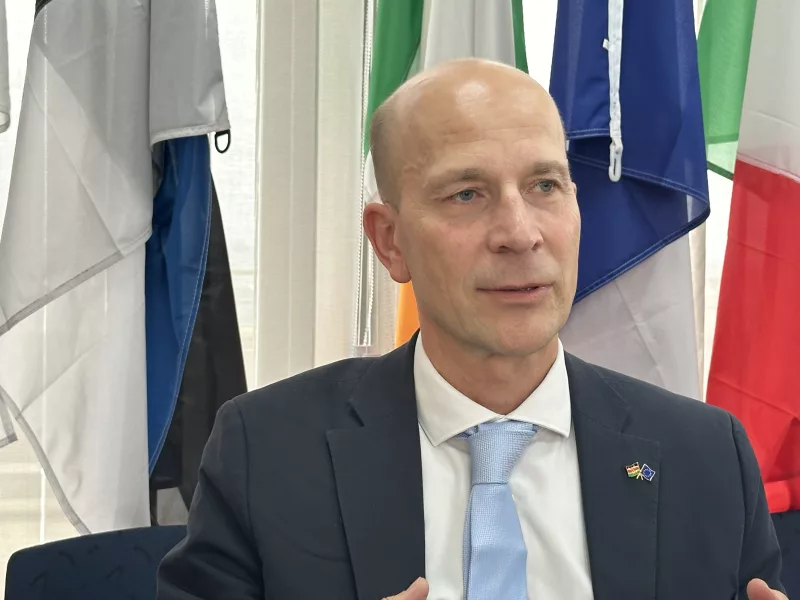
 EU Ambassador to Kenya Andreas Peschke
The European Union has raised concerns over shrinking democratic space in Kenya, warning that populism and disinformation are increasingly undermining democratic governance.
EU Ambassador to Kenya Andreas Peschke said Kenya and the European bloc should regard themselves as “partners in democracy” in dealing with the problems.
The challenges facing democratic systems are no longer confined to individual countries or regions, he said.
Speaking in his inaugural media engagement, Peschke identified “shrinking democratic spaces, challenges to democracy, populism and disinformation” among the major threats confronting democratic systems.
“These are big things that challenge the gist of our democracies,” he said, noting the same is also being experienced in Europe.
Peschke was responding to a question about whether the EU remains committed to human rights and democratic governance at a time when geopolitical tensions and economic interests are increasingly shaping diplomatic relations.
The ambassador noted that the concerns are not unique to one country, saying they are shared by Kenya and Europe.
“We are also facing these challenges in Europe. We have elections in our own countries and we are seeing similar developments,” he said.
Peschke’s evaluation comes as the 2027 campaigns gain momentum amid debate over civic space, freedom of expression, political participation and the role of state institutions.
His warning comes against the backdrop of mounting concern from both international and domestic rights organisations over the state of civic freedoms.
CIVICUS Monitor, for instance, downgraded Kenya's civic space to “repressed” in December 2024. It cited growing restrictions on freedom of expression, assembly and association. In its 2025 Kenya Watchlist, it pointed to lethal force against protesters, arbitrary arrests, digital surveillance and intimidation of human rights defenders.
Freedom House rated Kenya “Partly Free” in its 2026 report, giving it 49 out of 100, down from 51 the previous year. It cited a narrowing of political space and declining scores on political pluralism and freedom of expression. It said journalists and human rights defenders remain vulnerable to restrictive laws and intimidation.
ARTICLE 19, ForumCiv and Kenya's National Commission on Human Rights have similarly raised concerns over police violence, restrictions on protests, digital surveillance, threats against civil society and a broader erosion of civic space.
At the same time, various studies are also warning agains disinformation, misinformation and fake news.
A study by the Institute for Security Studies found that the 2022 elections exposed an emerging “marketplace” for political influence, in which digital entrepreneurs and organised networks could be mobilised to manufacture and amplify political narratives.
The Reuters Institute's 2025 Digital News Report warned that X, WhatsApp and TikTok had become major sources of information for Kenyans, while state and non-state actors continued to flood digital spaces with disinformation, deepfakes and manipulated narratives.
Freedom House study found that disinformation surrounding the 2022 election contributed to efforts to undermine confidence in the credibility of the presidential results.
The envoy also welcomed the increasing political engagement of Kenyan youth, particularly the Gen Z.
He said greater youth participation in politics should ultimately be viewed positively, even when it creates difficulties for governments.
“I think after all, it's a good thing that young people become involved. For them to take an interest, to get registered and to take responsibility, to want to have a say in the future, it's a good thing,” Peschke said.
He noted that some European countries have struggled to mobilise young people to participate in politics, with some becoming disenchanted with political processes.
The EU, he added, is engaging young people through its programmes and seeking to increase their participation in public affairs.
“Because I think after all, young people of today are the leaders of tomorrow,” Peschke said.
The ambassador's remarks also come against the backdrop of the EU's engagement with Kenya on electoral reforms ahead of next year's polls.
Peschke, however, said the EU would respect Kenya's sovereignty and the right of Kenyans to make their own democratic choices.
The envoy described the diplomatic relationship as one between equals, saying the EU and Kenya should be able to engage each other openly while respecting each other's sovereignty.