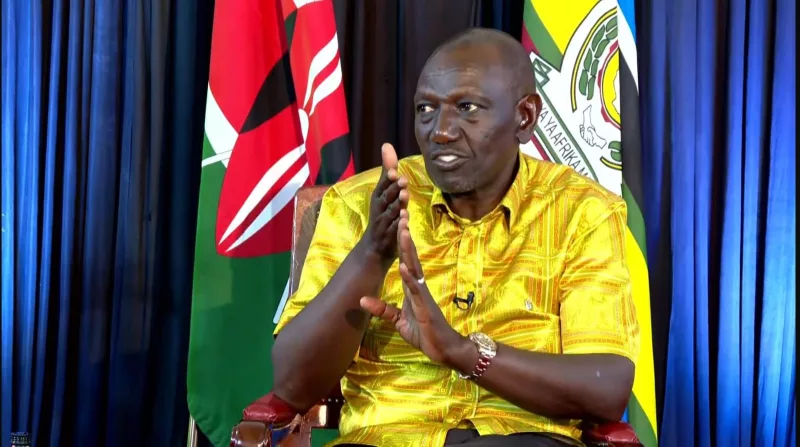
 President William Ruto speaks during a media engagement at Kisumu State Lodge on September 14,2026./FAITH MATETE
The government has so far raised about Sh320 billion for the National Infrastructure Fund, President William Ruto has said.
Speaking during a media engagement at the Kisumu State Lodge on Monday, Ruto said the money will finance major investments in roads, energy and water as Kenya seeks to accelerate economic growth.
Ruto said the fund, which he proposed in his State of the Nation address last year, had now been established in law and was moving into implementation following the appointment of its top management.
He said the government had also completed the policy framework that will guide investments from the fund.
“We have not only set up the National Infrastructure Fund, as I committed to the country in my State of the Nation address last year. We've passed it into law, and already we have raised close to three billion dollars, or Sh320 billion into that fund,” Ruto said.
The President said the fund would focus on three strategic areas: transport infrastructure, energy infrastructure and water infrastructure, which he described as critical to Kenya’s long-term development.
Ruto said the new financing mechanism would allow the government to pursue infrastructure investments on a larger scale, particularly in areas where inadequate infrastructure is holding back industrialisation and job creation.
A major priority under the energy component, he said, would be to increase Kenya’s electricity generation capacity from about 3,300 megawatts to at least 10,000 megawatts within seven years.
“In the energy sector, we have 3,300 megawatts of energy. For a country our size, we are living on the margin,” Ruto said.
He added: “Our plan under the National Infrastructure Fund is to generate 10,000 megawatts, at least in the next seven years.”
Ruto said the additional power would be necessary if Kenya is to attract industries, expand manufacturing and build a technology-enabled economy.
He linked the energy plan to the government’s efforts to tackle youth unemployment, saying Kenya cannot create enough jobs for its young population without expanding the infrastructure that supports businesses and emerging industries.
Ruto said agriculture and agro-processing could absorb a significant number of young people but argued that Kenya must increasingly shift towards a service economy.
He identified business process outsourcing, information and communication technology, data centres and other digital services as areas with potential to employ thousands of young Kenyans.
“For us to be able to generate the number of jobs that can absorb these young people, we can do so much with our agro-processing. Our agriculture can absorb so much, but we now progressively must move towards a service economy,” he said.
Ruto said Kenya had a competitive advantage in the global services industry because of its skilled workforce, education system and command of English. But he said adequate electricity was necessary to convert that human capital into jobs.
“We need energy because of the computing space that we are looking for, and that is why we have straightened that whole space around business process outsourcing, what we need to do about our ICT, and what we need to do about our digital space,” he said.
The President said Kenya already had six undersea cables connecting it to the rest of the world, giving the country a strong digital backbone.
“What we need is the last mile,” he said, adding that reliable electricity would be essential to powering the technology infrastructure required to employ young people.
The energy push also featured prominently in Ruto’s response to complaints over unreliable electricity in the Nyanza region.
He apologised to residents over frequent power interruptions, saying the government was fast-tracking the construction of transmission lines from Lessos and through Bomet.
He said the projects were expected to help stabilise power supply in the region before the end of the year.
“So as soon as those two are done, and hopefully before the end of this year, we will be able to stabilise power in this region,” Ruto said.
The President also announced longer-term plans to generate between 2,000MW and 5,000MW in Siaya, saying the additional capacity would help address the region’s energy needs.
Ruto said transport infrastructure would remain a major beneficiary of the fund, linking better roads and other transport networks to increased trade and economic activity.
He cited ongoing and planned road projects in Nyanza as part of the broader development programme.
In Migori, he said the government had completed procurement of a contractor for the long-awaited Migori Bridge and promised to inspect the project during his visit to the county on Wednesday.
“The people of Migori should relax. We are going to do the bridge for them, as we do all the other roads,” he said.
He said several other roads in Migori had already been procured and would be launched during his tour of the region.
Ruto also used the infrastructure debate to attack what he described as the politics of marginalisation and exclusion, arguing that development resources should reach all parts of the country.
“We must get rid of the politics of marginalising other areas. We must get rid of the politics of exclusion,” he said.
“It is possible for us to build this country everywhere equally and get everybody to get a chance of the pie of the national development.”
Ruto said the infrastructure fund was intended to mobilise large pools of capital for major development projects, with infrastructure investment forming the foundation for a broader economic transformation from agriculture to manufacturing and services.
“If we don't, we cannot invest in proper industrialisation. We cannot invest in the technologies of the future. We cannot set up data centres," Ruto said.
He added: “Let me finish. So what I am saying is for us to be able to drive that, we need energy.”