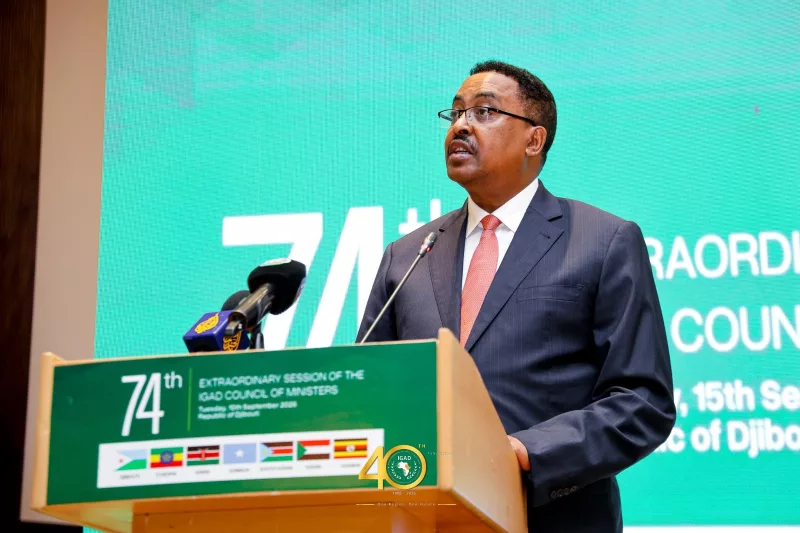
The Intergovernmental Authority on Development (IGAD) is facing financial and institutional strain that could undermine its ability to respond to mounting crises in the Horn of Africa, Executive Secretary Workneh Gebeyehu has warned.
Gebeyehu said the regional bloc needed member states to stabilise essential operations, settle historical arrears and agree on a financing framework to prevent recurring funding problems.
Speaking on Tuesday in Djibouti at the opening of the 74th Extraordinary Session of the IGAD Council of Ministers, Gebeyehu said he would present ministers with a detailed report on the organisation's institutional condition, performance and finances.
“I will not soften the second Part. The strain is real, it is measurable, and it is also very solvable,” Gebeyehu said.
He said the financial challenges were emerging as the region dealt with multiple crises, including war, food insecurity and displacement.
Gebeyehu told ministers that close to 49 million people in the region were acutely food insecure, while more than 19 million had been displaced within their own countries.
He said Sudan remained the epicentre of one of the world's gravest emergencies, adding that conflicts outside the region were also affecting IGAD countries through their impact on ports, fuel supplies, grain markets and humanitarian budgets.
Against that backdrop, Gebeyehu said IGAD could not afford to allow financial difficulties to weaken the organisation's capacity.
“I ask this Council for three specific things: stabilise essential operations now, settle historical arrears in an orderly way, and build a financing framework that prevents this recurring,” he said.
The remarks come as IGAD continues to face pressure to strengthen its role in resolving conflicts in the region, particularly in Sudan and South Sudan.
The bloc has previously acknowledged shortcomings in its mediation efforts and called for greater commitment from member states to support its programmes.
Gebeyehu also pointed to areas where the organisation was making progress despite the challenges.
He said 77 per cent of IGAD's priority areas were on track in the first half of the year, while its early warning system had exceeded its half-year target for decision-support products and supported three election observation missions.
He said the regional groundwater information system had maintained 99.9 per cent availability across more than 42,000 monitored wells, springs and dams.
Gebeyehu also reported that IGAD's regional universal health coverage index had risen from 60 to 65, against a target of 70 for 2027, while anticipatory action frameworks were operating in four of the bloc's seven member states.
He congratulated Djibouti, Ethiopia and Uganda on elections held under IGAD observation and said the organisation was looking with confidence towards South Sudan's preparations for elections expected in December.
The meeting is also taking place as IGAD transitions to its new treaty framework.
Gebeyehu said the new IGAD Treaty had secured the required ratifications, with five of the seven member states having ratified it, allowing the treaty to formally enter into force.
The treaty replaces the 1996 agreement and is intended to strengthen regional cooperation, including in peace and security, climate resilience, infrastructure, health, trade and social development.
Gebeyehu urged member states to take greater ownership of the organisation as it enters the new treaty era.
“This is a moment for all of us to step up and secure IGAD's future,” he said.
He also said the organisation would have to prepare for the expected El Niño season and explore ways of ensuring the region becomes an “author, not a subject” in the development and use of artificial intelligence.