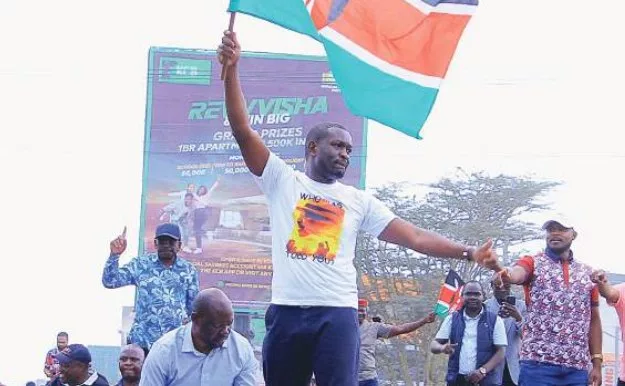
 Senator Edwin Sifuna during a Linda Mwananchi rally in Kitengela /EZEKIEL AMINGA
In the scramble to find its footing after the death of its founding leader Raila Odinga, ODM may have created its own political headache in Nairobi Senator Edwin Sifuna.
After Raila’s death, Sifuna went almost immediately from being his trusted political foot soldier and one of the strongest voices of ODM to a man the party increasingly viewed as a problem to be managed.
And as the post-Raila succession battle hardened, the party sidelined him, stripped him of key positions and, ultimately, pushed him towards the exit door.
It was in handling that delicate transition that many believe ODM may have made one of its biggest political miscalculations, turning Sifuna from a loyal party operative into an independent political force.
University don Prof Gitile Naituli says Sifuna was in many ways, made into what he is today by the manner in which the Orange Party handled the situation.
He added that Sifuna’s consistency, even during Raila’s time, had also endeared him to the public.
“I knew the moment ODM will kick him out he was going to be bigger,” Naituli told the Star on phone.
“Also, Sifuna has been consistent even during Raila days and you know Kenya lacks such consistent leaders.”
Naituli argues that ODM may not have anticipated that the man it sought to silence would emerge with a louder voice, a new movement and ambitions that could threaten the very political space the party is now fighting to retain.
Political analyst Suba Churchill said the emergence of a new leader within ODM was inevitable following the death of Raila.
He said Raila had dominated the party for years, making his death a major turning point that was bound to trigger a struggle for influence and the emergence of a new political generation.
“Definitely, when there is a towering figure leading a party and when such a figure departs confusion emerge. The manner in which the transition was handled led to the emergence of Sifuna,” Churchill said.
Until Raila’s death on October 15, 2025, Sifuna had been one of his closest political lieutenants, the party’s Secretary-General and one of the most recognisable defenders of the orange outfit.
He was among those sent to India to bring Raila’s body home.
He was therefore away when key decisions on the party’s future, including the move to have Oburu Oginga replace Raila, were being made in Nairobi.
Sifuna has since alleged that while he was travelling to India to bring Raila home, plans were already being made to determine the party’s future and sideline him.
He has repeatedly described Raila’s death as the moment his problems within ODM began.
Sifuna represented a strand of ODM that was uncomfortable with the party’s post-Raila political direction, particularly its increasingly close engagement with President William Ruto.
Even before Raila’s death, Sifuna had openly expressed frustration with the implementation of the UDA-ODM Memorandum of Understanding.
By July 2025, he had publicly declared the memorandum dead.
After Raila’s death, that disagreement became intertwined with the succession battle.
The new leadership needed political room to negotiate its future. Sifuna, meanwhile, continued to speak out against any political deal with Ruto’s UDA.
His removal as Secretary-General and subsequent loss of his Senate leadership position transformed what had been an internal disagreement into a full-blown political confrontation.
The senator turned his removal from the position of ODM secretary-general into one of the central themes of his political rallies.
The party may have taken away his official title, he often says, but ordinary Kenyans have given him a more powerful one.
“They took away the SG title from me. However, people want me to have another title, HE. Is that what you people also want?” Sifuna always says.
HE is short for His Excellency, an honorific usually reserved for heads of state.
According to political analyst Dr Alfred Makotsi, the internal wars and Sifuna’s bold stand on the implementation of the ODM-UDA deal strengthened him politically.
“ODM’s internal blunders, especially its uneasy handling of the post-Raila transition, helped strengthen Edwin Sifuna politically. Senior party figures, including the party chairman and sections of the ODM kitchen cabinet, appeared to isolate and fight him rather than manage dissent constructively,” Makotsi said.
“The 10-point agenda signed with UDA
was largely ignored by the party establishment, while Sifuna kept raising it
publicly. That contrast made him look principled, consistent and courageous.”
The ‘danger’ was not invisible to ODM leaders themselves.
Suba North MP Millie Odhiambo is on record admitting that the party had effectively elevated Sifuna by fighting him.
Millie said ODM had inadvertently raised Sifuna's political profile by placing him in the same league as President Ruto.
“I think we just upped the game for Sifuna and put him in the same league with the sitting president,” Odhiambo said on August 21.
She said Sifuna could, however, pose a challenge to ODM at the parliamentary level by taking some of the seats currently held by the party.
“The only threat he could pose to ODM is that he might take away some of the seats we had,” she said.
Rarieda MP Otiende Amollo was also among those who urged caution over the treatment of Sifuna.
“I warned Oburu that ousting Sifuna would destroy ODM. I told him there was nothing to gain from such a move, yet my advice was ignored,” Otiende said in May.
Sifuna's removal ultimately birthed the
Linda Mwananchi movement, giving him a political platform from which to amplify
his anti-Ruto message and build his movement.
INSTANT ANALYSIS
In trying to contain Sifuna, the party may have helped give him precisely what he needed to break free , a grievance, a platform and a growing constituency beyond the Orange party