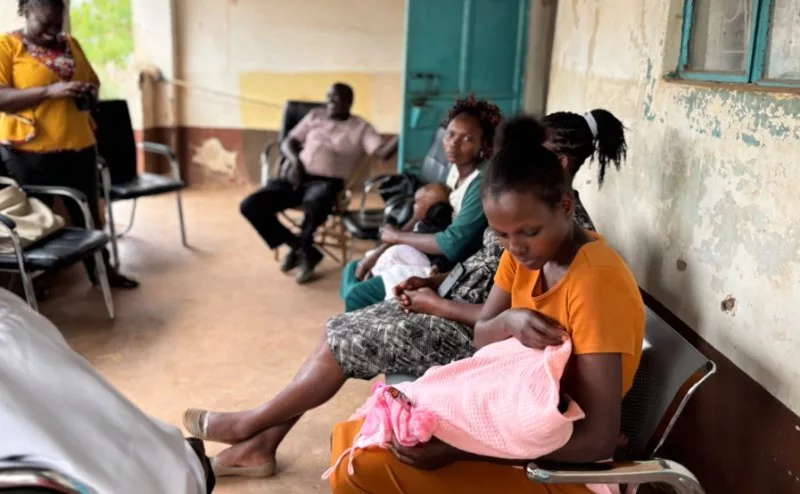
 Janet Mureithi (right) and her baby, Winnie, attend a clinic at Kamayagi Dispensary. Photo/Pauline Tom.
It was 3 am in Kamayagi village when Janet Mureithi went into labour. There was no phone network, and after the previous night’s rain, the seasonal rivers around the village had become difficult to cross. Usually, having a baby meant finding a motorcycle and traversing through rough terrain for 10 km to the nearest hospital; she would not have made it. For other women, the journey had ended in a home delivery or a dangerous delay.
This time, however, Janet made her way to Kamayagi dispensary; her mother ran to find the village’s only nurse, Martin Njogu. He crossed one river and made his way to the dispensary.
About an hour later, baby Winnie Mureithi was born.
Before Kamayagi Dispensary existed, women in this remote corner of Kitui County had to travel more than 10 kilometres to reach the nearest hospital, in Tseikuru. Some went into labour on the way. Others delivered at home rather than risk the journey, particularly in the rainy season, when the rivers became impassable.
James Muthengi, the chairman of the dispensary building committee, says that the dispensary was born out of that need, his own family experience included.His wife gave birth by the roadside on the way to hospital, when rough roads accelerated her labour and a motorcycle was the only transport available.
“My wife had our second-born by the road, just like several other women in the community,” he says. “So, when it came time to identify our needs, we chose maternity, because of how much we had suffered.”
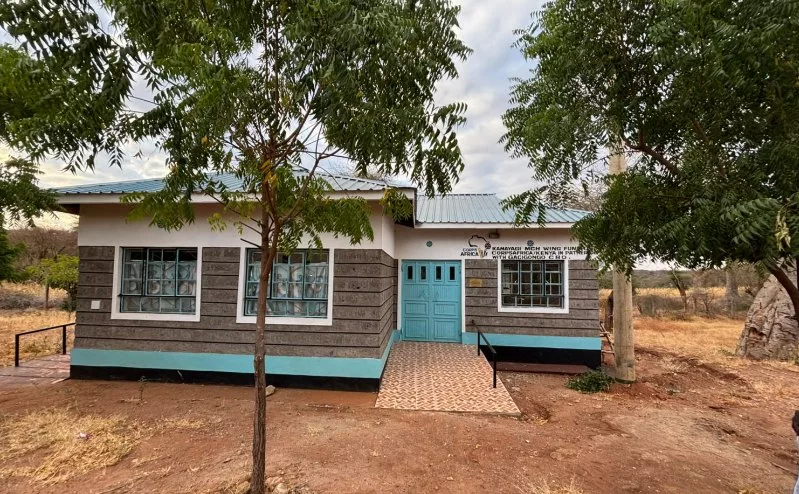
It is out of necessity that Kamayagi Dispensary was born; rather than keep waiting, residents decided to build it themselves. They pooled resources, including land, money, materials and labour; they further contributed 25 per cent of the Sh 1.58 million cost, with the remainder funded by a non-profit, CorpsAfrica.
The facility officially opened in December 2025. It features a maternity unit, with a delivery unit with 10 beds. Since opening, it has served about 400 mothers and children, and is expected to eventually serve more than 850 households.
Now, when labour starts, there is somewhere to go.
“I was not afraid of making my way here,” Janet says “It was much easier because, given the time and the floods, there was no way I would have made it to Tseikuru.”
Maternal deaths are commonly linked to three delays: deciding to seek care, reaching a facility, and receiving care once there. According to the Ministry of Health, distance has long been amajor barrier to survival, accounting for 30 per cent of maternal and perinatal deaths nationally.
MoH further estimates that only 64 per cent of women in Kitui County give birth in a facility or under a skilled attendant's care, and in Kamayagi, that statistic is the lived reality of many women.
Kiretu Mwenga, a teacher now and a former boda boda rider, remembers a time when transporting women to health facilities was part of community life.
“I used to ferry pregnant women, even at night, to Tseikuru to deliver,” he says, “the result was not always favourable.”
One of his clients lost her baby after reaching the hospital. At one point, he says, women and other sick community members were transported to Tseikuru on a wheelbarrow.
“I am glad that we now have a hospital; it means more mothers and babies survive,” Mwenga says.
Martin is the dispensary's only nurse, serving over 850 households and about 60 children monthly; he says he needs help as the facility isn't equipped to handle complications. “Here, you can give IV fluids as you plan for referral,” he says. “I do what I can.”
“This community requires this facility to be upgraded. It can't treat patients 24 hours,” James, the building committee chairman, says. “We were informed that we are included in the budget for this financial year, so we are hopeful.”