
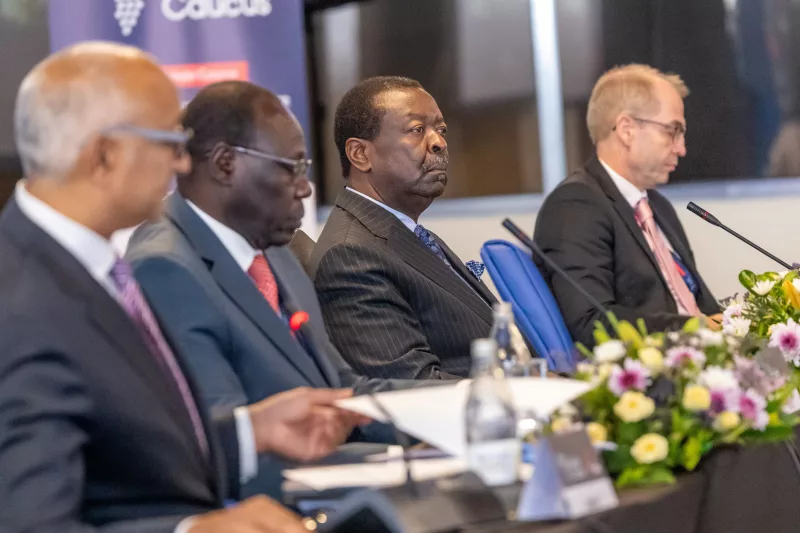
Prime and Foreign Affairs CS Musalia Mudavadi said on Monday that his office is considering a Foreign Agents Registration framework requiring the registration and disclosure of foreign agents, lobbyists and foreign-funded activities.
He said the framework would enhance transparency and safeguard Kenya’s national interests, while ensuring legitimate international partnerships are not constrained.
Mudavadi made the remarks at the Fifth Nairobi Caucus on Protecting Critical Infrastructure Systems and Public Spaces, where he linked the need for stronger safeguards to evolving terrorism, cyber threats and other risks to national security.
The proposal puts Kenya in a regional debate that has already gained momentum in Uganda, where the government has enacted the Protection of Sovereignty Act, 2026.
Uganda’s law provides for the registration and regulation of agents of foreigners and places controls on foreign funding and activities linked to foreign interests.
Uganda’s legislation generated strong opposition during its passage, with critics warning that broad provisions could affect political activity, civil society organisations and groups receiving foreign funding.
Parliament subsequently narrowed some of the provisions before the legislation was passed, including dropping a proposal that would have classified Ugandans living abroad as foreigners. Some provisions that critics feared could criminalise ordinary associations with foreign entities were also reviewed.
The final law nevertheless requires people acting as agents of foreigners to register and introduces restrictions around foreign funding and political activities.
The new law broadly defines a foreigner to include foreign governments, diplomatic missions, companies, NGOs and international or multinational organisations where they finance or support specified activities.
Uganda’s opposition argued that the legislation was unnecessary and potentially harmful to the country’s democratic and economic environment, saying existing laws already addressed issues such as illicit financial flows and unlawful foreign funding.
The debate exposed the delicate balance between protecting national sovereignty and maintaining legitimate international engagement.
Kenya now faces a similar dilemma. Nairobi is one of Africa’s major diplomatic and international cooperation hubs, hosting hundreds of diplomatic missions, United Nations agencies, international organisations, development partners, multinational companies, media and civil society organisations.
Many of these organisations operate through foreign financing, technical assistance and partnerships with governments and institutions outside Kenya.
The Foreign Agents Registration framework could potentially require organisations and individuals acting on behalf of foreign interests to disclose their relationships, sources of funding and activities.
While Mudavadi emphasised that the proposed framework should not constrain legitimate international partnerships, he did not provide details on who would be classified as a foreign agent, which institution would administer the framework, what information would have to be disclosed or what penalties would apply.
He cited the United States’ Foreign Agents Registration Act as an example of the international practice of requiring registration, oversight and public disclosure of foreign agents and lobbyists, framing it as a protective measure.
“A nation that understands the foreign forces shaping its decisions is a nation that safeguards its sovereignty,” he said.
The timing of the proposed framework is also significant. Kenya is heading towards the 2027 General Election, when foreign funding, political lobbying, digital influence and international advocacy are likely to attract greater scrutiny.
The government has increasingly emphasised the need to protect critical infrastructure and public spaces from security threats, while political actors and civil society organisations are expected to remain under greater scrutiny as the election approaches.