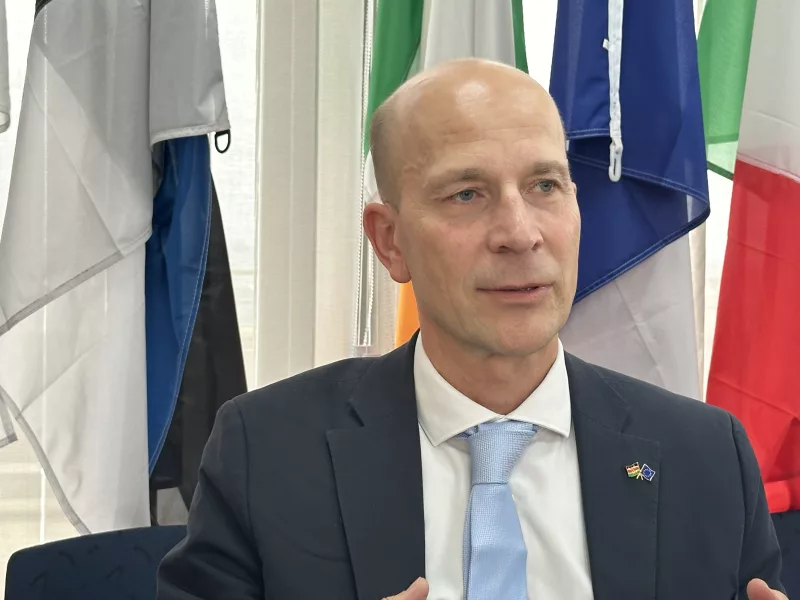
In his inaugural media engagement, EU Ambassador to Kenya Andreas Peschke said the bloc was following preparations for the elections closely and remained interested in engaging with Kenya on strengthening the democratic process.
Peschke said any decision to deploy a full EU Election Observation Mission would depend on an invitation from the Kenyan government.
“In our case, I think the question whether you're going to send election observation mission depends upon the invitation of the host country,” Peschke, who previously served in Nairobi as the German envoy, said.
“I can tell you that we would look at it favourably, but it would start, I think, with an invitation by the Kenyan side.”
His remarks came a day after Prime CS Musalia Mudavadi told diplomats that those seeking to bring election observers should prepare early to ensure timely accreditation and avoid inconveniences arising from non-compliance.
Mudavadi also urged respect for the independence of electoral institutions, saying the electoral commission must be allowed to discharge its constitutional mandate independently and professionally.
But Peschke drew a clear distinction between election observation and interference.
“Observation is not interference,” he said, adding that election observation was one of the tools used to increase trust in democratic institutions.
“Interfering in the elections, in the democratic election, is a no-go,” he said.
Peschke said the EU was also conscious that even the perception of interference could undermine its role.
“That's why I'm saying it so clearly. We must not, even if you don't do it, you must not be perceived as interfering,” he said.
He said Kenyans should be allowed to make their own choices without outside actors seeking to influence the outcome.
“That’s the sovereign right of the people of a country... to make their own democratic decisions, not for us, for any outsider,” Peschke said.
The EU's interest in the 2027 elections is also shaped by concerns over the implementation of recommendations made after the 2022 polls.
The EU deployed an Election Observation Mission for the August 2022 elections and subsequently issued recommendations on electoral reforms.
In February and March 2025, the bloc returned with an Election Follow-up Mission to assess progress ahead of the 2027 elections.
The follow-up mission reviewed 21 recommendations, seven of which were identified as highest priority. While noting some positive movement, it warned of limited tangible progress in implementing recommendations from the 2022 election.
The mission also raised concerns over delays in appointing new IEBC commissioners, saying this had affected by-elections and boundary delimitation, halted continuous voter registration and risked compromising preparations for the 2027 elections.
Peschke acknowledged the issue of implementation but said responsibility ultimately rested with Kenya.
“It's the country itself. It looks at the recommendations and then needs to make their own sovereign decision how to proceed with them,” he said.
However, he said the EU would naturally want to see recommendations arising from its work addressed.
He said implementation is part of the dialogue between the EU and its partner countries.
Peschke said the EU could also work with Kenya on technical electoral issues without crossing into political interference.
“There are all kinds of sharing of experiences,” he said, citing technical issues around electoral systems and preparations.
Beyond the electoral process, Peschke said the EU considered Kenya a partner in democracy and shared concerns over challenges facing democratic systems.
“I see Kenya and the European Union as partners in democracy,” he said, pointing to “shrinking democratic spaces, challenges to democracy, populism and disinformation” as challenges facing both sides.
The ambassador also welcomed the growing political engagement of Kenyan youth, particularly Gen Z, saying increased participation was ultimately positive even when it created difficulties for governments.
He noted that some European countries had struggled to mobilise young people to participate in politics.
“For them to take an interest, to get registered and to take responsibility, to want to have a say in the future, it's a good thing,” he said.
The EU, he added, was engaging young people through its programmes and seeking to increase youth participation.
“Because I think after all, young people of today are the leaders of tomorrow,” Peschke said.