
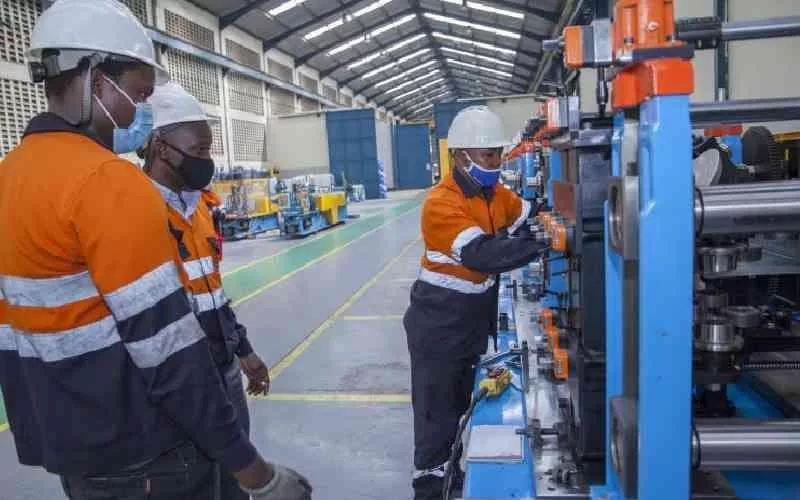
The government is overhauling the country’s industrialisation strategy as the manufacturing sector remains far below the targets set by the Kenya Kwanza administration.
The draft National Industrialisation Policy, 2026, says manufacturing contributed only 7.1 per cent of GDP in 2025, down from more than 11 per cent in 2009.
The figure is also well below the 20 per cent Vision 2030 target, while manufacturing growth has averaged only two–three per cent in recent years against earlier ambitions of 15 per cent annual growth.
The new policy, on which the State Department for Industry is seeking public input, comes as the Kenya Kwanza administration approaches the final year of its first term and prepares to seek a fresh mandate next year.
Manufacturing was a major component of the administration's economic programme.
In its 2022 manifesto, Kenya Kwanza said the sector was “headed in the wrong direction”, with its contribution to the economy having fallen from 9.3 per cent to 7.6 per cent between 2016 and 2020.
The administration committed itself to reversing that decline through a value-chain approach, focusing on sectors including leather, textiles and garments, pharmaceuticals, building materials, edible oils, rice, coffee, dairy and plastics.
The government's stated target was to raise manufacturing's contribution to GDP from about seven per cent to 15 per cent by 2027 and 20 per cent by 2030.
The latest draft policy, however, shows manufacturing's contribution stood at 7.1 per cent in 2025, leaving the sector far from the 15 per cent target set for the end of the current administration.
The draft acknowledges the problem extends beyond the policies of one government, describing Kenya's industrial decline as a “gradual, structural failure” accumulated over successive policy cycles and administrations.
It says previous industrial strategies repeatedly failed to translate policy commitments into sustained investment and structural economic change.
The document identifies implementation as one of the biggest weaknesses, saying previous policies were introduced without adequate financing, while responsibilities were spread across agencies with overlapping mandates.
Weak monitoring and accountability systems also meant that underperforming programmes were not identified and corrected in time.
The new policy also cites high production costs, expensive energy, inadequate industrial land, transport costs, and infrastructure inefficiencies as barriers to manufacturing investment.
These challenges directly overlap with issues identified by Kenya Kwanza in its 2022 manifesto.
The manifesto argued that manufacturers had been crowded out of the credit market and faced high costs of doing business, while external debt pressures had contributed to foreign-exchange constraints.
It also identified high taxes and production costs as barriers to sectors such as pharmaceuticals.
The new policy proposes to tackle some of these problems by restructuring the Industrial Development Fund, which it says has never been adequately or sustainably capitalised.
Under the proposal, the fund would have seven financing windows covering MSME lending, risk-sharing with commercial banks, equity investment, export credit, industrial innovation and green industrialisation.
The draft policy also acknowledges that high public debt-service obligations are limiting the fiscal space available to capitalise the fund.
The policy also seeks to address Kenya's continued dependence on raw and semi-processed exports.
Four of the country's leading exports remain tea, flowers, horticultural products and coffee, while Kenya ranks 92nd out of 145 countries on export diversity under the Harvard Atlas of Economic Complexity.
The government is therefore proposing to concentrate industrial policy on seven priority areas: agro-processing; textiles, apparel, and leather; pharmaceuticals; the blue economy; minerals and extractives; green energy and manufacturing; and emerging sectors.
Leather is singled out for greater value addition, with the policy proposing a shift from exports of raw hides and wet-blue leather towards crust and finished leather.
This was also an area specifically identified in the Kenya Kwanza manifesto, which said Kenya had the potential to build a Sh120 billion leather industry and create 100,000 jobs.
The administration pledged to establish leather industry clusters in Athi River, Narok, Isiolo and Wajir and use public procurement to expand the sector.
Textiles and garments were similarly identified as a major opportunity in the manifesto, with a promise to develop a local cotton-to-fabric supply chain rather than relying heavily on imported raw materials.
The new policy now proposes broader interventions to strengthen local value chains and export manufacturing.
It also proposes establishing industrial ecosystems outside the traditional manufacturing centres of Nairobi, Mombasa and Kiambu by linking industrial parks with universities, TVET institutions and innovation hubs in the counties.
The government also wants to give industrial policy greater continuity beyond individual administrations for sustainability.
Towards this, the draft proposes a National Industrialisation Act, a National Industrial Coordination and Development Committee, and a National Industrial Competitiveness Observatory.
It also proposes a formal industrial-policy handover protocol requiring incoming and outgoing administrations to transfer information on industrial commitments, projects and implementation status.
The Industrial Development Fund would also be ring-fenced through statutory appropriation to prevent its resources from being diverted during budget cycles or political transitions.