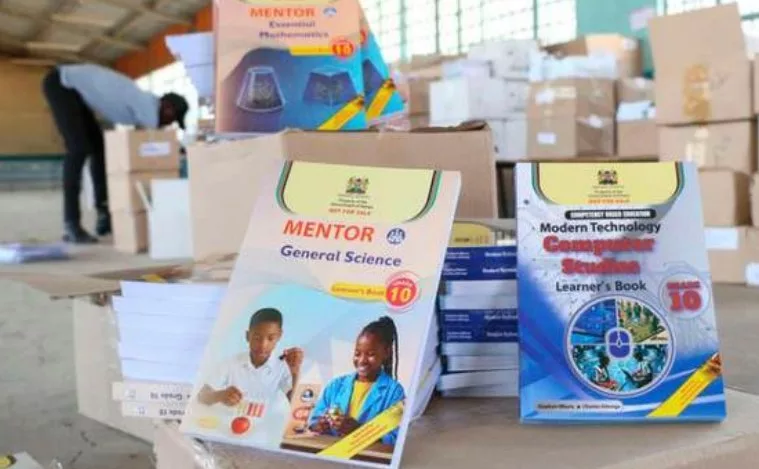
 Grade 10 textbooks /FILE
MPs have summoned top officials of the Kenya Institute of Curriculum Development (KICD) to explain the discrepancies in textbook distribution to public secondary schools.
The National Assembly's Public Investments Committee on Governance and Education resolved after it emerged that some schools received hundreds of books beyond their requirements.
The committee also observed that other institutions, particularly those in marginalised and far-flung areas, continued to face shortages.
The concerns emerged as the committee examined Auditor-General’s reports covering the 2020/21 to 2024/25 financial years for several national schools during its retreat in Kisumu.
Luanda MP Dick Maungu chairs the committee.
In an address to the media, Maungu said the committee had identified significant discrepancies between the number of textbooks supplied to some schools and the number of learners requiring them.
“We have seen a school that received 400 and 506 extra books,” Maungu said.
He questioned whether the distribution system was guided by accurate, up-to-date enrolment data.
“The question is, when you receive extra numbers, does it mean there is a school somewhere that does not have books?” he posed.
The committee now wants KICD officials to explain the criteria used to determine the number of textbooks allocated to individual schools.
The lawmakers are also seeking answers on how the institute ensures that supplies correspond with current enrolment and subject requirements.
The inquiry comes amid concerns that while some schools have accumulated excess or obsolete learning materials, others continue to report shortages, raising questions about efficiency, value for money and equity in the use of public funds for education.
Maungu said the government should ensure learning materials reach schools according to their needs, particularly institutions in areas that have historically faced resource constraints.
“We expect KICD to have the right data to ensure that the books supplied are enough for the students who are there, so that those in far-flung areas in Mandera, Turkana and other places get what is supposed to be theirs,” he said.
Auditor General Nancy Gathungu in her report, revealed that 7260 textbooks were distributed at Our Lady of Lourdes Nyabururu Girls National School in Kisii county during the financial year ended June 2025, while records showed only 5,048 were to be issued to students.
This translates to an excess of 2,162 books. It noted that the school did not have sufficient books for some of the subjects it offered.
Appearing before the committee, Chief Principal Dr. Joyce Orioki explained that the additional books were relevant and were being put to use, particularly for revision and borrowing.
“Yes, there were excess books, but the enrolment at the time was far less than what the school stands at now, and the books are relevant and are being used across the classes for revision and borrowing,” she said.
At Asumbi Girls High School, the report indicates that KICD distributed 20,800 textbooks, of which 15,476 were issued to the learners.
Appearing before the committee, Asumbi Girls principal Linet Pino Sati said the school had been providing information on its textbook requirements through the National Education Management Information System (NEMIS), but was not involved in the actual procurement and distribution process.
“The Ministry of Education did not involve the school when procuring textbooks, though the management has been remitting subject requirements per learner in NEMIS,” Sati said.
The issue drew sharp questions from Kiminini MP Maurice Kakai, who questioned why schools holding excess textbooks could not facilitate their redistribution to institutions facing shortages.
“Isn't there a mechanism when you receive excess books, you also redistribute for those who don't have?” he asked.
At Kisii School, the Auditor-General raised concerns over the management and distribution of textbooks.
The report found that there was no evidence of an instructional needs assessment to guide the determination of the number and subjects of learning materials required by the school.
The audit also reported that KICD had supplied 5,324 textbooks under four titles, against 5,056 books issued to students, leaving an unexplained excess of 268 books in the school store.
Kisii School principal Fred Mogaka told the committee that the books were supplied by the Ministry of Education through KICD and that schools were normally not consulted directly before supplies were made.
“The textbooks are being supplied by the Ministry of Education through KICD, and they normally don't consult schools on supplies,” Mogaka said.
INSTANT ANALYSIS
The committee’s decision to summon KICD is expected to allow the institute to explain the distribution system, including how enrolment data, subject requirements, curriculum changes and existing stock at individual schools are taken into account.