President William Ruto on Thursday reprimanded his security officers after they blocked residents from accessing Kapkatet Stadium, where he was addressing a gathering during his tour of Kericho county.
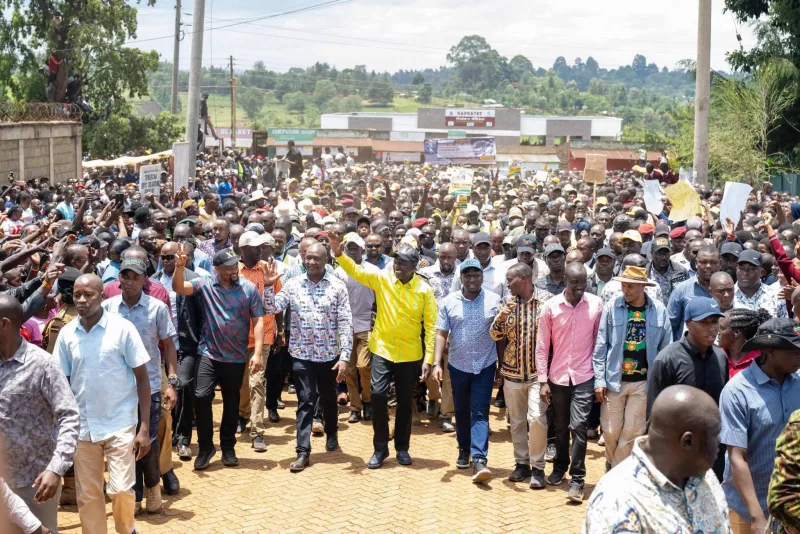
Ruto, visibly displeased by the situation, questioned why security officers were preventing residents from entering the stadium despite the large turnout.
“Bure kabisa!” the President exclaimed as he admonished the officers managing the entrance.
Security officers at the gate appeared overwhelmed by the large number of residents who had turned up to listen to the President.
Efforts by the officers to control the crowd were unsuccessful, with anxious residents later seen forcing their way through the blocked entrance into the stadium after the President intervened.
The incident occurred as Ruto addressed residents during his four-day tour of Bomet and Kericho counties, where he is inspecting and launching a series of development projects.
The President used the occasion to highlight road construction and other infrastructure projects being undertaken by his administration in Kericho.
Ruto said the government had revived stalled road projects across the country after settling a Sh900 billion debt owed to contractors, allowing them to return to construction sites.
“We have revived stalled road projects across the country by settling the KSh900 billion debt owed to contractors and enabling them to return to site,” he said.
He said more than 6,000km of roads were currently under construction across the country.
In Kericho, Ruto said the government was investing Sh22 billion to construct 300km of roads aimed at improving connectivity and opening up the county for economic activity.
He launched construction of the 53km Sabunit-Kapkondor/Furaha-Hill Tea Access Road in Kipkelion East at a cost of Sh3 billion.
The road will link tea farmers and other producers to processing facilities and markets while reducing transport costs and improving access to schools and health facilities.
Ruto also launched the Kipkelion Last Mile Connectivity Project, which is expected to extend electricity connections to more households and businesses.
On urban development, he said Sh5.6 billion was being invested in the first 2,200 affordable housing units in Kericho town, as part of a planned 5,000-unit project.
He said the government also plans to establish a Special Economic Zone in Kericho to attract investment and create digital opportunities.
The President announced that construction of the Sh1 billion Kabianga Medical School in Kericho town would begin shortly, alongside the construction of Londiani and Kericho referral hospitals.
Ruto said the government was also investing Sh1.1 billion in Kapkatet Stadium and another Sh1 billion in sports infrastructure in Kericho town.
The Kapkatet Stadium project, launched by the President, will cost Sh1.1 billion and is expected to be completed early next year.
The 10,000-capacity facility will have a six-lane athletics track, a standard football pitch and other sporting facilities.
Ruto also announced Sh1.6 billion for the Kapkatet and Litein water projects and another Sh400 million for Kericho town.
A further Sh1.6 billion last-mile electricity programme is expected to connect 16,000 households in the county.
The President said agricultural reforms were also benefiting farmers, noting that Kericho coffee farmers had emerged among the country's top earners with Sh6 billion in earnings.
He launched construction of the 34km Panda Pilis-Kampala/Bokoiyot-Mabasi road in Bureti Constituency, saying it would improve connectivity and facilitate movement of agricultural produce.
Ruto also handed over the Kapkatet Modern Market to small traders, including Mama Mboga.
The market will accommodate more than 200 traders and is among 12 modern markets being constructed across Kericho county.
The President said the facilities would provide traders with electricity, water, toilets, storage facilities, cold rooms and internet services, replacing open-air markets where traders are exposed to harsh weather conditions.
He said the government was fulfilling its promise to provide more than 600 modern markets across the country.