
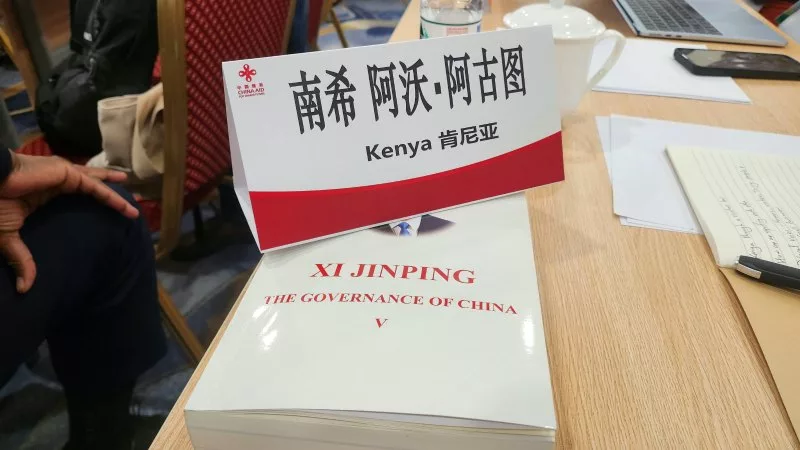
 Xi Jinping's book, The Governance of China /NANCY AGUTU
BEIJING — On a clear Tuesday morning in Shougang Park, retired steelworker Mr. Li points to the ski jump towering over abandoned blast furnaces and says the air is different now. "Before, you couldn't see the mountains," he says. Ten years ago, this was Beijing's largest source of pollution.
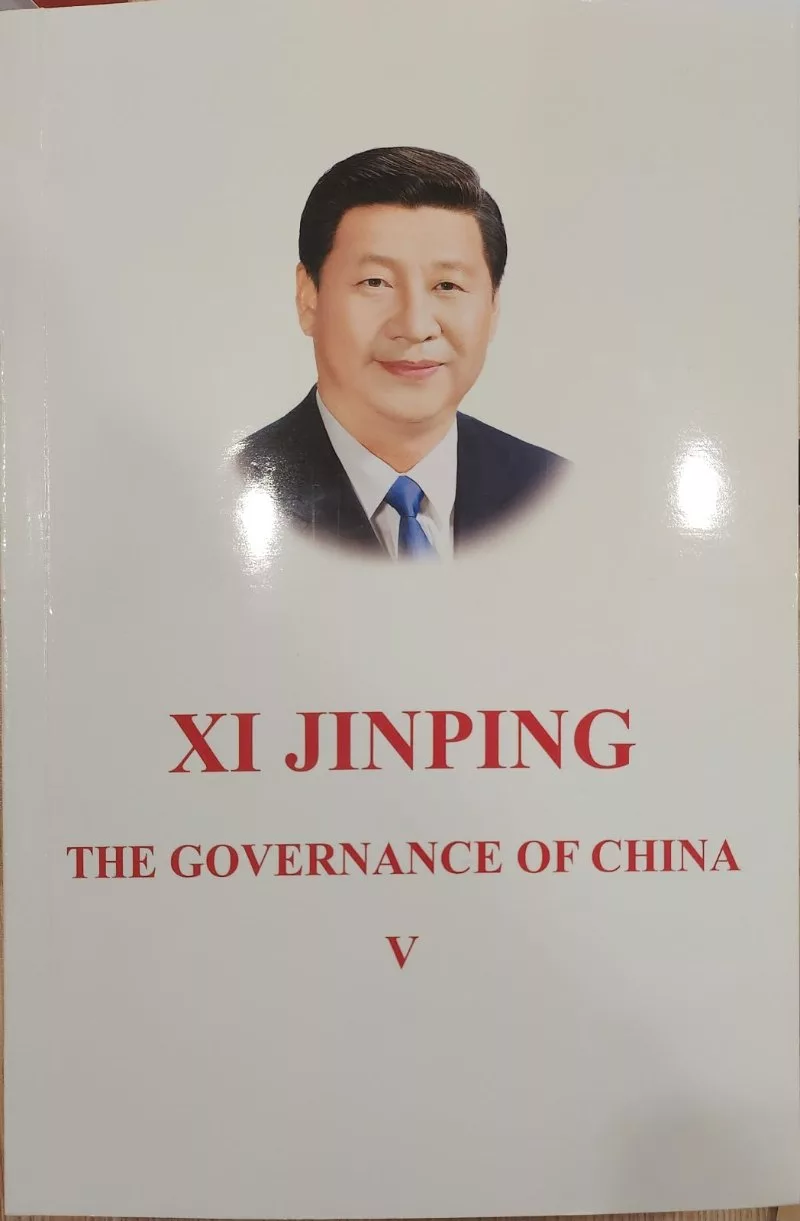
Today, it is a park. And it is the best place to read Chapter 1 of Xi Jinping: The Governance of China Volume V.
In the speech titled "Chinese Modernization: Harmony Between Humanity and Nature" delivered on July 17, 2023, Xi Jinping writes: "The next five years will be crucial in building a beautiful China." The core idea, the book states, is that "lucid waters and lush mountains are invaluable assets" and that China must "thoroughly implement the thought on eco-civilization of socialism with Chinese characteristics for a new era."
What does that look like in Beijing? Volume V provides a roadmap that can be checked against the city itself.
The Battle for Blue Skies
The book is blunt: "The blue skies initiative is a top priority." It specifically names the focus area as "the Beijing-Tianjin-Hebei Region and its surrounding areas, the Yangtze River Delta, and the Fenhe-Weihe River Plain."
The method, according to the text, is to "continue to control pollution in a targeted, well-conceived and law-based way" and to "optimize the industrial structure, the energy mix, and the composition of the transport sector."
In Beijing, that policy had a name: Move Shougang. The Shougang Steel Group, once employing 200,000 people in the capital, was relocated to Hebei. The book describes exactly this process as "promote advanced transformation of the steel, cement and coking industries to achieve ultra-low emissions." The book also calls to "bring about a shift in freight transport from highways to railways and waterways" visible now in the freight trains that bypass Beijing's center.
2. The Battle for Clear Waters
The second battle is defined in Volume V as "aimed at promoting harmony between humans and water."
Beijing is not a city known for rivers, but the Liangma River in Chaoyang district tells the story. Two years ago, it was on the city's list of black and fetid water bodies. Today, after dredging and ecological restoration, it is a 6-kilometer waterfront with cafes and paddle boats.
"They fish in that river," a colleague with whom we travelled to Beijing says as we link it to our Nairobi river back at home.
The river is a small-scale version of the book's goal to "largely eliminate black and fetid water bodies in urban and rural areas while creating a long-term mechanism."
The book further indicates that further north, Miyun Reservoir provides 60% of Beijing's drinking water. It is the living example of the chapter's pledge to "ensure the safety of drinking water in urban and rural areas" and "strengthen the protection and restoration of water source conservation areas." Fishing and farming are banned within 5 kilometers a local version of the "10-year fishing ban on the Yangtze River" mentioned in the same chapter.
3. The Battle for Clean Lands and the Future
The third battle, the book says, "is focused on better controlling pollution risks." For a visitor to Beijing, it is visible in the most mundane place: the trash bins. In every residential compound, four colored bins enforce what Volume V calls "the construction of zero-waste cities" and control of "plastic pollution at all points in the process."
But Volume V looks beyond cleaning up. It argues that "Upholding green and low-carbon development as a fundamental approach to resolving environmental problems" is necessary.
It sets hard limits: "We must ensure that the total area of China's farmland does not fall below the red line of 120 million hectares" and "strictly enforce red lines for ecological conservation."
And for the climate, it lays out the "1+N" framework: "We must actively and prudently work towards the goals of peak carbon and carbon neutrality" and "vigorously develop wind and solar power, coordinate hydropower development and environmental conservation, actively develop nuclear power in a safe and orderly manner, and step up efforts to build a new type of power system."
The chapter ends with an economic principle that ties the whole Beijing story together: "Those who contribute to protection and restoration will be appropriately rewarded, while those who damage the environment will pay the price."
In Shougang Park, former steelworkers now work as tour guides. The steel is gone, but the jobs remain.
Reading Volume V in Beijing, the concept of "Beautiful China" is not abstract. It is the blue sky over the old steel mill, the clean water in the city and the trash bins along the streets. It is, as the book says, supporting "high-quality development with a high-quality environment."