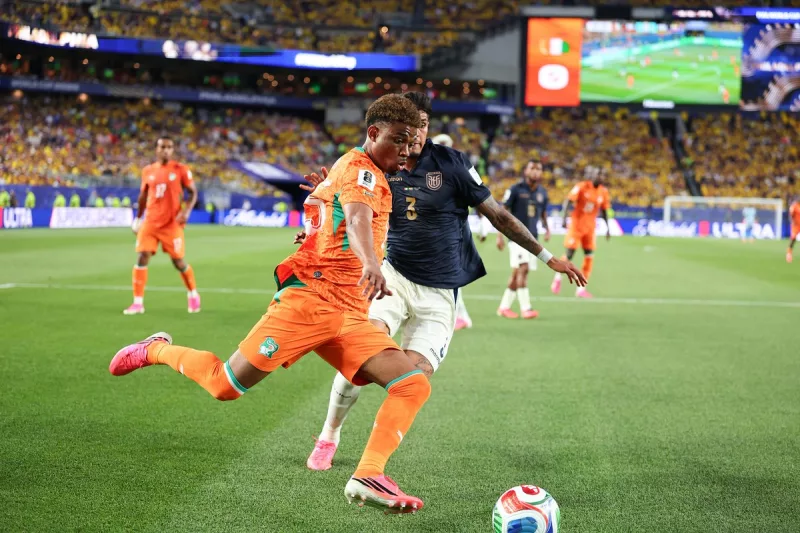
 Côte d’Ivoire competes at the 2026 FIFA World Cup. /FIFA
Côte d’Ivoire has emerged as Africa’s biggest source of elite football talent, according to a study that examined the presence of African players at some of the world’s most prominent clubs.
The June 2026 study by football predictions platform The Daily Punt analysed 25 leading clubs and ranked African countries according to the number of their players on the books of those clubs.
The exercise also considered players’ goals, assists and estimated market values to provide a broader picture of the quality and commercial appeal of the talent being produced.
Côte d’Ivoire topped the ranking with 17 players, narrowly ahead of the Democratic Republic of Congo and Nigeria, which each had 16.
The findings were based on a snapshot taken during the 2026 FIFA World Cup in June, meaning subsequent transfers, loan moves, retirements, changes in club status and the emergence of new players may have altered the picture.
That distinction is particularly important as the new European football season gets under way, with the English Premier League and other major competitions such as Serie A beginning to reshape the composition of clubs used in the study.
According to the study, Côte d’Ivoire had 17 players at elite clubs, the highest number recorded among African nations.
The average estimated market value of an Ivorian player in the study was about $39 million (Sh5.05 billion).
Overall, Ivorian players averaged 3.9 goals and 3.1 assists per season, suggesting a pool capable of making significant contributions in attack while also supplying players across different positions.
The study's conclusion was based largely on the depth of Ivorian representation across leading clubs and leagues rather than dependence on one or two high-profile players.
That depth gives Côte d’Ivoire an interesting advantage in a continent where several countries have traditionally relied on a smaller number of exceptionally prominent players to maintain their presence at the highest level.
The country's showing at the 2026 World Cup also provided some support for the broader picture. Côte d’Ivoire reached the knockout stage for the first time, finishing second in Group E before losing 2-1 to Norway in the round of 32.
DR Congo and Nigeria close behind
DR Congo finished second with 16 players at the selected clubs. Its players had a lower average market value of $23 million (Sh2.98 billion), while averaging 2.1 goals and 2.1 assists per season.
The study described this as a broad talent base rather than one built around a handful of standout stars.
Nigeria also had 16 players, matching DR Congo's total but recording a markedly stronger attacking return.
Nigerian players averaged 5.1 goals per season, the highest figure among the leading five countries, and had an average estimated value of $38.6 million (Sh5 billion).
That placed Nigeria almost level with Côte d’Ivoire in terms of average player value despite having one fewer player in the selected clubs.
The findings suggest that Nigeria's strength lies particularly in attacking talent, with the country's players producing a higher scoring return than their counterparts from the other leading nations.
The difference between the two countries is also reflected in their national teams. Nigeria was ranked 26th in the world in FIFA's July 20 ranking, while Côte d’Ivoire was 31st.
Senegal fourth, Ghana most valuable
Senegal occupied fourth position with 14 players. The average Senegalese player in the study was valued at $25.9 million (Sh3.36 billion) and contributed 2.4 goals and 1.6 assists per season.
The figures point to a relatively balanced production line, with Senegalese players represented in defence, midfield and attack.
Ghana completed the top five with 13 players but stood out for the financial value attached to its talent.
The average Ghanaian player was estimated at $40.9 million (Sh5.30 billion), the highest average among the five leading countries.
Ghanaian players averaged 2.9 goals and 2.4 assists per season. The contrast is revealing.
Ghana had fewer players than Côte d’Ivoire, DR Congo, Nigeria and Senegal in the selected clubs, but its smaller group carried a higher average valuation.
Cameroon has the biggest individual valuations
Further down the study, Cameroon produced perhaps the most striking figure. Only seven Cameroonian players featured among the selected clubs, but their average estimated market value was $88.84 million (Sh11.51 billion) per player.
They also averaged 11.1 goals, by far the highest scoring figure among the countries listed in the study. That makes Cameroon an outlier in the research: relatively few players, but exceptionally high average valuations and goal production.
Morocco also had seven players, with an average value of $38.47 million (Sh4.98 billion). Moroccan players averaged 2.9 goals and 3.6 assists.
Guinea-Bissau had six players, averaging $19.78 million (Sh2.56 billion), 0.8 goals and 0.5 assists.
Mali had four players valued at an average $32.24 million (Sh4.18 billion), with 2.0 goals and 2.3 assists.
Algeria also had four players, but recorded an average value of $41.93 million (Sh5.43 billion), alongside 3.3 goals and 4.8 assists.
What does FIFA ranking say?
The talent-production ranking does not correspond neatly with national-team strength.
FIFA's July 20 ranking, the latest official ranking before its next scheduled update in October, placed Morocco as Africa's highest-ranked side at sixth in the world.
Senegal was 18th, Nigeria 26th, Algeria 29th and Côte d’Ivoire 31st. That means Côte d’Ivoire, despite topping The Daily Punt's talent-production study, was only the sixth-highest African nation in FIFA's ranking.
Senegal provides the clearest contrast. It ranked fourth in the Daily Punt study for the number of players at prominent clubs but was second in Africa and 18th globally in FIFA's ranking.
Nigeria was third in the study and fourth in Africa according to FIFA, while Ghana's position illustrates an even bigger gap: it was fifth in the talent study but only 65th in the world in FIFA's July ranking.
The difference between the two measures indicates that having players at elite clubs does not automatically translate into national-team success.
International football depends on factors such as team cohesion, coaching, player availability, tactical systems and the quality of players in positions that may not be reflected by transfer valuations.
The 2026 World Cup offered some further evidence. Morocco, Africa's highest-ranked side, reached the quarter-finals and finished joint seventh overall, cementing its status as one of the continent's strongest performers on the global stage.
DR Congo, despite ranking only 41st in the world, reached the round of 32, its best-ever World Cup finish.
Côte d’Ivoire also reached the knockout stage, while Senegal went out in the round of 32 after a late collapse against Belgium.
Ghana reached the round of 32 before losing to Croatia, while Nigeria did not feature in the tournament.
A picture that may already have changed
The study was conducted in June, when the 2026 World Cup was being played, and its assessment depended on which players were attached to the selected clubs at that particular point.
The transfer window that followed has since changed the composition of several squads. Players have moved between clubs, while others may have changed from fringe or reserve roles to first-team players.
The start of the 2026-27 European season provides a natural reminder that a player transferring from one major league to another can change the representation of his country in a study such as this without the underlying talent base in that country changing at all.
The findings are consequently best read as a snapshot of where African football talent was concentrated at the time of the research.
And as the new European season unfolds, the more interesting question may not simply be which country has the most players at elite clubs, but which of these football talent hotspots can consistently convert that individual quality into success on the biggest international stage.