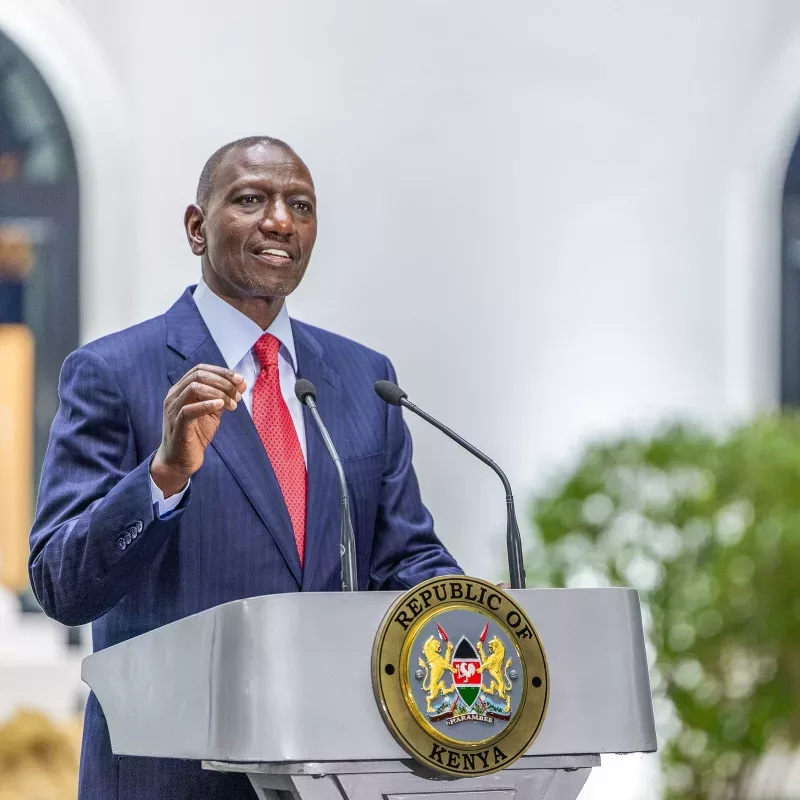
 President William Ruto/FILE
President William Ruto has called for urgent action to verify and settle pending bills owed by county governments, warning that unpaid government debts are hurting businesses, destroying jobs and weakening public confidence.
Speaking during the 13th National and County Governments Coordinating Summit at State House, Nairobi, on Tuesday, Ruto said pending bills were a major concern as the country approaches the next election cycle.
“For many enterprises, especially small and medium-sized businesses, an unpaid Government bill is not merely an accounting entry. It is working capital withheld, salaries delayed and livelihoods placed at risk,” Ruto said.
He called on the Office of the Controller of Budget and the Office of the Auditor-General to support county governments in verifying pending bills, establishing credible payment programmes and facilitating their settlement.
Ruto said county governments have been allocated Sh503.5 billion for the 2026/27 financial year, comprising Sh428 billion in equitable share and Sh75.5 billion in conditional allocations.
He noted that the equitable share had increased from Sh415 billion in the previous financial year to Sh428 billion.
However, Ruto said strengthening devolution should not be measured solely by the amount of money transferred to counties.
“Strengthening devolution is not simply about transferring more money. It is about converting every shilling into a service, every allocation into an opportunity and every public investment into a measurable improvement in the lives of citizens,” he said.
The President also disclosed that recommendations on an interim Sh65.9 billion allocation for functions transferred to counties had been developed by the Intergovernmental Relations Technical Committee (IGRTC) in collaboration with the Commission on Revenue Allocation.
According to Ruto, the recommendations will be submitted to the National Treasury for consideration in the 2027/28 financial year, with the aim of facilitating the transfer of the required resources to county governments.
He said resources must be accompanied by accountability, noting that a framework for evaluating the performance of both levels of government had been developed, but sectoral evaluation had not started because of budgetary constraints.
Ruto directed the National Treasury to work with IGRTC to identify immediate priorities and provide resources to commence the exercise.
“What is not measured cannot be improved; what is not evaluated cannot be strengthened; and what is not accounted for cannot inspire public confidence,” he said.
The President also outlined five immediate priorities for the Summit, including operationalising intergovernmental sector forums, strengthening alternative dispute resolution, settling pending bills, evaluating government performance and accelerating the transfer of legal ownership of gazetted assets to counties.
Ruto said the priorities were aimed at making devolution work through clearer responsibilities, adequate resources, efficient dispute resolution and stronger accountability.
“Kenyans do not experience devolution through budget figures or institutional structures. They experience it through medicine in hospitals, water in their homes, accessible roads, productive farms, cleaner towns, and responsive public services,” he said.
He also assured governors that National Government institutions implementing programmes that intersect with county mandates would consult and cooperate with county governments.
“Our mandates may be distinct, but the citizen we serve is the same; our responsibility is shared; and our objective is one: to improve the lives of the people of Kenya,” Ruto said.