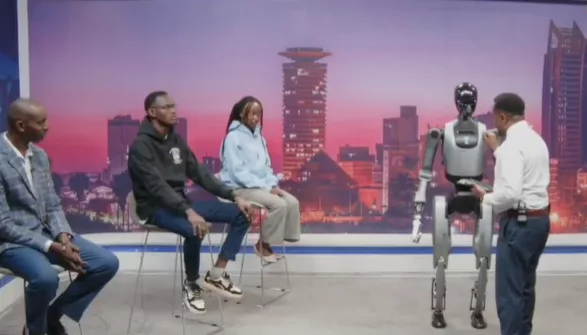
 During the early stages of the interaction, Mutembei appeared to struggle with the presenter's accent, resulting in a series of misunderstandings.
Kenyan television may have witnessed the debut of a humanoid robot during a live broadcast on Tuesday when students from Mount Kenya University presented Walker E, an advanced educational robot, during a breakfast debate on TV47.
Nicknamed Mutembei, the robot, which is designed with a human-like body, was put through a series of tests to demonstrate its ability to decipher verbal communication and interact physically with humans.
But what began as a showcase of robotics and artificial intelligence quickly turned into a practical demonstration of one of the challenges facing AI systems — understanding accents and variations in human speech.
During the early stages of the interaction, Mutembei appeared to struggle with the presenter's accent, resulting in a series of misunderstandings.
"Walker, what's your nickname? What do they call you at Mount Kenya University?" the presenter Fred Indimuli asked.
The robot's voice-recognition system appeared unable to capture the question and remained silent for about a minute.
When it eventually responded after the question was repeated, its answer was far removed from what the presenter had asked.
"I'm sorry, but Manten University is a different institution from Mount Kenya University. The term that you're referring to might be specific to Manten University, but I don't have the exact context or information about it without more details. Are you looking for a specific name or title there? If you can provide more details, I'll do my best to help you."
The misunderstanding continued as the presenter repeated the same question several times, with Mutembei producing similar responses.
It was only after the question was put to him again, this time more slowly, that the robot appeared to understand what was being asked.
"Hallo there, my name is Walker, but you might hear me called Mutembei. I'm here to help people navigate university, answer questions about courses and departments and support anyone who needs information or assistance. How can I help you today?" he responded.
The exchange offered an unscripted glimpse into a problem that can arise when AI-powered systems are exposed to accents and speech patterns that differ from those represented in their training data.
Linguistic bias can occur when speech-recognition systems perform less accurately because they have been trained predominantly on particular accents or dialects, making it harder for them to interpret other valid variations of spoken language.
In Mutembei's case, the difficulty was particularly notable because the robot was being demonstrated in Kenya, while its speech-recognition capabilities were developed in a technological ecosystem outside the country.
Mount Kenya University acquired the robot rather than manufacturing it from scratch. This means its underlying systems were developed and trained before it arrived in Kenya, potentially exposing it to speech patterns and accents different from those commonly encountered in the country.
As the interaction progressed, however, the robot appeared to become more responsive to the presenter's speech, with the accuracy of its responses improving.
Its physical capabilities were also put to the test when the presenter asked it to dance towards the end of the interview.
Although its movements were relatively primitive, Mutembei was able to coordinate a sequence of movements in response to the instruction, providing a glimpse of how humanoid robots can combine language processing with physical interaction.
The university unveiled the Walker E humanoid robot in November 2025 at its Thika Main Campus as part of its Robotics, Artificial Intelligence, Data Science and Immersive Technologies Lab.
The laboratory is designed to give students hands-on experience in programming, training and testing new AI algorithms, machine learning models and computer vision applications.
The TV demonstration therefore went beyond the novelty of seeing a human-shaped machine interact with presenters.
It provided students with an opportunity to test the technology in a real-world environment while exposing viewers to both the potential and limitations of AI-powered machines.
With continued investment in robotics and AI, learning institutions can use such technologies to foster creativity, practical skills and problem-solving while preparing students to participate in a rapidly changing technological landscape.
For Kenya's universities, such technologies could provide a new avenue for students to move beyond theoretical learning and experiment with systems that are increasingly shaping workplaces and industries around the world.
The interaction also showed that adopting advanced technology comes with its own learning limitations.
For AI systems to work effectively in diverse environments such as Kenya, there's a need to programme them to be able to recognise and respond to the country's wide range of accents, speech patterns and linguistic variations.