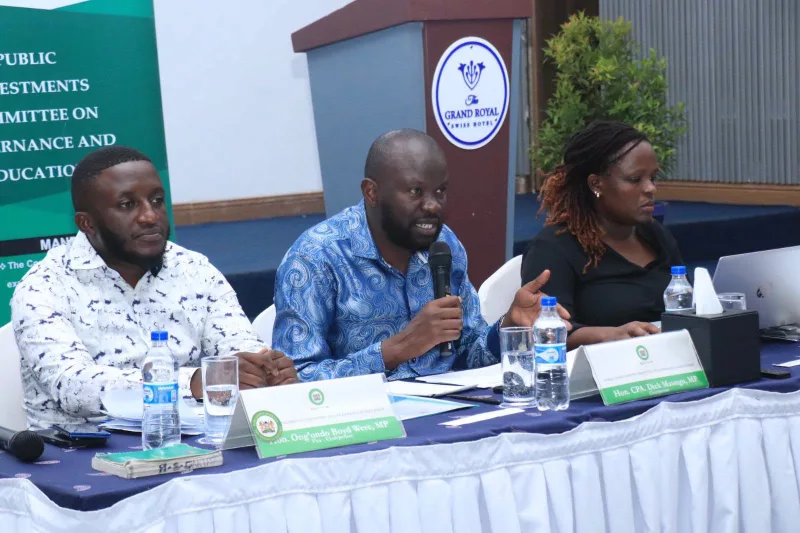
 National Assembly’s Public Investments Committee on Governance and Education chaired by Luanda MP Dick Maungu hold sittings at Royal Swiss Hotel in Kisumu, September 4 /PARLIAMENT
The Kenya Secondary School Heads Association (KSSHA) is on the spot over millions of shillings paid by public secondary schools, with MPs questioning whether the transfers have a legal basis and whether the funds are properly accounted for.
The National Assembly’s Public Investments Committee on Governance and Education plans to summon KSSHA officials to explain the legal status of the transfers and how the money received from public schools is managed.
The issue arose during the committee’s review of Auditor General reports for selected high schools covering the 2020-21 to 2024-25 financial years at a retreat in Kisumu on Friday, September 4.
The committee raised concerns after auditors raised questions over the legality and accountability of such transfers.
The Auditor General’s report said one school transferred Sh1.247 million to KSSHA for the year ended June 2024.
The auditor questioned the payment, noting that KSSHA is a welfare organisation whose membership comprises school principals and that it is not defined within the government funding system.
The audit further found no assurance that KSSHA had effective, efficient and transparent financial management and internal control systems for managing funds transferred by schools.
It said the payment contravened Regulation 23(2)(c) of the Public Finance Management (National Government) Regulations, 2015, which requires an accounting officer to obtain written assurance from an entity before transferring funds to it.
“Management was in breach of the law, and the value for money realised from the expenditure of Sh1,247,220 could not be confirmed,” the Auditor General said.
In their submissions, institution heads from three schools in Nyanza told the committee that the payments to KSSHA were meant to support extra-curricular activities, including sports, drama, music and other competitions.
One teacher told the committee that the funds were used for co-curricular activities after KSSHA sent requests to schools to finance the activities.
“The funds transferred to KESSHA are for conducting co-curricular activities. Each year KESSHA sends requests to schools for funding the budget for co-curricular activities,” the teacher said.
Another school head said the payments supported student welfare and participation in competitions, arguing that failure to contribute could leave students unable to take part in regional and national events.
He said the monies go towards supporting student welfare and participation in sports, drama, music and other competitions.
“The payments were purely for student welfare and co-curricular activities,” the teacher said.
But the committee said the explanation did not by itself justify transferring public money to KSSHA, arguing that the activities being funded did not remove the requirement for schools to comply with public finance laws.
Committee chair, Luanda MP Dick Maungu, said the committee needed to establish whether KSSHA is a legitimate recipient of public funds and whether money channelled to it is subjected to proper public financial controls and audit.
“What is coming out clearly is that most of these schools contribute money to an organisation known as KSSHA,” he said.
The committee noted that one school had paid about Sh6 million to KSSHA over five years, while another had paid approximately Sh5 million, raising the possibility that aggregate contributions from public schools could run into billions of shillings.
“These are billions if you convert them into all the schools in the country,” Maungu said.
“We want to find out whether KSSHA is a recipient of public money and whether the activities they are undertaking are audited by the Auditor General.”
Kiminini MP Maurice Kakai Bisau questioned why public schools should transfer money to an organisation he described as outside the formal government structure.
“KSSHA remains a private club managed by members of the teaching fraternity,” Bisau said.
Lungalunga MP Chiforomodo Mangale said the committee first needed to establish the legal framework governing the transfers.
“We must start from the point of understanding how these funds are transferred. KSSHA is an association for teachers and school heads, but it has no direct relationship with government,” he said.
Maungu said the committee was not questioning the importance of extra-curricular activities, but the legality and accountability of the mechanism through which schools finance them.
“The education activities may be good and necessary, but that does not mean public funds can be transferred outside the framework of the law,” he said.