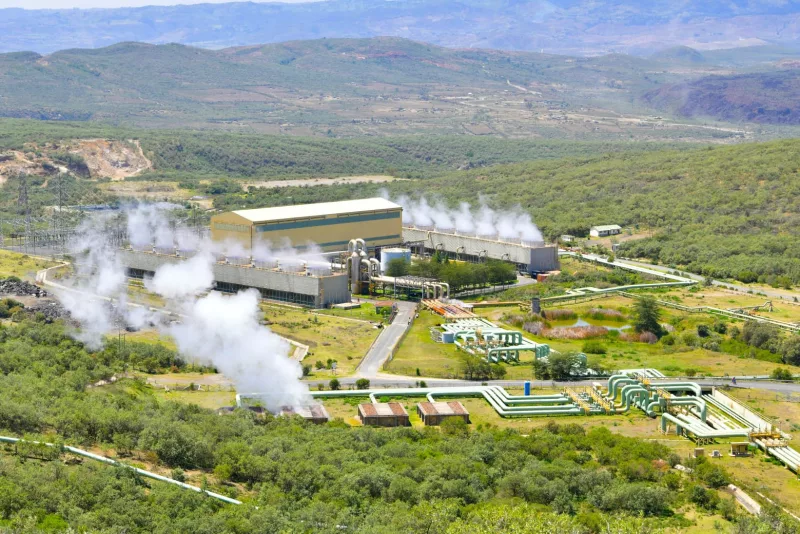
 One of KenGen's geothermal plants in Olkaria
Power generator Kengen's share price extended its strong run at the Nairobi Securities Exchange last week, underscoring renewed investor appetite for the energy sector.
Kengen however reported a marginal decline in annual earnings. The stock closed at Sh12.55 on Friday after touching an intraday high of Sh13.10 on Thursday.
The Friday price was still 14.6 per cent higher than at the beginning of the week, according to market data.
The rally came as KenGen reported a relatively stable financial performance for the year ended June 30, 2026.
Profit after tax slipped 1.2 per cent to Sh10.4 billion from Sh10.5 billion a year earlier.
The decline was largely linked to lower finance income, which fell from Sh4.1 billion to Sh2.9 billion after the company deployed more of its cash into capital investments aimed at expanding and strengthening electricity-generation capacity.
In contrast, the underlying operating business remained resilient.
Revenue rose 6.4 per cent to Sh59.7 billion from Sh56.1 billion, while operating profit increased to Sh14.2 billion from Sh13.6 billion.
The numbers point to a company generating more income from its core operations even as returns from its cash holdings decline because funds are being redirected towards long-term projects.
That distinction is important for investors. The fall in finance income has weighed on the bottom line, but it also reflects a deliberate shift from holding cash to investing in productive assets.
KenGen has been expanding its development pipeline as Kenya prepares for sustained growth in electricity demand.
The company recently raised its long-term renewable-energy development pipeline to 5,500 megawatts from the earlier 1,500MW target, signalling a much more aggressive investment strategy.
KenGen chief executive Peter Njenga said the results reflected the company's operational resilience and its central role in meeting the country's growing electricity needs.
The market response suggests investors are looking beyond the small decline in earnings and pricing in the potential benefits of the company's investment programme.
KenGen's shares have gained 36.7 per cent over the past year. Its market capitalisation stood at about Sh82.8 billion as of Friday's close.
KenGen was not the only stock attracting attention.
Longhorn Publishers emerged among the week's notable gainers, with the share rising sharply to Sh2.99 on Friday, up 8.33 per cent on the day.
It had closed at Sh2.80 on Thursday.
The publisher has also remained a relatively tightly held company, with institutional investors owning the bulk of its shares.
Data by the Capital Markets Authority (CMA) in May showed local institutions held about 81.9 per cent of Longhorn.
The other major counters helping drive activity were Equity Group and Safaricom.
Equity was particularly strong, hitting the Sh100 mark during the week and extending a six-session winning streak.
Its market value climbed to about Sh396 billion, while trading volumes surged, with 5.24 million shares changing hands on Thursday alone.
Safaricom, meanwhile, continued to underpin the market's broader valuation gains.
The telecommunications giant has added hundreds of billions of shillings to its market capitalisation since the beginning of the year, reinforcing its position as the NSE's largest company.
The strength in individual counters was reflected across the wider market.
The Nairobi Securities Exchange All Share Index gained 3.67 percent in the week to September 3, while the NSE 25 and NSE 20 indices rose 4.40 per cent and 4.51 per cent respectively.
Market capitalisation closed at Sh4.28 trillion, representing a 3.75 per cent increase.
Trading activity also accelerated sharply. Total shares traded increased by 43.5 per cent, while equity turnover jumped 54.24 per cent.
The rally is significant because it suggests that the improvement in investor sentiment is no longer confined to a handful of stocks.
Banks, energy companies and other large counters have increasingly attracted domestic and institutional money as investors search for better returns in an environment of declining interest rates.
The shift is also occurring as returns on short-term government securities ease, potentially making equities more attractive to investors with longer investment horizons.
Moreover, the money markets continued to rally, with huge subscriptions for both T-Bills and bonds.
The September 3 Treasury-bill auction attracted bids worth Sh56.3 billion against an advertised Sh28 billion, translating into a 200.9 per cent performance.
The heavy subscription came despite declining yields on the 91-day and 182-day bills.
The 364-day bill, however, recorded a marginal increase in its interest rate.
The Central Bank of Kenya continues to auction 91-day, 182-day and 364-day Treasury bills weekly, giving investors alternatives across different maturity periods.
The appetite for government paper points to continued confidence in the sovereign debt market even as investors adjust to a lower interest-rate environment.
The Central Bank Rate is 8.75 per cent, while the 91-day Treasury-bill rate was about 8.77 per cent in early September. Longer-dated government debt also attracted strong demand.
At the September 2 Treasury-bond auction, reopened 15-year and 30-year bonds received bids worth Sh68.2 billion against an advertised Sh60 billion, representing a subscription rate of 113.7 per cent.
Market analysts say that the contrasting behaviour of equities and fixed-income securities points to a market undergoing a broad reallocation of capital rather than a wholesale flight from one asset class to another.
“Investors are continuing to buy government paper for relatively predictable returns while simultaneously increasing exposure to shares whose valuations and earnings prospects are improving,’’ Paul Komu, an investment advisor, told the Star.