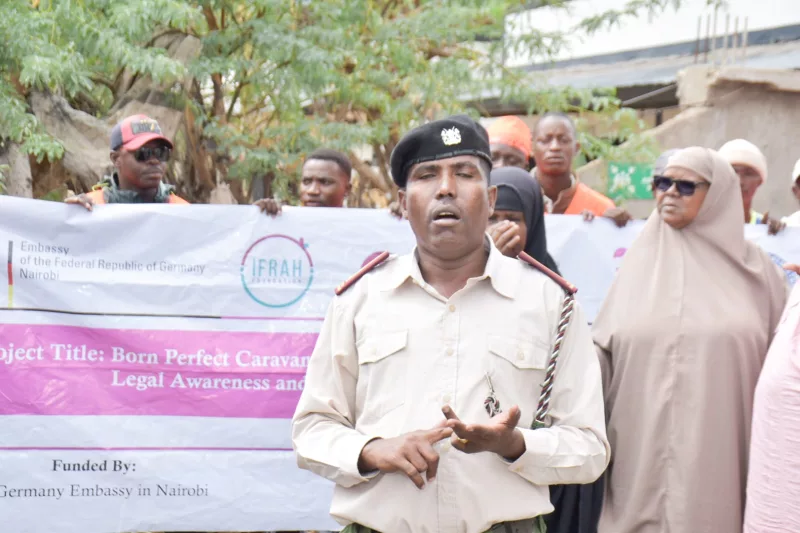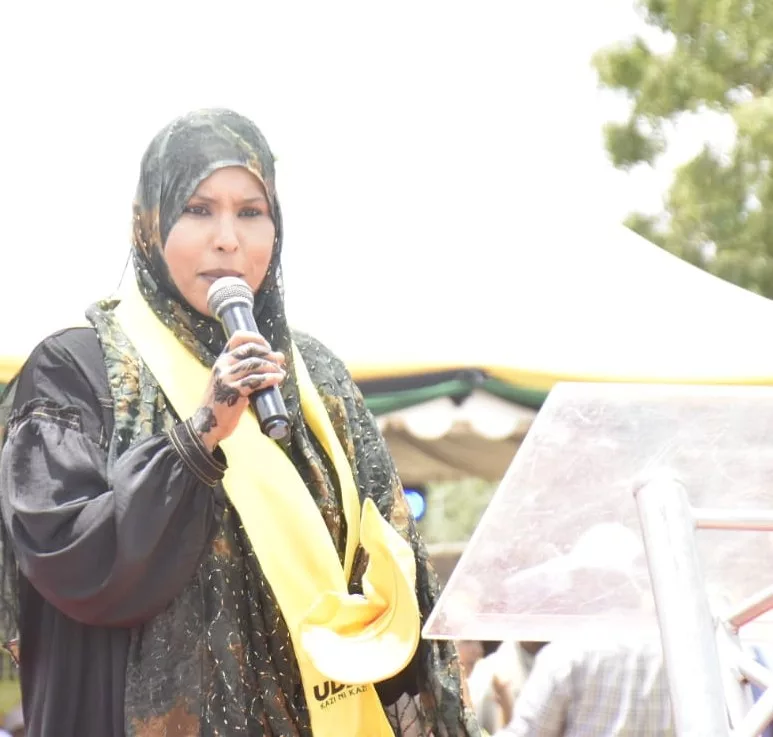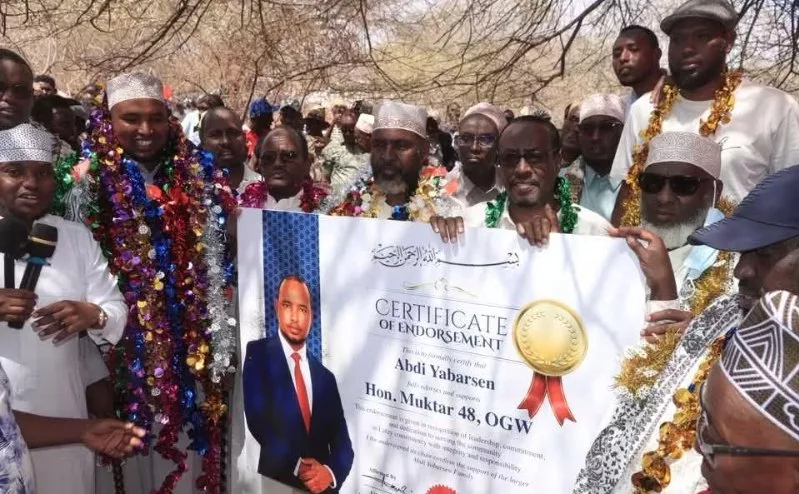
Lafey constituency MP aspirant Muktar Billow is issued an endorsement certificate by community members from Abdi Yabarsen sub-clan./STEPHEN ASTARIKO
Lafey constituency needs new leadership to unlock development, MP aspirant Billow says.
Lafey Constituency needs a change in leadership to break a cycle of underdevelopment and unlock its economic potential, youthful MP aspirant Muktar Billow has said.
Billow, who has already received endorsements from the Warfay and and the larger Yabarsen sub-clans, is positioning himself to challenge incumbent MP Mohamed Abdikheir in the 2027 General Election.
Addressing supporters in Lafey town, Billow blamed what he described as years of limited development on poor leadership, arguing that the constituency needs a new approach centred on infrastructure, healthcare, education, employment, security, investment and sustainable livelihoods.
“Lafey is endowed with hardworking communities, vast land and significant potential, but its development story remains one of unmet needs and missed opportunities,” he said.
Billow said residents should no longer settle for short-term interventions when the constituency requires long-term investments capable of transforming livelihoods.
“Lafey needs to catch up with the rest of Kenya. We cannot continue doing things the same way and expect a different outcome. Our people deserve better roads, better healthcare, better schools, reliable water and, most importantly, opportunities to earn a decent livelihood,” he said.
He questioned the development impact of successive MPs, arguing that despite substantial public resources being channelled to the constituency through various development programmes, many basic needs remain unmet.
“Our people must ask themselves: What can we point at and say this has fundamentally changed our lives? Billions of shillings have passed through the constituency over the years, but there is still a huge gap between what our people need and what is on the ground,” he said.
Billow promised to make accountability and public participation central to his leadership, saying residents should be involved in identifying priorities and monitoring projects from planning to completion.
“People should not hear about projects only when they are being launched. They should know what was allocated, where it is going, what it is supposed to achieve and whether it was completed. Leadership is about accountability to the people,” he said.
The aspirant singled out the slow growth of Lafey and Fino towns as evidence of the constituency’s untapped potential.
He said the towns need improved roads, markets, drainage, sanitation, lighting and public spaces to attract private investment and stimulate economic activity.
“We need to engineer vigorous change in our towns and create an environment where investors can see Lafey as a place worth investing in,” he said.
According to Billow, thriving urban centres would create markets, jobs and services while opening opportunities for surrounding communities.
Healthcare is another key pillar of his agenda, particularly maternal and emergency care.
While acknowledging that devolved health services fall under the County Government, Billow said political leaders must work across government levels to improve services.
“When our people are suffering, leadership cannot simply say, ‘That is a county function.’ We must collaborate, lobby and bring partners together to make healthcare better for our people,” he said.
He cited the plight of expectant mothers who may have to travel long distances for specialised treatment when complications arise, saying emergency referral systems must be strengthened.
His proposals include improving existing health facilities, maternity services, medical equipment and supplies, while lobbying national agencies and development partners for additional support.
On water, Billow said Lafey needs to move away from relying primarily on emergency drought interventions towards sustainable water security.
He proposed rehabilitating non-functional water points, expanding boreholes, promoting solar-powered water systems, improving storage and establishing reliable distribution networks.
“Relief is important when people are suffering, but resilience is the ultimate goal,” he said.
Billow identified poor roads as a major impediment to economic development, saying they increase transport costs and restrict access to markets, schools and health facilities.
He pledged to lobby for the upgrading and tarmacking of strategic roads while improving feeder roads linking villages to essential services and markets.
On education, he said Lafey must go beyond building classrooms and focus on quality learning, teaching staff, laboratories, libraries, digital opportunities and support for needy students.
He also wants greater investment in technical and vocational education to equip young people with employable skills.
“If we educate our young people but do not create opportunities for them afterwards, we will have solved only half of the problem. Education and employment must go together,” he said.
Billow proposes supporting youth enterprises, improving access to finance and markets, expanding digital skills and linking young people to government procurement opportunities.
“Our young people do not lack ideas. What they lack is an enabling environment, capital, skills, markets and opportunities. Leadership must help create that environment,” he said.
Billow said women should be active participants in development rather than being mobilised primarily during election campaigns.
“Women should not be used as a campaign tool and then forgotten. Women must be part of development, decision-making and economic empowerment throughout the entire term, not only during campaigns,” he said.
He proposed support for women-led enterprises and cooperatives, skills development and greater participation in agriculture and livestock value chains.
On food security, Billow said Lafey must reduce its dependence on relief during drought by investing in sustainable production.
His proposals include irrigation, solar-powered farming, drought-resistant crops, water harvesting, community gardens, farmer cooperatives and better access to certified seeds and farm inputs.
He also wants greater investment in livestock through fodder production, veterinary services, livestock health programmes and improved markets, alongside food storage and value addition.
Billow said insecurity threatens virtually every other development effort by discouraging investment, disrupting education and restricting access to healthcare and markets.
He proposed stronger cooperation between communities and security agencies, improved emergency communication and greater involvement of elders, religious leaders and community structures in preventing and resolving insecurity.
He argued that creating jobs and economic opportunities for young people would also contribute to building more peaceful and resilient communities.
He insisted that the contest should not be reduced to personalities or clan politics, but should focus on the constituency’s development trajectory.
“This is not about changing a name on a ballot paper. It is about changing the reality on the ground. We want a Lafey where a mother can access emergency healthcare without travelling for hours, where our towns attract investors, where our roads are improved, where our children receive quality education and where our young people can find meaningful opportunities,” he said.
Ends………………..
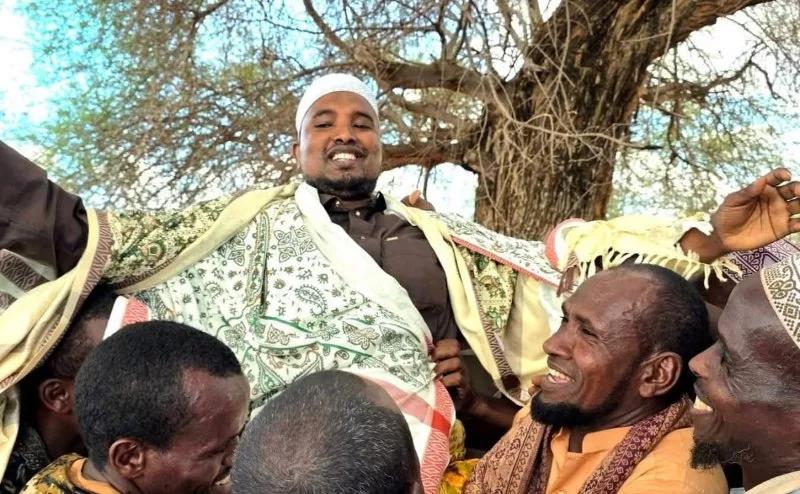
Lafey constituency MP aspirant Muktar Billow is lifted shoulder high during the endorsement ceremony. /STEPHEN ASTARIKO
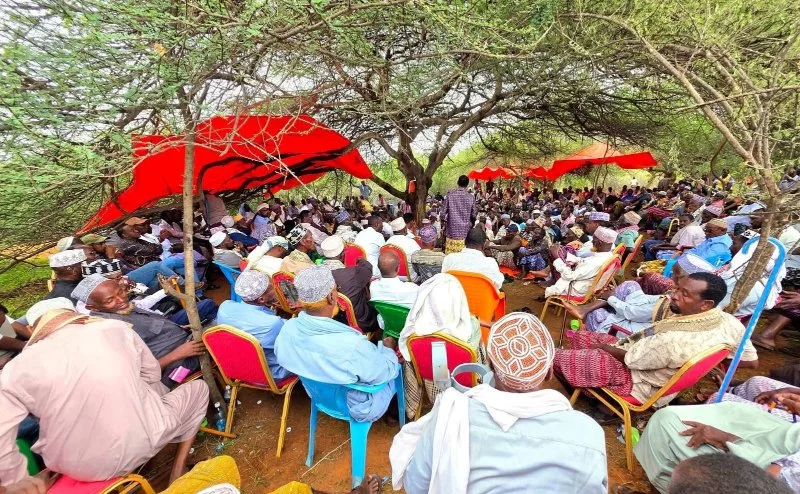
Community members from the Abdi Yabarsen sub-clan during the endorsement ceremony. /STEPHEN ASTARIKO