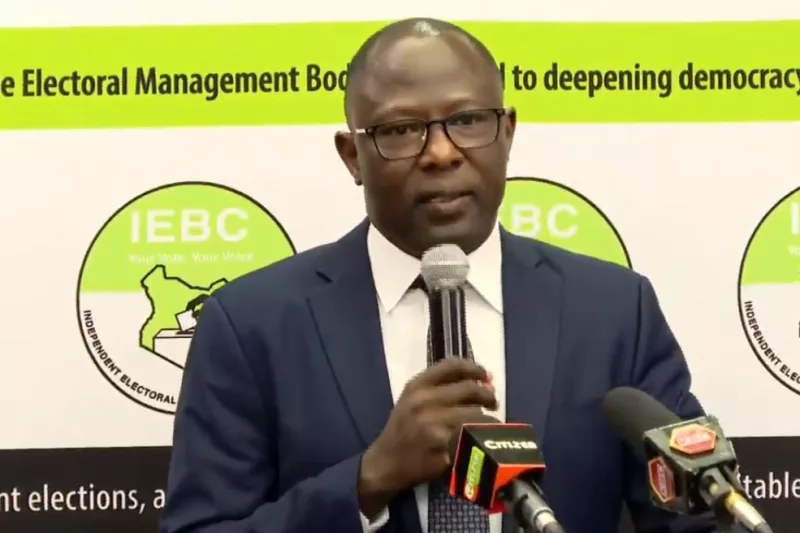
The Independent Electoral and Boundaries Commission (IEBC) faces a Sh34 billion funding shortfall ahead of the 2027 general election.
This is after the National Treasury committed only Sh41 billion of the Sh74.8 billion budget MPs approved for the polls.
The funding gap could pile pressure on the electoral agency as it races to complete preparations for the elections including acquisition of election technology.
IEBC has also lined up a second mass voter registration, seeks to conduct voter education, has logistics to take care of as well as procurement of election materials.
The National Assembly’s Justice and Legal Affairs Committee had backed a record Sh74.8 billion budget for IEBC to finance its preparations and conduct of the 2027 elections.
The money was expected to be available by June 2027 to enable the commission complete preparations and conduct the polls.
However, the Draft 2026 Budget Review and Outlook Paper shows that Treasury’s provision for the commission during the electioneering period will amount to only about Sh41 billion.
This leaves the electoral agency with a shortfall of nearly Sh34 billion against the budget approved by Parliament, raising fresh questions about whether IEBC will be sufficiently resourced for the polls.
Treasury says IEBC will receive Sh16.4 billion in the 2027-28 financial year and another Sh29.2 billion in the subsequent year.
The commission has already been allocated Sh24.9 billion in the current financial year.
Taken together, the allocations amount to Sh70.5 billion, which is still below the Sh74.8 billion requirement approved by Parliament.
More significantly, Treasury's projections indicate that the commission's total allocation over the relevant budget period will remain below the amount Parliament has approved.
This is likely to leave IEBC to seek additional resources if it is to meet its full election budget, yet much of the election preparation has to be completed before polling day.
IEBC requires money well in advance to procure election materials, prepare and test election technology, recruit and train temporary election officials.
It is also expected to undertake voter registration and verification and organise the movement of materials across the country.
Any delay in releasing funds could therefore affect procurement timelines and preparations for the polls.
“Funds are critical to the electoral process and we must strive to ensure there is no delay, and no accumulation of pending bills,” Elog National Coordinator Mule Musau said Thursday.
The commission earlier said it needed Sh74.8 billion to conduct the 2027 general election, reflecting the rising cost of elections and the need to replace ageing equipment.
Most of the billions are to go to the new Kenya Integrated Election Management System kits, with the existing equipment set to be replaced after years of use.
The commission plans to undertake total replacement of 45,353 kits that had been purchased in 2017, with the 14,000 purchased in 2022 to be reused in the 2027 general elections.
IEBC told MPs that the total required Kiems kits are 59,352, being 55,393 for polling stations and 3,959 for training. With no clear budgets, IEBC’s bid to retire old kits is in limbo.
Besides the Sh9.3 billion for KIEMS kits, MPs also approved Sh2.7 billion for ballot papers and statutory forms.
MPs also okayed additional Sh2.7 billion for voter registration and biometric verification, and Sh5.2 billion for hiring temporary poll officials – clerks, presiding officers, and other poll officials.
Transport and field mobility received Sh1.5 billion, while public communication and citizen engagement was allocated Sh1.7 billion more.
The Treasury position now puts pressure on Parliament to find additional resources for the commission before the election.
The National Assembly had backed the larger allocation after IEBC presented its budget requirements for the 2027 polls.
In what points to the looming trouble, the government is already facing a tight fiscal environment, with the Draft BROP projecting a Sh1.321 trillion deficit in the 2027-28 financial year.
Treasury expects to finance the deficit through Sh1.085 trillion in domestic borrowing and Sh235.9 billion in external financing.
The fiscal pressure could make it difficult for IEBC to secure the additional funds without cuts elsewhere or seek a supplementary allocation.
A cash-strapped IEBC could face difficulties replacing obsolete equipment, expanding voter registration, training election officials and preventing manipulation of the electoral process.
The CS John Mbadi-led Treasury itself acknowledges that the 2027-28 budget is being prepared within a constrained resource envelope, staging the need for discipline and prioritisation.
Kenya’s election is regarded as among the most costly compared with its peers. In 2013, taxpayers spent Sh25 billion, most of which was for buying kits.
In 2017, the figure went up to Sh49 billion while the 2022 election cost Sh44 billion despite some election kits being reused.
Ahead of the 2022 election, the IEBC spent Sh4.2 billion on election technology, including 14,100 new kits supplied by election technology firm Smartmatic.
At the time, the commission maintained that more than 41,000 older KIEMS kits were still operational. Now, the IEBC says up to 45,352 kits require replacement.