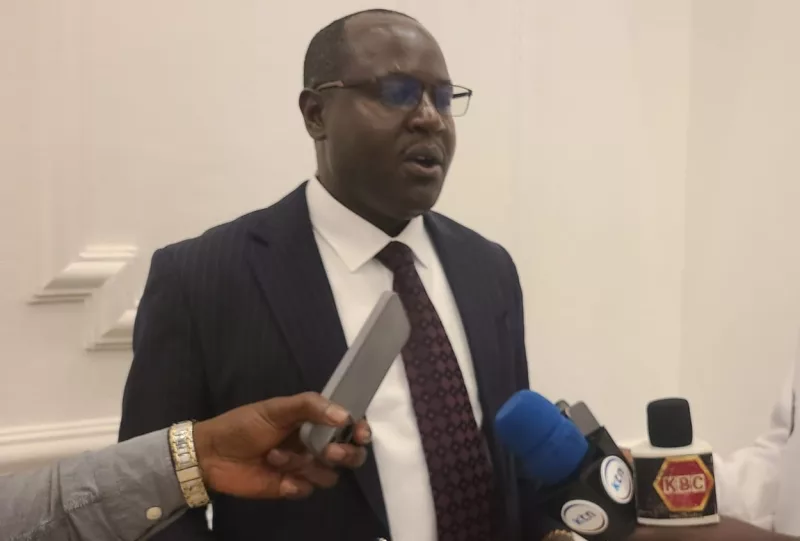
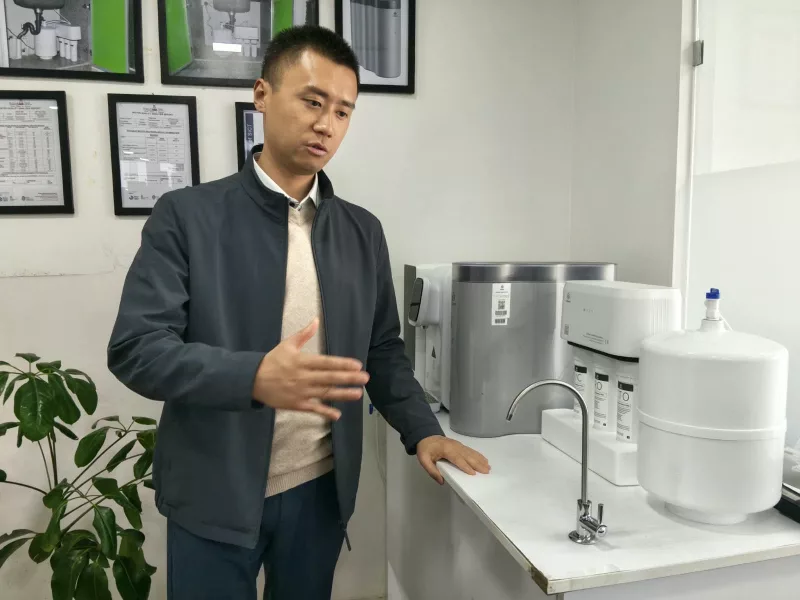
 iClear co-founder and CEO Yanxiong Zhong /JACKTONE LAWI
Kenya's persistent water shortages and growing reliance on mixed water sources are creating a fast-growing market for household water purification systems, as companies race to meet demand from consumers seeking safe drinking water amid unreliable municipal supplies.
Water treatment firm iClear says demand for home purification systems has risen as more households grapple with intermittent water supply, forcing them to rely on a combination of municipal water, boreholes and water bowsers whose quality can vary significantly.
As Nairobi's population continues to grow, its water supply is no longer sufficient.
The Kenyan capital already faces a daily shortfall of hundreds of millions of liters, forcing researchers to search deeper underground for new sources.
"The municipal water system is not able to cover 100 per cent of the population. Some regions cannot access the system while others receive water on a rotational basis. People therefore rely on different sources, and the water they use every day is mixed," said iClear co-founder and CEO Yanxiong Zhong in an interview with the Star.
According to Zhong, the inconsistency in water quality is prompting more households to install reverse osmosis (RO) systems capable of removing dissolved salts, fluoride and other contaminants that conventional methods such as boiling cannot eliminate.
The trend reflects a broader challenge facing Kenya's urban water sector.
Data from the Water Services Regulatory Board (WASREB) shows millions of Kenyans still lack access to safely managed drinking water, while utilities continue to struggle with growing demand driven by rapid urbanisation and population growth.
The city’s available production estimated at about 525,600 cubic metres a day against projected demand of roughly 1.2 million cubic metres.
This translates to a shortfall of approximately 674,400 cubic metres, or 674 million litres of water every day, highlighting the scale of investment required to secure reliable supplies for the capital.
In Nairobi, residents frequently experience water rationing, with many estates receiving piped water only on designated days of the week, forcing households to invest in storage tanks and alternative water sources.
The situation has created a commercial opportunity for companies specialising in domestic water treatment, a segment that until recently occupied only a small niche within the broader water equipment market.
"When water is only available one or two days a week, people have to store it in tanks and containers for future use. Because they are sourcing water from different places, they cannot always guarantee its safety," Zhong said.
"Boiling can kill bacteria and viruses, but it cannot remove salts, fluoride or other dissolved minerals. That is where reverse osmosis comes in."
Unlike many competitors that combine water purification with businesses such as borehole drilling, irrigation systems and swimming pool equipment, iClear has focused exclusively on household reverse osmosis systems, betting that rising concerns over drinking water quality will sustain long-term demand.
The Hong Kong-headquartered company entered Kenya in 2022 and now operates branches in Nairobi and Nakuru, with plans to establish a third outlet in Mombasa before the end of the year.
The coastal expansion is being driven by increasing customer enquiries and the region's long-standing challenges with saline water.
Its entry underscores how Kenya is becoming an increasingly attractive market for water treatment technology providers as consumers spend more on improving water quality at home.
The company's bestselling unit, priced at about KSh25,000, targets households of three to five people, while larger systems serve offices and commercial users.
Zhong said household demand has remained the strongest as middle-income families increasingly view purified drinking water as an essential household investment rather than a discretionary purchase.
Industry players are also forging partnerships with property developers to install purification systems in newly completed residential estates before homeowners move in, signalling a shift towards integrating water treatment into modern housing developments.
Where pre-installation is not possible, companies’ market directly to new homeowners as they occupy the units.
Beyond equipment sales, companies are increasingly competing on after-sales services, with customers required to replace filters periodically to maintain water quality.
iClear says it has positioned itself as a service-led business, providing installation, maintenance and scheduled filter replacement to build long-term customer relationships.