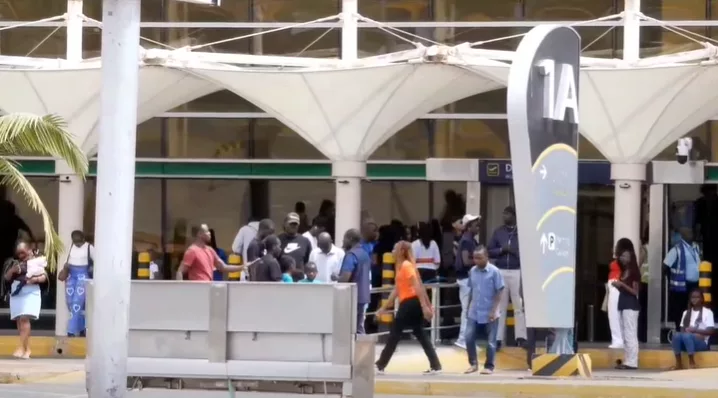
 Stranded passengers at JKIA following aviation workers' strike that disrupted flights.
Failure by the government and aviation agencies to fulfil commitments made under a framework agreement reached with workers in July has triggered fresh industrial action in Kenya, disrupting flights and leaving passengers stranded at Jomo Kenyatta International Airport (JKIA) and other airports.
The Kenya Aviation Workers Union (KAWU) suspended an earlier strike notice on July 27 after reaching an agreement with the government and aviation agencies to address a raft of grievances within 30 days.
The union later lifted the suspension, saying key commitments had not been fulfilled, leading to the latest strike.
The dispute has also been fuelled by longstanding grievances over remuneration, recruitment policies and demands for changes to the management boards of key aviation agencies.
"Since 2015, 1st of July, KCA staff have never had a salary review or salary increment," KAWU secretary general Moss Ndiema said as the strike began on Sunday.
He claimed the Salaries and Remuneration Commission (SRC) had told workers it lacked the resources to implement CBAs retrospectively but was willing to implement arrears accrued from the current pay deal, which dates back to 2023.
"We are saying no," Ndiema said.
The strike involves air traffic controllers and airport workers affiliated with the Kenya Civil Aviation Authority (KCAA) and Kenya Airports Authority (KAA).
Why are flights being disrupted?
The industrial action has slowed air traffic control and affected airport operations, resulting in delays, cancellations and rescheduled flights.
From JKIA to Moi International Airport in Mombasa, airlines have been forced to adjust their schedules as the union maintains there will be no compromise without its demands being addressed.
"There will be no return to work formula without a recognition agreement and a condition that all disciplinary decisions that have been made for the last two years have to be reviewed," Ndiema said.
KCAA confirmed that air traffic control services had been slowed by the strike, resulting in rolling delays and flight diversions across the country.
What has KAA said?
As the disruption intensified, KAA urged passengers to contact their airlines for the latest information on flight status before travelling to the airport.
The authority said it was working closely with airlines and other aviation stakeholders to mitigate the operational impact of the disruption and to facilitate the safe, secure and orderly operation of the airport.
"KAA regrets the inconvenience caused and appreciates the patience and understanding of passengers and others as the situation is addressed."
More than 24 hours after the assurance, however, disruptions persisted, with some airlines moving affected passengers to hotels.
Some carriers also advised passengers with flights scheduled during the disruption not to travel to JKIA until they have confirmed their updated flight status through airline apps or customer support channels.
Kenya Airways said delays exceeding six hours had created a backlog, forcing it to cancel and reschedule some flights.
The national carrier said its teams were working round the clock to manage the disruption and minimise its impact.
"We advise our customers to only come to the airport once they have a confirmed flight. Customers who would like to change/reschedule their flights can do so without penalty," Kenya Airways said in a statement on Monday.
It also advised passengers to update their contact details on the Kenya Airways website or KQ Mobile App to ensure they receive the latest travel notifications.
The airline said passengers who opt to change or reschedule their flights will not incur any extra costs.
What does the strike mean for passengers?
Travellers have borne the immediate impact, with some spending hours at airports as they wait for information on their flights.
Those affected may incur additional costs for food, local transport and accommodation.
Passengers who miss connecting flights may also have to rearrange their travel plans, particularly where the connecting flight was booked separately.
Families travelling with children face additional challenges when forced to spend long periods in crowded terminals or make unexpected overnight arrangements.
The disruption is also affecting businesses that depend on air travel, including tour operators, taxi operators, hotels and other tourism-related services.
Who pays when a flight is cancelled or delayed?
Airlines may be required to provide assistance or compensation depending on the circumstances of the disruption and the applicable passenger-rights framework.
As a general aviation practice, airlines are expected to provide remedies such as rebooking, refunds, care and, in some jurisdictions, cash compensation where disruptions are attributable to circumstances within the carrier's control.
However, airlines are generally not required to pay additional cash compensation where a disruption results from "extraordinary circumstances" beyond their control, such as severe weather or certain air traffic control disruptions.
Passengers should therefore establish the cause of the disruption and the remedy available to them before incurring additional expenses.
What role does travel insurance play?
Travel insurance can provide protection against some costs that an airline may not be legally required to reimburse.
Depending on the policy, this may include non-refundable hotel bookings, car rentals, pre-paid events and certain costs arising from missed connections.
However, coverage varies between policies, and travellers should check the terms and exclusions of their insurance before making a claim.
Passengers without comprehensive travel insurance may have to bear some secondary costs, particularly where the disruption results in missed connections booked on separate tickets or other losses that are not covered by the airline.
Ultimately, the financial impact on individual travellers will depend on the cause of the disruption, the airline's obligations, the terms of any insurance policy and how long the industrial action lasts.