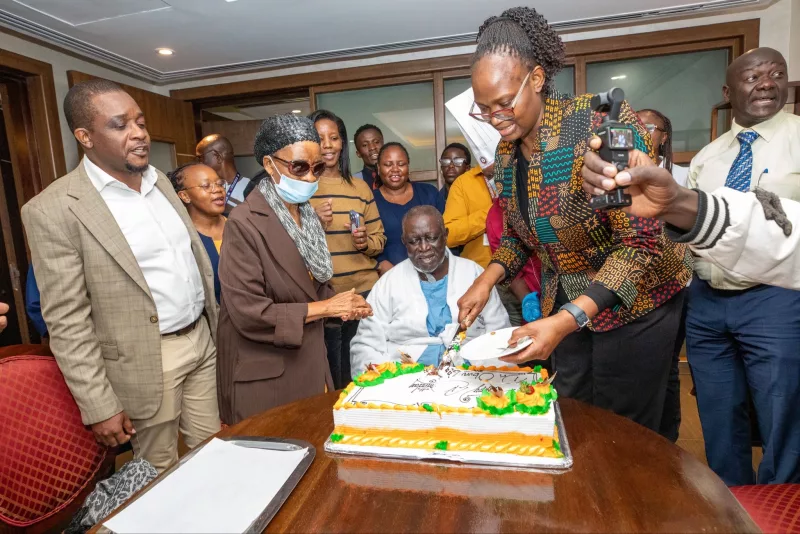
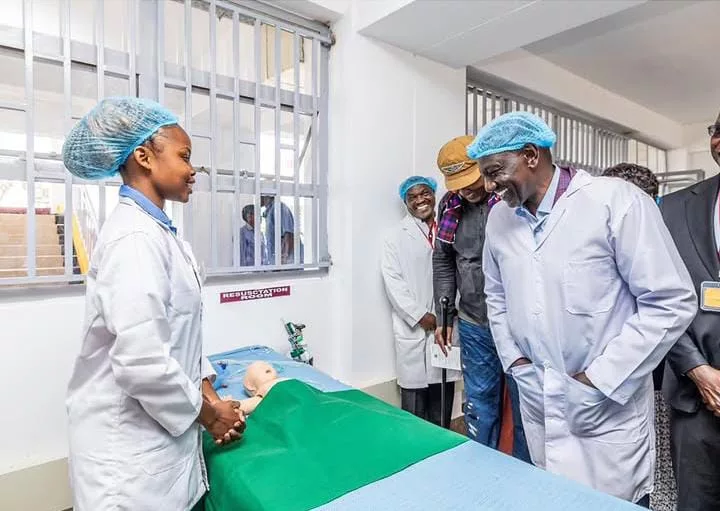
 President William Ruto visits a hospital/ PCS
Four years into President William Ruto’s administration, the government has made community-level primary healthcare a central part of its plan to shift the health system from treating illness in hospitals to preventing and detecting disease closer to where people live.
The approach has been built around Community Health Promoters (CHPs), Primary Care Networks (PCNs), household screening, community health units and digital tools linking households with health facilities.
But the expansion has also raised questions over equipment, financing, coordination between the national and county governments, and whether services reaching households are translating into timely treatment at health facilities.
The number of CHPs increased from 101,100 in 2022 to 107,831 in 2023, according to the Kenya National Bureau of Statistics (KNBS) Economic Survey 2024. The number remained at 107,831 in 2024, according to the 2025 Economic Survey.
The figures provide a baseline for measuring the expansion of the programme during Ruto’s first four years in office.
In April 2023, Ruto said the government would rename Community Health Volunteers as Community Health Promoters and standardise their remuneration and equipment.
“We are going to begin from the bottom in our UHC plan. The critical unit is at the bottom of the pyramid under a community health promoter,” Ruto said.
The national and county governments agreed to co-sponsor the CHPs, with Ruto saying the two levels would standardise their remuneration and kits.
Two months later, Ruto announced that one CHP would be assigned to every 100 households and would visit homes to identify conditions requiring lifestyle changes or basic medical attention.
He subsequently said the government would spend Sh3.5 billion to equip the promoters and enable them to provide preventive healthcare at community level.
“Our hospitals are full of people with minor ailments, which if managed early will decongest our hospitals,” Ruto said.
The government then moved to equip the workforce.
On September 25, 2023, Ruto flagged off 100,000 CHP kits containing items including first-aid boxes, weighing scales, infrared thermometers and mid-upper arm circumference tapes for children and adults.
The Ministry of Health said the promoters would provide basic services at household level while referring cases they could not handle to health facilities.
The model was linked to Primary Care Networks, with community health units connected to Level 2 dispensaries and Level 3 health centres, which in turn were linked to Level 4 hospitals under a hub-and-spoke system.
In September 2023, Public Health PS Mary Muthoni said the government was working towards operationalising all 315 PCNs across the country.
The Ministry said two counties, Kisumu and Garissa, had fully established PCNs at the time, while others were at different stages of implementation.
By June 2024, the Ministry of Health said 160 PCNs were operational, with another 41 in progress. This meant 87 per cent of counties had at least one operational PCN.
The networks were intended to coordinate services across different levels of care and improve referrals, resource sharing and the flow of patient information.
By October 2024, the Ministry reported that 195 of the targeted 315 PCNs had been established, representing 61 per cent coverage across the 47 counties. It also reported that 107,000 CHPs had been recruited and trained.
The government also introduced the Primary Health Care Fund under the new health financing framework.
The fund was designed to finance primary care services delivered through community facilities within PCNs. By the end of 2024, the government said the target was to have all 315 PCNs operational.
At household level, the programme began producing digital records of visits and screenings.
In January 2025, the Ministry of Health reported that 8,525,305 households had been registered in the electronic Community Health Information System, representing 68 per cent of the national target of 12.5 million households. At the time, 106,504 CHPs had been trained, equipped and were receiving stipends.
The use of CHPs has also extended beyond health education.
Ruto said in July 2025 that CHPs were helping register Kenyans for the Social Health Authority and that the information collected would help the government determine demand for medicines, equipment and health personnel.
“Registration helps the government understand how many patients visit each hospital, dispensary, or health centre, so we can allocate the right amount of medicine, equipment, and healthcare personnel,” Ruto said.
The programme has, however, faced financing challenges.
In January 2025, Deputy President Kithure Kindiki acknowledged that the government was facing financial difficulties in facilitating CHPs and that the allocation in the financial year might not be sufficient.
In September, Ruto criticised counties that had failed to pay CHPs, saying delays were undermining healthcare delivery at the grassroots.
“The heroes of universal health...are the CHPs,” Ruto said.
The financing arrangement itself has required cooperation between the two levels of government. In January 2024, the national government said it would contribute Sh3 billion annually, matched by a similar contribution from counties, towards CHP stipends. The national government also committed to provide an additional 7,809 kits.
The 2026 KNBS Economic Survey showed that the wider health system has also expanded during the period.
In 2025, the number of operational health facilities increased by 4.6 per cent to 16,700, largely driven by growth in Level 3 facilities. Hospital beds increased by 5 per cent to 106,300, while cots rose by 8.3 per cent to 12,200.
National Government expenditure on health services was projected to rise by 22.8 per cent to Sh150.9 billion in 2025/26, while county health expenditure was projected to increase by 23.3 per cent to Sh133.4 billion.
The comparison with the beginning of the period shows a health system that had 16,517 operational facilities in 2022, according to the 2023 Economic Survey.
National Government health expenditure stood at Sh88.2 billion in 2021/22 and was projected at Sh117.4 billion for 2022/23.
Ruto has continued to defend the community model as the administration moves into its fourth year.
In June 2026, he announced that the government had allocated Sh13.7 billion to support the 107,000 CHPs, including providing working tools and covering their SHA contributions.
He also said funding for healthcare supplies under SHA had increased by Sh5 billion, from Sh21 billion to Sh26 billion.
“There should be no shortage of essential medicine,” Ruto said, directing counties to ensure medicines were available in health facilities.
In July, he announced that the government had allocated Sh390 million to begin enrolling all CHPs under SHA.
“I announce that the Government of Kenya, working with our counties, will make sure that every community health promoter has SHA as coverage,” Ruto said.
In Nairobi, the latest figures provide a more specific picture of household-level reach.
Ruto said in July that the city’s 7,480 CHPs had registered 810,590 households on eCHIS, equivalent to 54 per cent of the county’s target, and had revisited more than 766,000 homes for routine care.
He said the promoters had also conducted nearly 2.7 million diabetes screenings involving about 943,000 people and referred nearly 30,000 patients for further management.
They had conducted more than 2.16 million hypertension screenings involving more than 743,000 people, resulting in nearly 50,000 referrals.