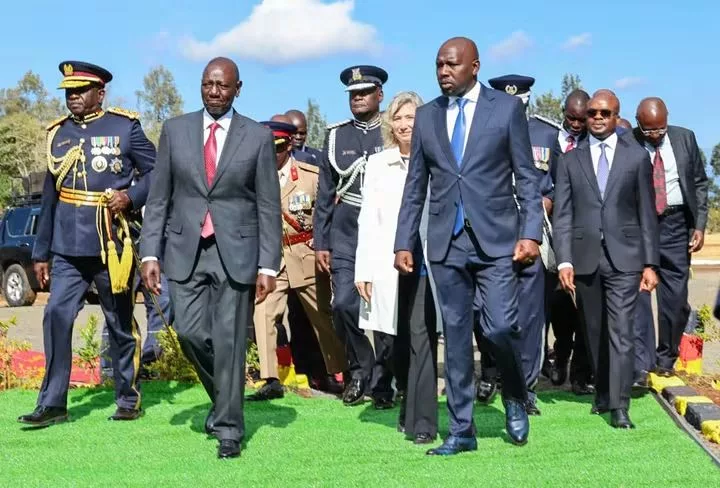
 President William Ruto with Interior Cabinet Secretary Kipchumba Murkomen during the pass-out parade at Kiganjo/PCS
Interior Cabinet Secretary Kipchumba Murkomen has said the government will expand police field training grounds across the country as continuous training becomes central to efforts to reform and modernise the National Police Service.
Murkomen said new training grounds would be established in strategic areas, including the Kerio Valley, northern Kenya, and the Coast, to expose officers to different security environments and improve their ability to respond to emerging threats.
Speaking during the 149th Kenya Police Service pass-out parade at the National Police Service training college in Kiganjo, Nyeri County, where President William Ruto presided over the ceremony, Murkomen said training would remain central to the service's transformation.
“We have also increased the training grounds, the field training grounds. Starting with the training ground that is in Meru, we will be moving to other areas of Kerio Valley, the northern part of the country and the coastal part of the country, where they are conducive for training,” he said.
The CS said the government wants officers to be equipped to deal with complex security challenges while maintaining a positive relationship with the public.
“Training and training and training is going to be the cornerstone of reforming the National Police Service because that is extremely important,” Murkomen said.
He added that officers must be able to combine operational skills with professionalism and community engagement.
“We would like our police officers to be able to combat the challenges they face, but at the same time to be friendly and work with members of the public to combat challenges of our time,” he said.
Murkomen said the expansion of field training facilities would allow officers to continuously sharpen their skills instead of relying solely on training received before deployment.
The CS also credited the police modernisation programme initiated by President Ruto with improving the operational capacity of security agencies.
He said the programme had seen officers receive protective gear, modern vehicles, tactical equipment, air support and crowd-management equipment.
“When you came to office, you established a police modernisation programme that ensured that we have protective gear for police officers,” Murkomen told the President.
“We bought modern vehicles that are anti-personnel carriers, ensured that we have tactical equipment and air support systems for security officers, and we have crowd-management equipment,” he said.
According to Murkomen, the investment has contributed to a significant reduction in banditry in areas that have historically experienced insecurity.
He said incidents of banditry in northern Kenya and the Kerio Valley had declined by between 75 and 80 per cent, although some hotspots remain.
“As an example of this modernisation, we have been able to reduce acts of banditry, especially in the northern part of the country and Kerio Valley region, by almost 75 to 80 per cent,” Murkomen said.
He said the government was now focusing on the remaining insecurity, particularly around the borders of Isiolo, Samburu, Marsabit and Laikipia.
“There is a remaining 25 per cent that we are dealing with, especially this corner of Isiolo, Samburu and Marsabit and Laikipia,” he said.
Murkomen said improved security had enabled communities in affected areas to resume normal activities, including education and farming.
“Thanks to that effort, now children are back to school, farmers are back to farming,” he said.
He further said investments in security had strengthened Kenya's ability to secure its borders and protect communities across the country.
The CS said the government would continue investing in equipment, training and personnel to ensure officers were prepared for conventional and emerging security threats.
The field training expansion is expected to give officers practical exposure to environments such as arid and semi-arid areas, border regions and coastal settings, where security challenges differ significantly.
Murkomen said the ultimate objective was to build a police service that is better equipped, professionally trained and capable of working closely with communities to maintain peace and security.