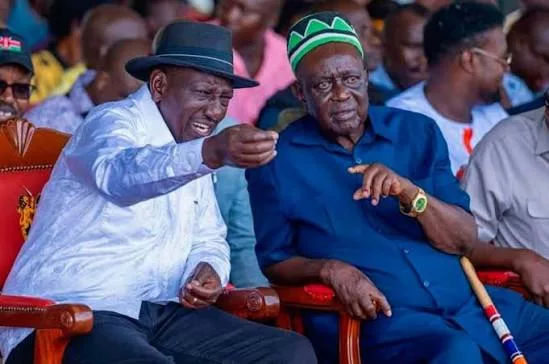
 President William Ruto and ODM boss Oburu Oginga during a past meeting/FILE
ODM party leader Oburu Oginga has linked the party's emerging political partnership with the United Democratic Alliance (UDA) to the continuation of the late Raila Odinga's legacy, saying an ODM-UDA victory in the 2027 general election would advance the next phase of the country's liberation struggle.
Speaking in a statement marking the 16th anniversary of the promulgation of the 2010 Constitution, Oburu described economic liberation as the “Third Struggle” facing Kenya, following the country's earlier battles for independence and multiparty democracy.
“A beautiful constitution on paper cannot feed a hungry child. Political democracy without economic dignity is a house built on sand,” Oburu said.
He said Raila had played a central role in Kenya's democratic struggles, including the campaign for multiparty democracy and the constitutional reforms that culminated in the promulgation of the 2010 Constitution.
Raila's political journey, the ODM party leader said, had been defined by his advocacy for democratic rights, devolution and the sovereignty of the people.
“Raila Amolo Odinga fought the first two battles and won,” he said, adding that the former prime minister had left the country at the gates of what he described as the “Third Struggle: The Economic Liberation and rights of our people.”
According to Oburu, the next phase should focus on translating political freedoms and constitutional rights into tangible improvements in the lives of Kenyans.
He cited unemployment among young people, the cost of healthcare, challenges in education and persistent poverty as some of the issues that should form part of the economic liberation agenda.
“This Third Struggle is the final piece of the puzzle. It is the bridge that will make our decades of sacrifice complete,” Oburu said.
The ODM leader stressed that the party was seeking to build on Raila's political legacy by working with the younger generation and combining their energy with the experience of leaders who participated in the country's earlier political struggles.
He also linked the agenda to ongoing coalition negotiations between ODM and President William Ruto's UDA-led Kenya Kwanza administration.
“It is with this structural vision in mind that we, as ODM, are engaged in structured coalition negotiations with (UDA-Kenya Kwanza) administration,” Oburu stated.
He maintained that the political strategy could change, but the party's objective remained unchanged.
“As ODM the strategy to achieve all these freedoms' and rights might change but the goal still remains the same, which is to form the next government,” he said.
Oburu further claimed that the combined ODM-UDA numbers would be sufficient to secure victory in the 2027 elections.
“Our numbers (ODM-UDA) combined we are assured to form the next government come August 2027 general elections through democratic process,” he said.
The remarks place the emerging ODM-UDA cooperation within the wider context of Raila's political legacy and the constitutional ideals he championed during his career.
Oburu also used the Katiba Day statement to reaffirm ODM's commitment to constitutionalism, saying political change should be pursued through democratic processes.
He cited Raila's belief that “no single individual nor interest is greater than this country” and called for the protection of constitutional institutions, including judicial independence.
The ODM leader also condemned political violence witnessed earlier in Homa Bay and said the party did not condone “goonism in any form.”
He called on the police to investigate the incidents and bring those responsible to justice.
As Kenya marks 16 years of the 2010 Constitution, Oburu said the country should now focus on protecting the democratic gains of the past while pursuing economic transformation.