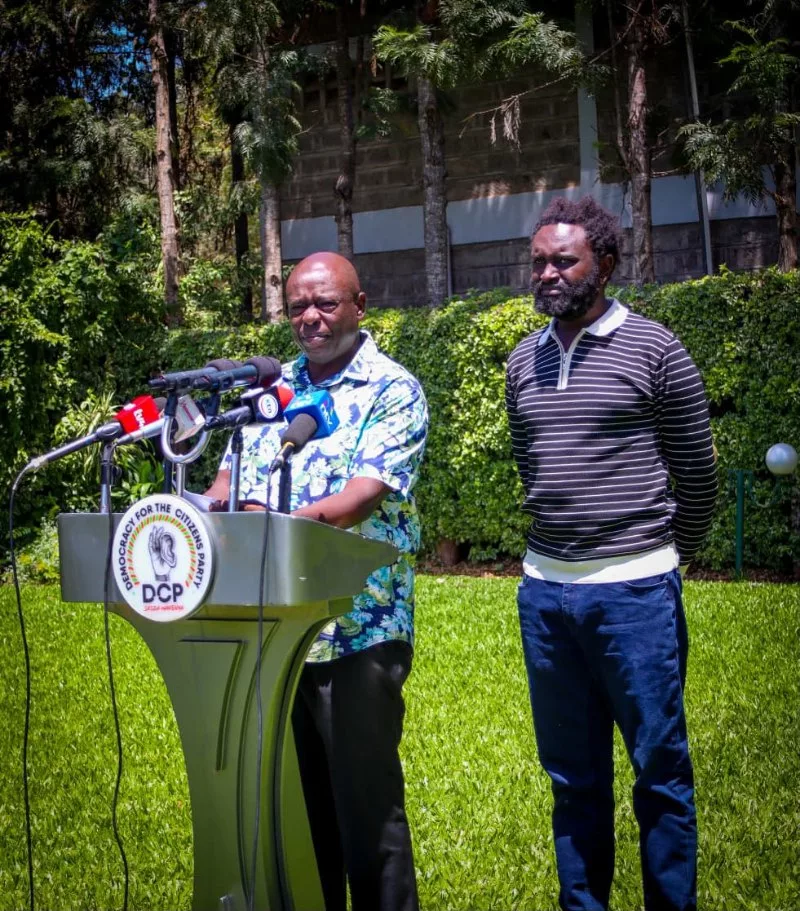
 DCP Party leader Rigathi Gachagua addresses the media at his Keren residence on August 26, 2026. JULIUS OTIENO
Former Deputy President and DCP party leader Rigathi Gachagua has questioned the transparency of the tender for election technology ahead of the 2027 general election.
Gachagua has raised concerns over specifications that he claims could favour a particular supplier.
The DCP party leader made the allegations on Wednesday, August 26, 2026, during a statement at his Karen residence.
He questioned the procurement process for the Integrated Elections Management System, whose tender was advertised on August 11, 2026, with the submission deadline set for September 1.
Through a tender notice seen by the Star on August 11, the electoral commission invited eligible bidders to provide, install, test, commission and maintain the Kenya Integrated Elections Management System (KIEMS), including the required hardware, equipment and accessories.
“The Independent Electoral and Boundaries Commission (IEBC) invites tenders from interested eligible bidders for the supply, delivery, installation, testing, commissioning, support and maintenance of the Integrated Elections Management System (IEMS), hardware equipment and accessories until 1st September, 2026 at 10am East African Time,” IEBC stated.
The tender also covers support and maintenance of the integrated Elections Management System (EMS), which will form part of the technology infrastructure used in the management of the elections.
In a separate tender, the IEBC sought suppliers for ballot papers, tactile folders, the register of voters and statutory election result declaration forms.
Gachagua claimed that the outcome of the procurement process had already been predetermined in favour of an overseas technology company, howeverr he did not provide evidence in the statement to establish that the tender had been awarded.
Instead, he challenged the electoral agency to disclose how the technical specifications were developed and approved.
Gachagua called for the release of internal committee minutes, technical working papers, market surveys and approval records relating to the tender.
He also questioned whether the mandatory technical and qualification requirements could exclude other qualified bidders.
“Can IEBC produce documentary evidence showing who drafted the technical specifications,” he asked.
Gachagua further questioned the Sh30 million tender security requirement, arguing that bidders needed sufficient information on the procurement's quantities, commercial scope, estimated value and budgetary basis to assess the financial risks involved.
"Why did IEBC require a tender security of Sh30 million while failing to disclose sufficient information regarding the quantities, commercial scope, estimated procurement value, or the budgetary basis necessary to demonstrate compliance with Section 61 of the PPADA, and how were bidders expected to assess commercial risk under those circumstances?" Gachagua asked.
He also asked what safeguards had been put in place to ensure that the procurement remained fair, transparent, competitive and cost-effective.
The former Deputy President linked his concerns to Article 227 of the Constitution and provisions of the Public Procurement and Asset Disposal Act.
"The IEBC must tell Kenyans whether this procurement process is in line with the provisions of Article 227 of the Constitution and Sections 60–61 of the Public Procurement and Asset Disposal Act (PPADA)," Gachagua said.
He also raised questions over proposed changes to election technology laws and the ownership of intellectual property associated with election management systems.
Gachagua's claims were made in the context of his broader concerns about preparations for the 2027 election.