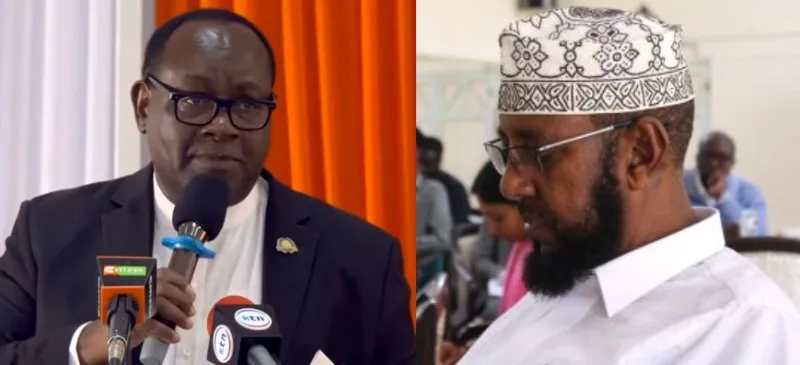
 Collage of NCIC Chairman Bishop Dr Kepha Omae and IRCK Chairman Sheikh Abdullahi Salat
The National Cohesion and Integration Commission (NCIC) and faith leaders have mounted a joint effort to promote peaceful coexistence before, during and after the 2027 general election.
The commitment to tackle political violence, hate speech, misinformation and identity-based mobilisation was made on Wednesday at CORAT Africa in Nairobi.
It was contained in a joint communiqué issued by the NCIC, the Inter-Religious Council of Kenya (IRCK) and World Vision Kenya, alongside participating religious leaders, government representatives, civil society organisations and development partners.
"We, the religious leaders, faith-based institutions, government representatives, civil society organisations, and development partners, do hereby issue this solemn communiqué to reaffirm our collective commitment to national cohesion, peace, and peaceful elections ahead of 2027," it states.
The groups said elections should be treated as more than political contests, describing them as critical tests of national cohesion, social trust and institutional resilience.
They said the country faces risks from “misinformation, disinformation, political polarisation, and identity-based mobilisation” as it enters the 2027 electoral cycle.
The signatories committed to promoting political tolerance, responsible leadership and respect for democratic processes while rejecting political violence, intimidation, ethnic mobilisation and goonism.
The groups also placed young people at the centre of their peacebuilding strategy, particularly Generation Z, saying their growing political awareness should be reflected in civic and political processes.
"We will establish sustained platforms for engagement between faith leaders and young people on governance, political participation, economic concerns and national cohesion," the faith leaders stated.
They also plan to integrate youth into peacebuilding and early-warning structures while supporting civic education, mediation and digital literacy.
The communiqué further identifies the spread of harmful content online as a growing concern ahead of the elections.
The signatories committed to actively countering “hate speech, misinformation, disinformation and digitally enabled incitement, including AI-generated content and deepfakes.”
"We will launch a coordinated 'Faith Against Hate' campaign and strengthen faith-based digital peace initiatives to promote tolerance, responsible digital citizenship and peaceful coexistence," they pledged.
According to the communique, the leaders and youth influencers will also be trained to identify hate speech, misinformation and disinformation, verify information and develop effective counter-messaging.
On conflict prevention, the groups committed to strengthening faith-based early warning, mediation, and rapid-response mechanisms at the national, county, and community levels.
They proposed an Interfaith Early Warning and Early Response mechanism linked to NCIC and relevant national and county institutions.
“We will strengthen existing faith-based peace and mediation structures in high-risk areas and establish an Interfaith Early Warning and Early Response mechanism,” the communiqué states.
The groups also committed to addressing grievances that could fuel conflict, including youth unemployment, inequality, exclusion, land and resource disputes and county-level tensions.
They said inclusive dialogue would provide safe spaces for young people and marginalised groups to participate in finding solutions to community grievances.
The media was also identified as a strategic partner in promoting peace.
“We will engage the media as strategic peacebuilding partners by promoting conflict-sensitive and responsible reporting,” they said.
The groups further pledged to strengthen child protection and adult safeguarding systems to protect children and caregivers from violence, exploitation and harm before, during and after the elections.
To coordinate the commitments, the signatories will establish a National Interfaith Elections Peace Coordination Committee, co-chaired by the IRCK and NCIC.
The committee will oversee implementation, monitor progress and coordinate with government institutions, security agencies, civil society, media, youth and women's organisations and other stakeholders.
In addition, the groups committed to translating the resolutions into a Joint Peace and Cohesion Action Framework covering 2026 to 2028.
They called on political leaders to reject violence, intimidation, ethnic mobilisation and goonism, while urging young people to exercise their political agency peacefully.
“We call upon young people to exercise their political agency peacefully and to reject recruitment into violence,” the communiqué states.
NCIC Chairman Bishop Dr Kepha Omae, IRCK Chairman Sheikh Abdullahi Salat and World Vision Kenya Interim National Director Dr Gershon Mwakazi signed the communiqué.