For decades, Qingdao's global image has been tied to two enduring attractions: its scenic coastline and its famous beer.
The eastern Chinese port city, known for its beaches, European-style architecture and annual beer festival, has long marketed itself as a tourism destination.
But behind that familiar image, Qingdao is quietly building a different future, one centered on film, media, technology and creative industries.
A visit to several of the city's key cultural and media institutions reveals a coordinated effort to transform Qingdao into one of China's leading hubs for film production and digital storytelling.
From state-of-the-art movie studios and artificial intelligence research to media innovation and film education, the city is investing heavily in an industry increasingly viewed as both an economic driver and a source of cultural influence. The ambition becomes apparent at every stop.
At Qingdao Media Group, one of the city's major media organizations, executives and content creators are adapting traditional broadcasting models to a rapidly changing digital landscape.
The focus is no longer limited to television and news production but extends to multimedia content, digital platforms and cultural programming designed to reach audiences far beyond Qingdao.
The shift reflects a broader strategy embraced by many Chinese cities seeking to diversify their economies through creative industries. In Qingdao's case, storytelling has become a tool for both economic development and city branding.
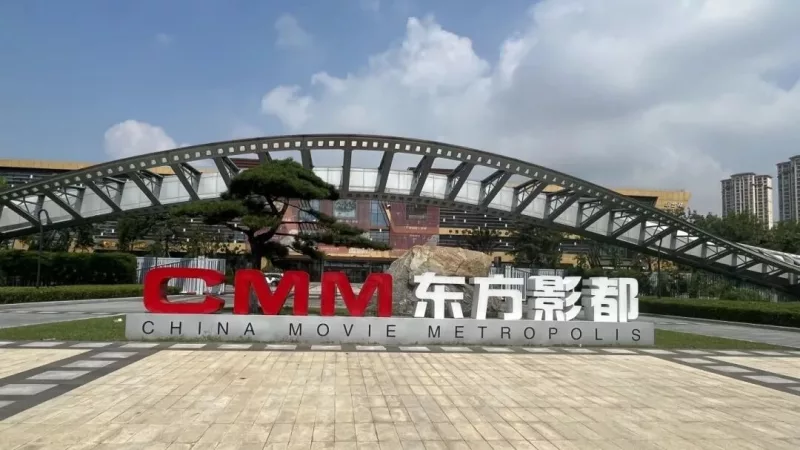
That vision is perhaps most visible at China Movie Metropolis, the sprawling film production complex that has become the centerpiece of Qingdao's cinematic ambitions.
Located in the city's West Coast New Area, the facility resembles a miniature city dedicated entirely to filmmaking.
Massive sound stages, production workshops, visual effects facilities and post-production centers have been designed to accommodate large-scale productions from concept to completion. Yet it is not just the scale of the complex that stands out but the emphasis on innovation.
Among the facilities visitors’ encounter is a meticulously designed submarine set built specifically for film production. Created to provide realistic shooting environments, the structure allows filmmakers to capture scenes that would otherwise require expensive location shoots or extensive digital effects.
The submarine is only one example of the technical capabilities being developed within the complex.
"One of the most impressive facilities we have developed is a full-scale submarine set designed specifically for film production," said Chan Xu, a filmmaker who was our guide during the tour.
"The goal is to provide filmmakers with a highly realistic shooting environment that would otherwise require costly location filming or extensive visual effects work. By creating these immersive sets, we can help productions achieve greater authenticity while improving efficiency and reducing costs."
He added that the submarine is just one example of the advanced production capabilities being built within the complex.
"Our vision extends beyond traditional studio spaces," he said. "We are developing a comprehensive filmmaking ecosystem that combines physical production infrastructure, cutting-edge technology, artificial intelligence applications, animation development, and post-production services. We want filmmakers to find everything they need in one place, from concept development to final production."
During the tour, researchers and developers demonstrated projects exploring how artificial intelligence is being integrated into creative production.
Teams are working on AI-assisted animation tools, technologies designed to streamline visual effects workflows, and applications that support content creation.
Elsewhere, experimental projects are examining how artificial intelligence could be incorporated into theater and live performance, creating new forms of audience interaction and immersive experiences.
The work reflects broader trends reshaping the global entertainment industry, where studios and production companies are increasingly exploring how emerging technologies can enhance creative processes while reducing production costs.
For Qingdao, the investment signals an intention to compete not only as a filming location but also as a center for innovation in media technology.
The city's cinematic ambitions, however, extend beyond infrastructure and technology.
At the Qingdao Film Academy, students are preparing for careers in an industry undergoing rapid transformation. The academy offers training in filmmaking, directing, animation, digital media and other creative disciplines, providing a pipeline of talent for the growing ecosystem surrounding it.
Faculty members emphasize that today's film professionals must be equipped with both artistic and technical skills. As artificial intelligence, virtual production and digital effects become increasingly important, educational institutions are being challenged to prepare students for jobs that did not exist a decade ago.
The academy's proximity to major production facilities provides students with opportunities to engage directly with industry practitioners and emerging technologies.
Observers say this integration of education and industry is becoming one of Qingdao's greatest strengths.
"Building studios is important, but building talent is essential," said Annie Guan the dean at the university. "Without skilled people, infrastructure alone cannot sustain a creative economy."
The city's commitment to film culture is also evident at the Qingdao Film Museum, where visitors can trace the development of Chinese cinema through interactive exhibits, archival collections and displays showcasing the evolution of filmmaking technology.
Opened as part of Qingdao's broader strategy to establish itself as a major film and cultural hub, the museum serves as both a celebration of China's cinematic heritage and a window into the industry's future.
Visitors are taken through the history of Chinese film, from its early beginnings in the early 20th century and the country's first silent productions, through the emergence of revolutionary cinema, the growth of state-backed film studios, and the rapid modernisation of the industry following China's economic reforms.
The exhibits highlight how Chinese filmmakers adapted to changing social, political and technological landscapes, ultimately helping transform China into one of the world's largest film markets.
The museum's contemporary design blends traditional displays with immersive digital experiences, featuring vintage cameras, costumes, movie props, film posters and multimedia installations that bring landmark productions to life.
Looking ahead, several exhibits explore the growing role of emerging technologies in filmmaking, including artificial intelligence, virtual production and digital animation.
Visitors can learn how AI is increasingly being used to assist with script development, character design, visual effects and production planning, offering a glimpse into how future films may be conceived and produced.
Together, the museum, academy, media organisations and production facilities form what officials describe as a complete creative ecosystem.
The strategy mirrors successful models seen in global entertainment centers such as Los Angeles, Seoul and Mumbai, where education, production, technology and cultural institutions work together to support industry growth.