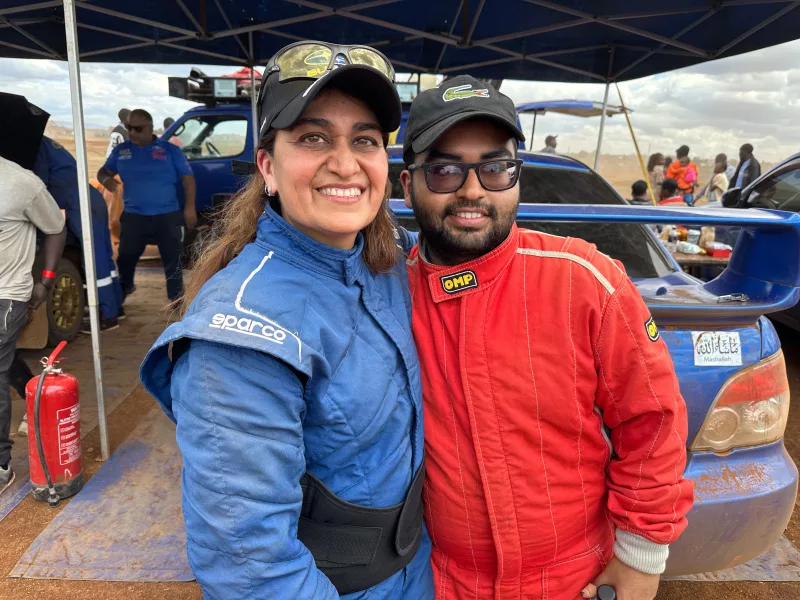
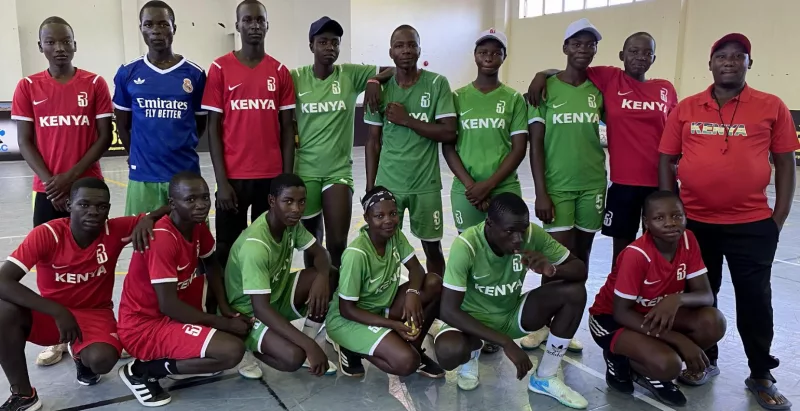
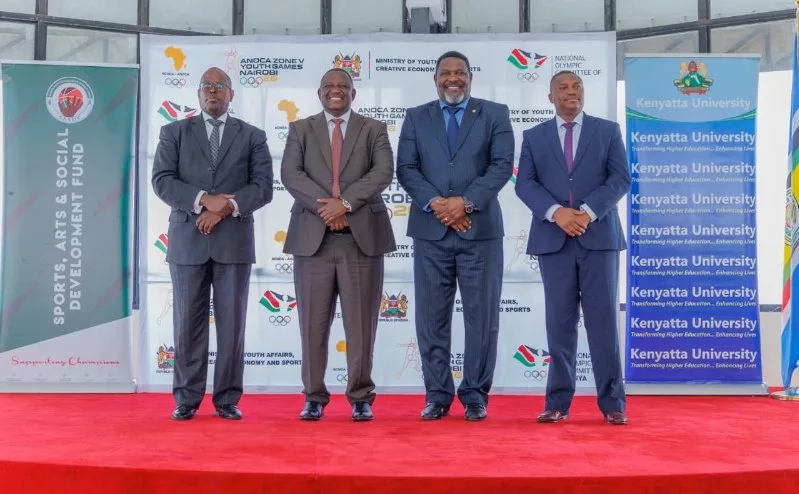
 ANOCA Zone V President Donald Rukare, Sports CS Salim Mvurya, NOCK President Shadrack Maluki and Sports PS Elijah Mwangi during the launch of the ANOCA Zone V Youth Games/ HANDOUT
 The National Olympic Committee of Kenya (NOCK) has announced that Kenya will host the 2026 Association of National Olympic Committees of Africa (ANOCA) Zone V Youth Games in Nairobi from August 24 to 28 at Kenyatta University.
Around 300 young athletes from 11 countries are expected to grace the continental showcase, whose primary objective is to identify, nurture and expose promising young talent to high-level competition.
The 11 nations Kenya will play host to are Kenya, Uganda, Rwanda, Tanzania, Ethiopia, Burundi, Eritrea, Somalia, South Sudan, Sudan and Egypt. The young athletes will go head-to-head in a variety of sports, including athletics, swimming, 3x3 basketball, judo, cycling, tennis and beach volleyball.
For Kenya, the event marks the country's first opportunity to host the continental Games, with Rwanda having staged the inaugural edition in 2019 before the competition went into a seven-year hiatus.
Beyond providing a platform for young athletes to test themselves against their peers from across the region, the ANOCA Zone V Games will serve as an important springboard towards the much-anticipated Youth Olympic Games, scheduled for October 31 to November 13 in Dakar, Senegal.
But what exactly are the Youth Olympic Games?
Today's episode of Know Your Sport delves into the World of the Youth Olympic Games, giving our readers a clearer picture of the global extravaganza and why the games are an important stepping stone for the next generation of sporting stars.
The Youth Olympic Games (YOG) are an elite, multi-sport international competition organised by the International Olympic Committee (IOC) for young athletes. Like the traditional Olympic Games, the YOG bring together athletes from across the globe, but they are specifically designed to provide a platform for the next generation of sporting talent.
The Games have both summer and winter editions, with each held every four years. However, the YOG are about far more than medals, podium finishes and sporting glory.
Alongside high-level competition, the Games place a strong emphasis on education, cultural exchange and personal development. Young athletes get the opportunity to interact with peers from different countries and cultures, while taking part in programmes designed to promote sportsmanship, friendship, healthy living and global citizenship.
In that sense, the YOG are not simply a smaller version of the senior Olympics. They are designed to give young athletes a taste of the Olympic experience while helping them develop both on and off the field.
Qualifying for the Youth Olympic Games is a carefully structured process involving the IOC, International Federations (IFs) and National Olympic Committees (NOCs).
The qualification system varies from sport to sport, with individual International Federations setting criteria to determine which athletes earn places within their allocated quotas.
Because the YOG are intended to serve as a pathway towards the senior Olympic stage, athletes must meet strict age requirements and qualification standards.
For the Dakar 2026 Games, the eligibility window is centred on athletes aged between 14 and 17, although the exact requirements vary from sport to sport.
To preserve the youth-focused nature of the event, some sports also have restrictions on athletes who have already competed at senior World Championships or senior Olympic-level multi-sport competitions.
The qualification system also seeks to ensure that the Games remain genuinely global. The IOC has limits on the number of athletes a single country can send, preventing a handful of dominant sporting nations from taking up an excessive share of available places.
The host nation, meanwhile, receives a designated number of places across various sports, helping ensure that its young athletes have an opportunity to compete on home soil.
The Youth Olympic Games feature a fascinating blend of traditional Olympic sports and disciplines that appeal to a younger generation.
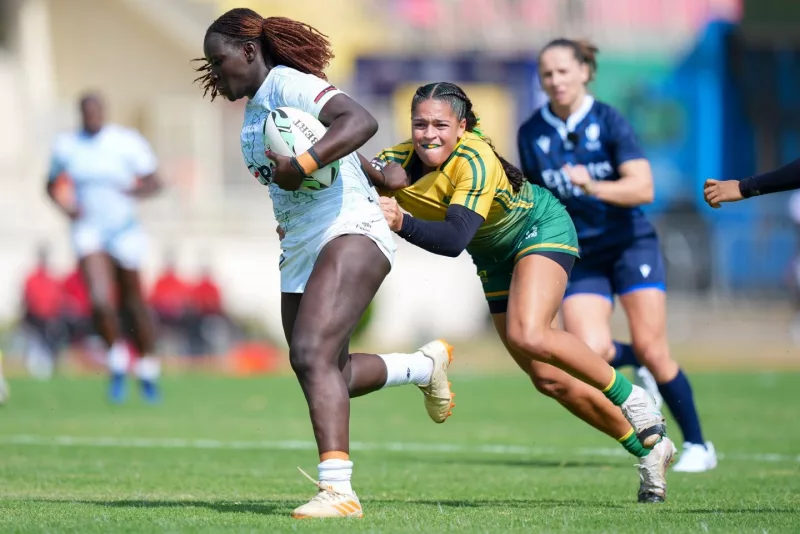
For the Dakar 2026 Summer Games, athletes will compete in 25 sports: swimming, archery, athletics, badminton, baseball, 3x3 basketball, boxing, breaking, cycling, equestrian, fencing, football, gymnastics, handball, judo, rowing, rugby, sailing, skateboarding, table tennis, taekwondo, triathlon, beach volleyball, beach wrestling and wushu.
Wushu will make its maiden appearance at the Youth Olympic Games in Dakar.
Singapore became the first host of the Youth Olympic Games when it staged the inaugural Summer edition in August 2010. The YOG were created under the leadership of then-IOC president Jacques Rogge as part of an effort to tackle emerging challenges in youth development and the changing sporting landscape.
The idea was to create a global sporting platform where young athletes could compete at an elite level while also learning valuable lessons away from competition. Since Singapore 2010, the Summer and Winter editions have taken the Games to different corners of the world.
The Winter YOG travelled to Innsbruck, Austria, in 2012, while Nanjing, China, hosted the 2014 Summer edition. Lillehammer, Norway, staged the 2016 Winter Games, followed by Buenos Aires, Argentina, for the 2018 Summer edition. Lausanne, Switzerland, hosted the 2020 Winter Games, while Gangwon, South Korea, staged the 2024 Winter edition.