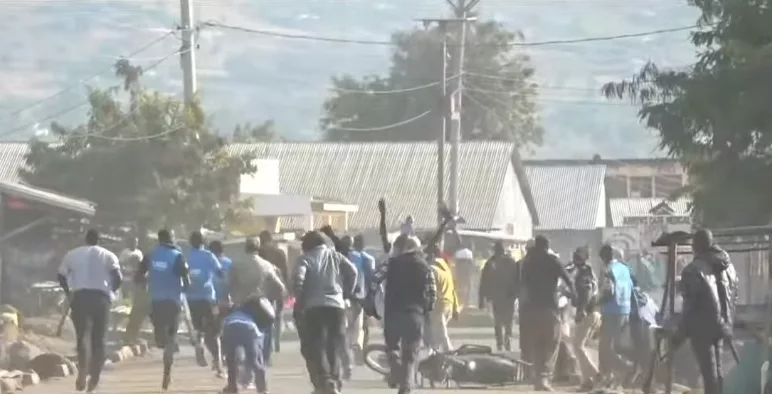
 On Sunday, the Linda Mwananchi convoy came under attack as it travelled from Sindo to Homa Bay.
The government has repeatedly promised to curb political goonism, yet, weeks after those warnings, incidents of organised violence continue to disrupt political rallies.
This has raised questions about whether security agencies are unable to contain the menace or are ineffective in preventing such incidents.
Questions have also been raised over the response to statements by politicians about mobilising supporters and establishing networks, amid concerns over political violence.
The latest incidents have revived scrutiny of the government's response to political violence and its repeated calls for security agencies to rein in the menace and end the goon culture.
Following the June 12 goon attack at All Saints Cathedral in Nairobi, Interior Cabinet Secretary Kipchumba Murkomen warned that those found culpable of disrupting public events and political rallies would not go scot-free.
"We will take those people to court and they will be held to account," he said.
But despite the tough talk and repeated promises of action, political rallies have continued to be disrupted by violence, leaving a trail of destruction and, in some cases, deaths.
The latest incidents have come against the backdrop of growing concerns over the use of organised groups to disrupt political activities and intimidate opponents.
On Sunday, August 16, the Linda Mwananchi convoy came under attack as it travelled from Sindo to Homa Bay, raising fresh questions about the ability of security agencies to protect political groups holding rallies in areas where they face opposition.
Arrests were made, but the damage had already been done. Police reported that two people, including a police officer, died, six vehicles were torched, while a hotel and a church were vandalised.
A day earlier, on Saturday, DCP leader Rigathi Gachagua's convoy came under a hail of stones in Gilgil and Nakuru as he returned from a series of rallies.
The incidents have added to a pattern of political violence witnessed during several recent by-elections, where political groups and their supporters reported confrontations and attacks.
In Ol Kalou, as in Homa Bay, journalists were also attacked and injured, raising concerns that violence at political events could also be used to intimidate the media and discourage coverage of events on the ground.
"When people who mete out violence against journalists are not held to account, then it encourages that culture of impunity," Press Freedom and Advocacy manager Rebecca Mutiso said during an interview on TV47 on Tuesday.
She advised media houses to conduct risk assessments before sending journalists to the ground and urged journalists covering political events to prioritise their safety.
"Do not break news in a hostile environment," she said.
The violence has also raised questions about whether security agencies are failing to act despite having the capacity to prevent or contain such incidents.
Former Interior Cabinet Secretary Fred Matiang'i, meanwhile, claimed that the government had prior intelligence about the Homa Bay violence.
Political commentator Brian Weke echoed similar concerns, arguing that police were reluctant to act.
"They did absolutely nothing when we were being attacked, they only took action when police were attacked," Weke said on TV47 on Tuesday.
Weke said the apparent reluctance by police to intervene, particularly when violence unfolded in their presence, risked creating the perception that the State was either unable or unwilling to act.
Such perceptions, he argued, could further damage public confidence in security agencies and raise questions about the government's commitment to curbing political violence.
Speaking during the same interview, advocate of the High Court Harrison Kinyanjui said the growing use of political goons and guns to suppress political opponents could push the country towards a repeat of the violence witnessed after the 2007 General Election.
"Goonism is not a solution to political disfavour. Suppressing political opponents and blocking their meetings only fuels anti-government sentiment, undermines democracy and could ultimately hurt President William Ruto’s re-election bid," he said.
The concerns come at a time when the government has repeatedly said security agencies must act within the law to prevent criminality, regardless of the political affiliation of those involved.
But critics argue that repeated warnings without visible accountability could create a perception that political actors and their supporters can use violence at political events without facing consequences.
Amid growing criticism, former Mwingi Central MP Joe Mutambu came to the defence of the government and the police, arguing that political goonism should not be blamed solely on the State.
"The most unfortunate thing is that the people who are driving this agenda of goonism are actually leaders of this country. Leaders from both divides. We can't say it's the government. We can't say it's the opposition. I can tell you without fear of any contradiction, this is driven by the politicians themselves across the board," he said.
Mutambu said leaders found to have incited the masses should not only be summoned by the National Cohesion and Integration Commission but also arrested and made to account before a court of law.
Mutambu's argument introduces another dimension to the debate, that political violence may be less about government versus opposition and more about political actors across the divide deploying groups to intimidate rivals.
The question, therefore, is not only whether the government has failed to stop political goonism, but also whether gaps in the security system could be exploited by political actors seeking to advance their interests.
The government's repeated warnings have established its position, while what remains under scrutiny is whether those warnings will be followed by consistent investigations, arrests and prosecutions, regardless of who is responsible.
For a country with a painful history of election-related violence, the continued use of organised groups to disrupt political meetings, attack opponents and intimidate journalists carries consequences beyond individual rallies.
With the 2027 General Election less than a year away, the government and security apparatus have been called upon to act and ensure political goonism does not continue to thrive as the country heads into a more politically charged season.
"If somebody incites Kenyans, that is a crime, that person.